All species › Passerines › Tanagers and allies › Ringed Warbling Finch
Ringed Warbling Finch | Microspingus torquatus
Zwartbandboomgors | Monterita acollarada | Capacetinho-de-colar
The Ringed Warbling Finch is a small grey-and-white warbling finch with a black mask and a black breast band, from the dry forest and scrub of the Chaco and the dry Andean valleys. In the guide area it lives only in Bolivia. In this circumscription the species has not yet been assessed separately for the Red List.
Voice
The song is a rapid, high series of chirping and trilling notes; also thin tsit calls.
Recording: Franco Vushurovich — CC BY-NC-SA 4.0 · xeno-canto
Identification
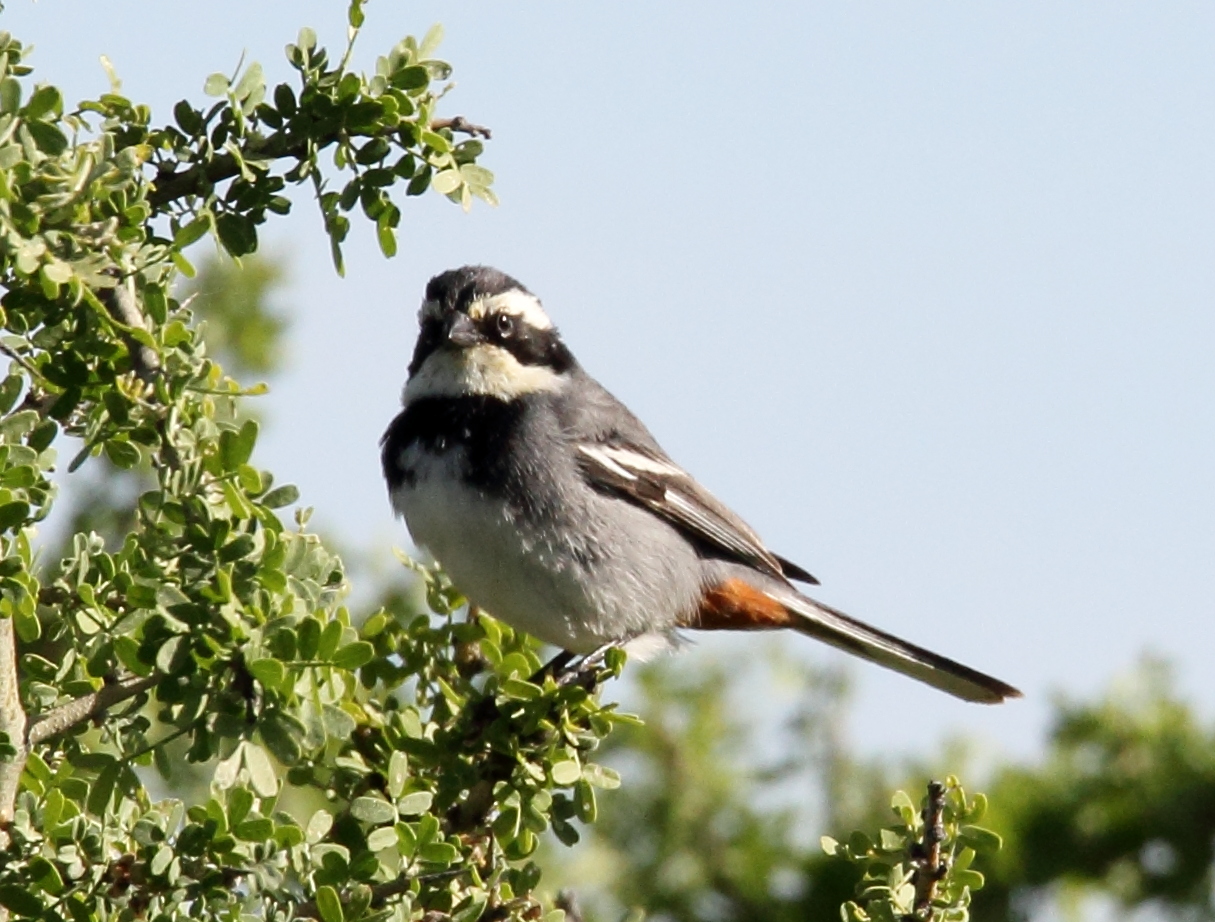
13 cm, with a short, pointed, dark bill. The upperparts are grey, with a long white supercilium above a black mask. The throat and belly are white, separated by a narrow black breast band; the undertail coverts are rufous. The wings have a white wing bar, and the tail has white corners that show in flight. The sexes are similar; the female is slightly duller. Young birds lack the crisp breast band.
Confusion species
Black-capped Warbling Finch Microspingus melanoleucus has a black cap and cheek, no white supercilium and no breast band. Masked Gnatcatcher Polioptila dumicola is blue-grey, with a thin bill and a long tail that is often cocked. Collared Warbling Finch Poospiza hispaniolensis has a similar breast band but lives in western Ecuador and Peru.
Habitat
Dry forest, thorn scrub and Chaco woodland, and scrub in the dry Andean valleys, from the lowlands up to roughly 3000 m. It forages in pairs or groups in shrubs and low trees for insects and seeds, often in mixed flocks. The nest is an open cup in a shrub.
Where the bird is most at home, classified by the vegetation units of the Andes and the west coast.


Range and movements
In Bolivia in the dry valleys of the eastern Andes and in the Chaco, in Cochabamba, Santa Cruz, Chuquisaca and Tarija. Absent from Colombia, Ecuador, Peru and the Galápagos. Outside the guide area in western Paraguay and northern and central Argentina; southern birds partly move north in winter.
- Resident
- dark = core range, pale = thinly spread
How and when to look
Search dry scrub in the valleys of Cochabamba and Chuquisaca or the Chaco woodland of south-eastern Bolivia; watch for the white tail corners and black breast band of a bird in a mixed flock.
Conservation status
Not evaluated in this circumscription. The species has a large range and tolerates degraded dry forest and scrub, but deforestation in the Chaco is reducing its habitat.
Scientific name
Microspingus torquatus | (d'Orbigny, ACVMD & de Lafresnaye, 1837)
D'Orbigny, ACVMD & de Lafresnaye described the species in 1837 as Emberiza torquata; because it was later moved to another genus, the author and year stand in brackets. The genus Microspingus was introduced in 1874 by Taczanowski. The genus name comes from Greek mikros, 'small', and spingos, 'finch'. The species name comes from Latin torquatus, 'collared', after the black breast band. The specimen the first description was based on came from Sicasica, La Paz, Bolivia.