All species › Passerines › Tanagers and allies › Rusty-browed Warbling Finch
Rusty-browed Warbling Finch | Microspingus erythrophrys
Roestbrauwboomgors | Monterita cejirrufa | Capacetinho-de-sobrancelha-ruiva
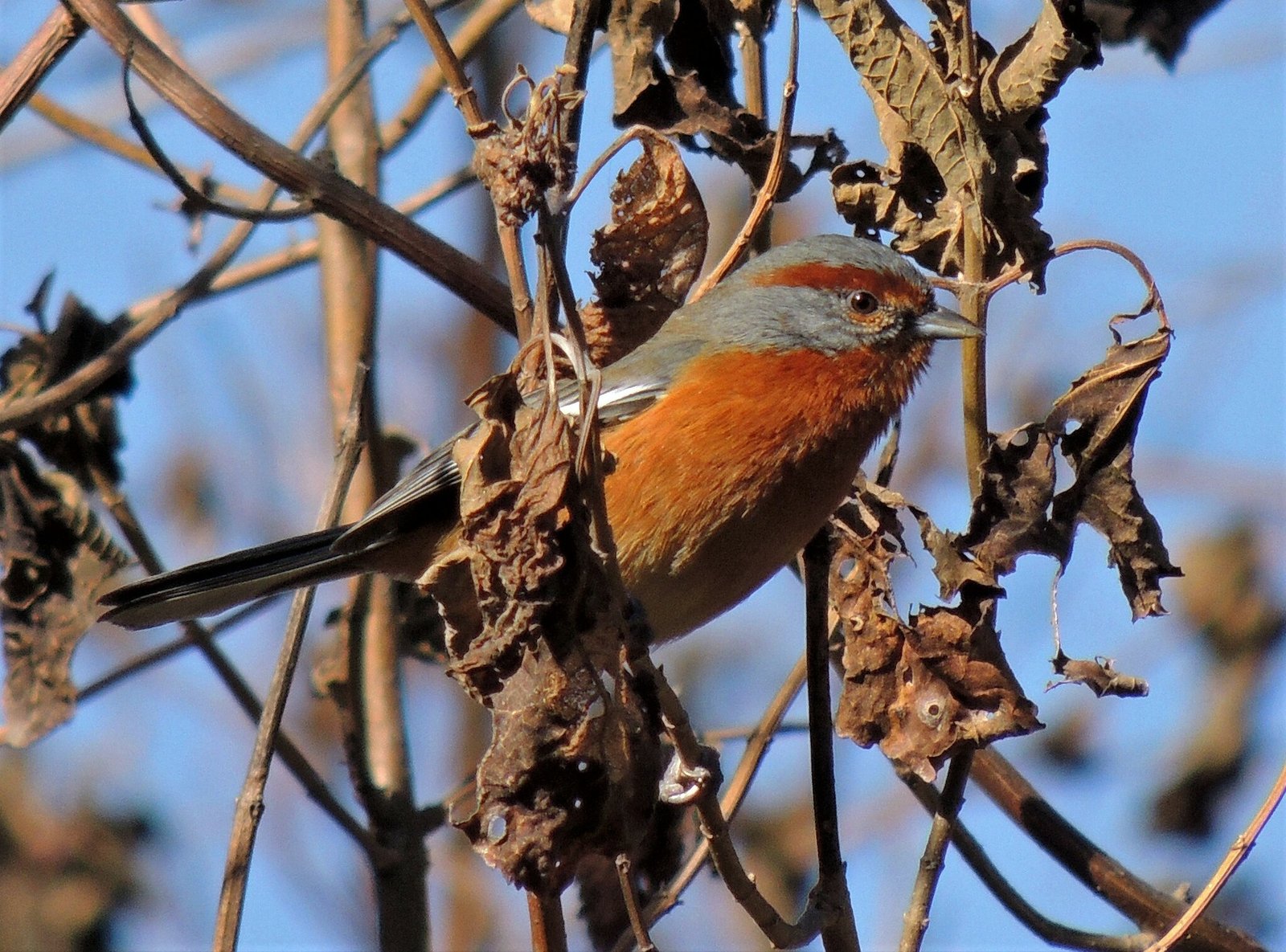
The Rusty-browed Warbling Finch is a grey warbling finch with a rufous brow and ochre underparts from the montane forests of the southern Yungas. In the guide area it lives only in Bolivia. Pairs and small groups forage in the middle layers of forest edges and alder woodland.
Voice
The song is a short, rapid series of high, clear notes; also thin tsit calls.
Recording: Rosendo Manuel Fraga — CC BY-NC-SA 4.0 · xeno-canto
Identification
15 cm, with a pointed, dark bill. The crown, nape and back are grey, the wings darker grey. A broad rufous supercilium runs from the bill to behind the eye, above a dark grey cheek. The throat, breast and flanks are ochre to rufous, the centre of the belly paler. The dark tail has white corners. The sexes are similar. Young birds are duller and faintly streaked.
Confusion species
Cochabamba Mountain Finch Poospiza garleppi is larger, has more uniformly rufous underparts and lives higher, in Polylepis woodland. Black-and-chestnut Warbling Finch Poospiza whitii has a white supercilium and white malar stripe and darker, blackish-grey upperparts. Rust-and-yellow Tanager Thlypopsis ruficeps has a rufous head and yellow underparts.
Habitat
Edges and clearings of humid montane forest, alder woodland and scrub, roughly between 1500 and 3000 m. It forages in pairs or small groups in the shrub layer and middle tree layers for insects, often in mixed flocks. The nest is an open cup in a shrub.
Where the bird is most at home, classified by the vegetation units of the Andes and the west coast.


Range and movements
In Bolivia on the east slope of the Andes and in the mountains of Cochabamba, Santa Cruz, Chuquisaca and Tarija. Absent from Colombia, Ecuador, Peru and the Galápagos. Outside the guide area in north-western Argentina.
- Resident
- dark = core range, pale = thinly spread
How and when to look
Search forest edges in the Yungas of Cochabamba and southern Bolivia, for example alder woodland in Tarija; watch for the rufous brow and white tail corners of a bird in a mixed flock.
Conservation status
Least Concern. The species occurs locally in fair numbers and tolerates forest edges and secondary forest.
Scientific name
Microspingus erythrophrys | (Sclater, 1881)
Sclater described the species in 1881 as Poospiza erythrophrys; because it was later moved to another genus, the author and year stand in brackets. The genus Microspingus was introduced in 1874 by Taczanowski. The genus name comes from Greek mikros, 'small', and spingos, 'finch'. The species name comes from Greek eruthros, 'red', and ophrys, 'eyebrow', after the rusty eyebrow stripe. The specimen the first description was based on came from Sierra de Totoral, Catamarca, Argentina.