All species › Kingfishers, bee-eaters and rollers › Motmots › Rufous Motmot
Rufous Motmot | Baryphthengus martii
Rosse motmot | Momoto canelo mayor | Juruva-ruiva
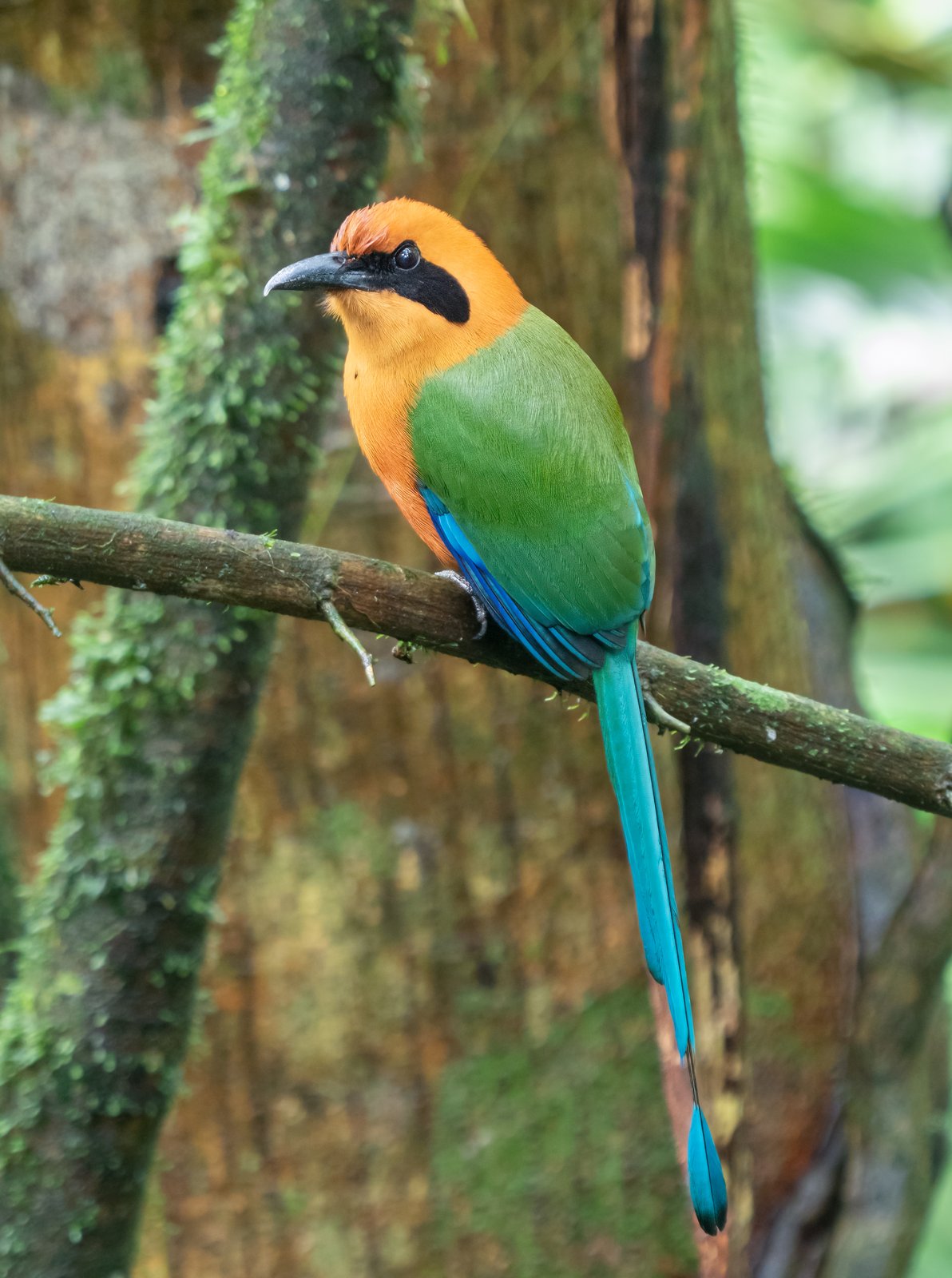
The Rufous Motmot is the largest lowland motmot, with an all-rufous head, neck and breast and a long, racquet-tipped tail. It lives in humid forest on both sides of the Andes and usually reveals itself by its voice. Its deep, hollow calls are part of the dawn chorus of Amazonian forest.
Voice
A deep, hollow, quavering call, like hoo-oo-oo or a doubled hoo-doo, often by pairs or groups, mainly in the twilight before dawn and at nightfall.
Recording: JAYRSON ARAUJO DE OLIVEIRA — CC BY-NC-SA 4.0 · xeno-canto
Identification
42–47 cm, including the long, racquet-tipped tail. The head, neck, breast and upper belly are rufous, with a black mask and a small black spot in the centre of the breast. The back, wings and lower belly are green, the flight feathers and tail blue-green. The bill is heavy, black and fairly narrow. The sexes are alike; juveniles are duller.
Confusion species
Broad-billed Motmot Electron platyrhynchum is very similar but much smaller, with a broad, flat bill, a greenish-blue chin and a green belly. Amazonian Motmot Momotus momota and Whooping Motmot Momotus subrufescens have a black crown surrounded by blue and a red iris. Rufous-capped Motmot Baryphthengus ruficapillus of the Atlantic Forest has a green breast and only a rufous crown and nape.
Habitat
The middle and lower storeys of humid lowland and foothill forest, also várzea forest, up to about 1300 m. It sits still for long periods and sallies for large insects, spiders, small lizards and frogs; it also eats fruit and sometimes follows army ants. It nests in a long tunnel in an earth bank.
Where the bird is most at home, classified by the vegetation units of the Andes and the west coast.


Range and movements
In Colombia in the Pacific lowlands, in the north and in the Magdalena valley, and east of the Andes in Amazonia. In Ecuador in the north-western lowlands and foothills and in the east. In Peru in the Amazonian lowlands and the foothills of the eastern slope. In Bolivia in the north. Absent from the Galápagos. Outside the guide area from Honduras to western Amazonian Brazil.
- Resident
- dark = core range, pale = thinly spread
How and when to look
Listen in the twilight before dawn in lowland forest for the deep, hollow calls, such as around the Amazonian lodges of Peru and Ecuador or in the Pacific lowlands of Colombia. By day the bird often sits still in the shade below the canopy.
Conservation status
Least Concern. The species has a large range but disappears where forest is cleared.
Scientific name
Baryphthengus martii | (Spix, 1824)
Spix described the species in 1824 as Prionites martii; because it was later moved to another genus, the author and year stand in brackets. The genus Baryphthengus was introduced in 1860 by Cabanis & Heine. The genus name comes from Greek barus, 'heavy, deep', and phthongos, 'voice, sound', after the low call. The species name honours Carl Friedrich Philipp von Martius (1794–1868), a German botanist who travelled through Brazil with Spix. The specimen the first description was based on came from Near Belém (Pará), Brazil.