All species › Kingfishers, bee-eaters and rollers › Motmots › Rufous-capped Motmot
Rufous-capped Motmot | Baryphthengus ruficapillus
Roodkopmotmot | Momoto yeruvá | Juruva
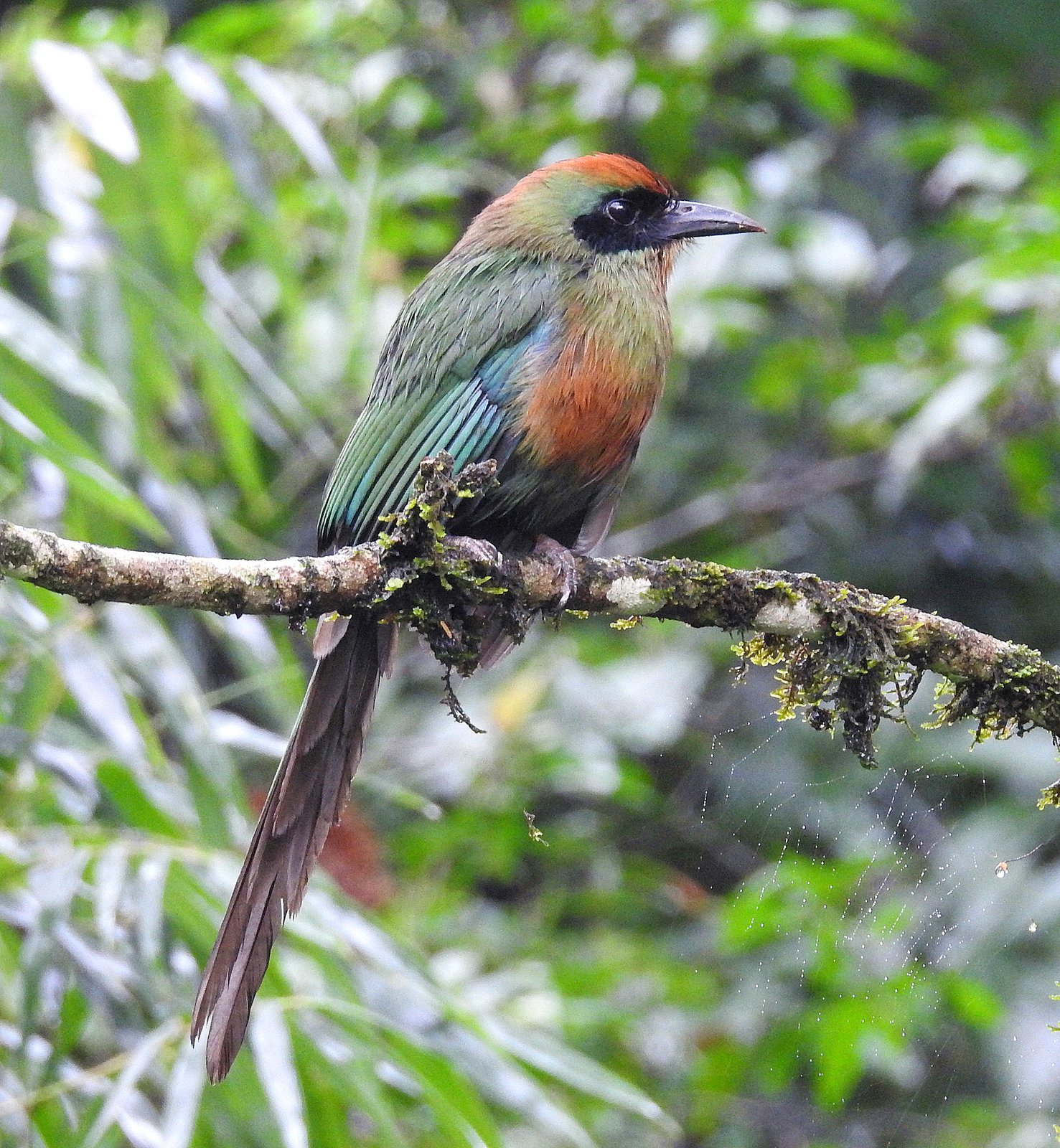
The Rufous-capped Motmot is a large, green motmot with a rufous crown and nape, from the Atlantic Forest of south-eastern South America. As far as is known it has not been reliably recorded in the guide area. It is closely related to the Rufous Motmot of Amazonia, which was formerly sometimes treated as the same species.
Voice
A deep, hollow, owl-like call, like hoo-hoo-hoo, often in duets or by several birds at once, mainly in the twilight before dawn.
Recording: Faustino Hollmann — CC BY-NC-SA 4.0 · xeno-canto
Identification
38–42 cm, with a long, blue-green tail, usually without or with small racquets. The crown and nape are rufous, with a broad black mask. The upperparts are green. The throat and breast are green, with a small black spot in the centre of the breast; a cinnamon band crosses the belly, and the lower belly is greenish. The bill is heavy and black. The sexes are alike.
Confusion species
Rufous Motmot Baryphthengus martii has an all-rufous head, neck and breast and a tail with distinct racquets; it is the Amazonian species in the guide area. Broad-billed Motmot Electron platyrhynchum is smaller, with a rufous breast and a broad, flat bill. Amazonian Motmot Momotus momota has a black crown surrounded by blue.
Habitat
The lower and middle storeys of humid forest and old secondary forest in the lowlands and lower mountains, up to about 1100 m. It eats large insects, other invertebrates, small vertebrates and fruit, taken from a perch. It nests in a tunnel in an earth bank.
Where the bird is most at home, classified by the vegetation units of the Andes and the west coast.


Range and movements
As far as is known not in the guide area: there are no reliable records from Colombia, Ecuador, Peru or Bolivia, and it is absent from the Galápagos. Reports from the guide area probably refer to Rufous Motmot. Outside the guide area in the Atlantic Forest of south-eastern Brazil, eastern Paraguay and north-eastern Argentina.
- Resident
- dark = core range, pale = thinly spread
How and when to look
The species is not to be expected in the guide area; a large motmot with a rufous head in Amazonia is almost certainly a Rufous Motmot. Within its own range it gives itself away in the early morning by its hollow calls.
Conservation status
Least Concern, although the Atlantic Forest is heavily fragmented by deforestation.
Scientific name
Baryphthengus ruficapillus | (Vieillot, 1818)
Vieillot described the species in 1818 as Baryphonus ruficapillus; because it was later moved to another genus, the author and year stand in brackets. The genus Baryphthengus was introduced in 1860 by Cabanis & Heine. The genus name comes from Greek barus, 'heavy, deep', and phthongos, 'voice, sound', after the low call. The species name comes from Latin rufus, 'rufous', and capillus, 'hair of the head', after the rufous crown. The specimen the first description was based on came from Southeastern Brazil.