All species › Kingfishers, bee-eaters and rollers › Motmots › Broad-billed Motmot
Broad-billed Motmot | Electron platyrhynchum
Breedsnavelmotmot | Momoto piquiancho | Udu-de-bico-largo
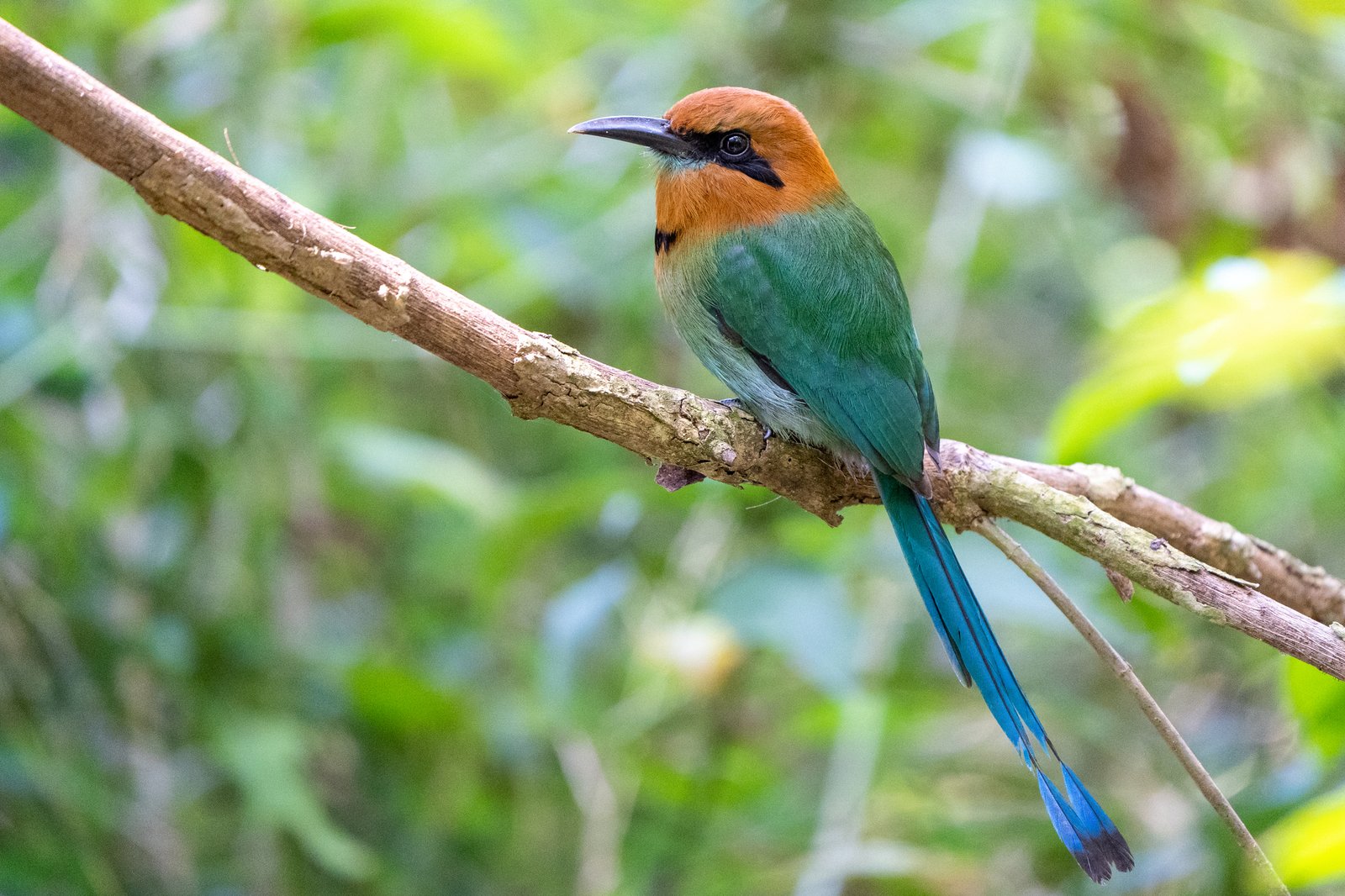
The Broad-billed Motmot is a medium-sized motmot with a rufous head and breast and a broad, flat bill with a ridge along the upper mandible. It perches upright in the mid-storey of humid forest, slowly swinging its tail from side to side. It is the most widespread lowland motmot in the guide area, both west and east of the Andes.
Voice
A hoarse, nasal, croaking call, like kwaank, repeated at intervals, mainly in the morning and at dusk.
Recording: Alain Verneau — CC BY-NC-SA 4.0 · xeno-canto
Identification
31–38 cm, including the long, racquet-tipped tail. The head, neck and breast are rufous, with a black mask and a small black spot in the centre of the breast. The chin is greenish blue. The back, wings and belly are green, the flight feathers and tail bluer. The bill is broad and flat, with a distinct central ridge. The sexes are alike; juveniles are duller, with less rufous.
Confusion species
Rufous Motmot Baryphthengus martii is very similar but much larger, with a narrower bill, and the rufous extends onto the belly. Amazonian Motmot Momotus momota and Whooping Motmot Momotus subrufescens are larger, with a black crown surrounded by blue and no all-rufous head. Tody Motmot Hylomanes momotula of north-western Colombia is much smaller, with a short tail without racquets.
Habitat
The middle and lower storeys of humid lowland and foothill forest, also várzea forest and tall secondary forest, from the lowlands up to about 1200 m. It sallies from a perch for large insects such as beetles, cicadas and butterflies, and also takes small lizards and fruit. It nests in a long tunnel that it digs in an earth bank.
Where the bird is most at home, classified by the vegetation units of the Andes and the west coast.


Range and movements
In Colombia in the Pacific lowlands, in the north and in the Magdalena valley, and east of the Andes in Amazonia. In Ecuador in the western lowlands and foothills and in the east. In Peru in the Amazonian lowlands and the foothills of the eastern slope. In Bolivia in the north and centre, in the lowlands and on the lower Yungas slopes. Absent from the Galápagos. Outside the guide area from Honduras to western Amazonian Brazil.
- Resident
- dark = core range, pale = thinly spread
How and when to look
Along forest trails and edges in the lowlands and foothills, such as at the Amazonian lodges of Peru and Ecuador and in the western foothills of Ecuador. The croaking call leads you to it; the bird often stays long on the same branch.
Conservation status
Least Concern. The species has a large range but depends on forest.
Scientific name
Electron platyrhynchum | (Leadbeater, 1829)
Leadbeater described the species in 1829 as Momotus platyrhynchus; because it was later moved to another genus, the author and year stand in brackets. The genus Electron was introduced in 1848 by Gistel. The genus name is a Latinisation of Greek ēlektron, 'amber', also used for 'bright' in scientific names. The species name comes from Greek platus, 'broad', and rhunkhos, 'bill'. The specimen the first description was based on came from Western Ecuador.