All species › Kingfishers, bee-eaters and rollers › Motmots › Tody Motmot
Tody Motmot | Hylomanes momotula
Kleine motmot | Momoto enano | Udu-anão
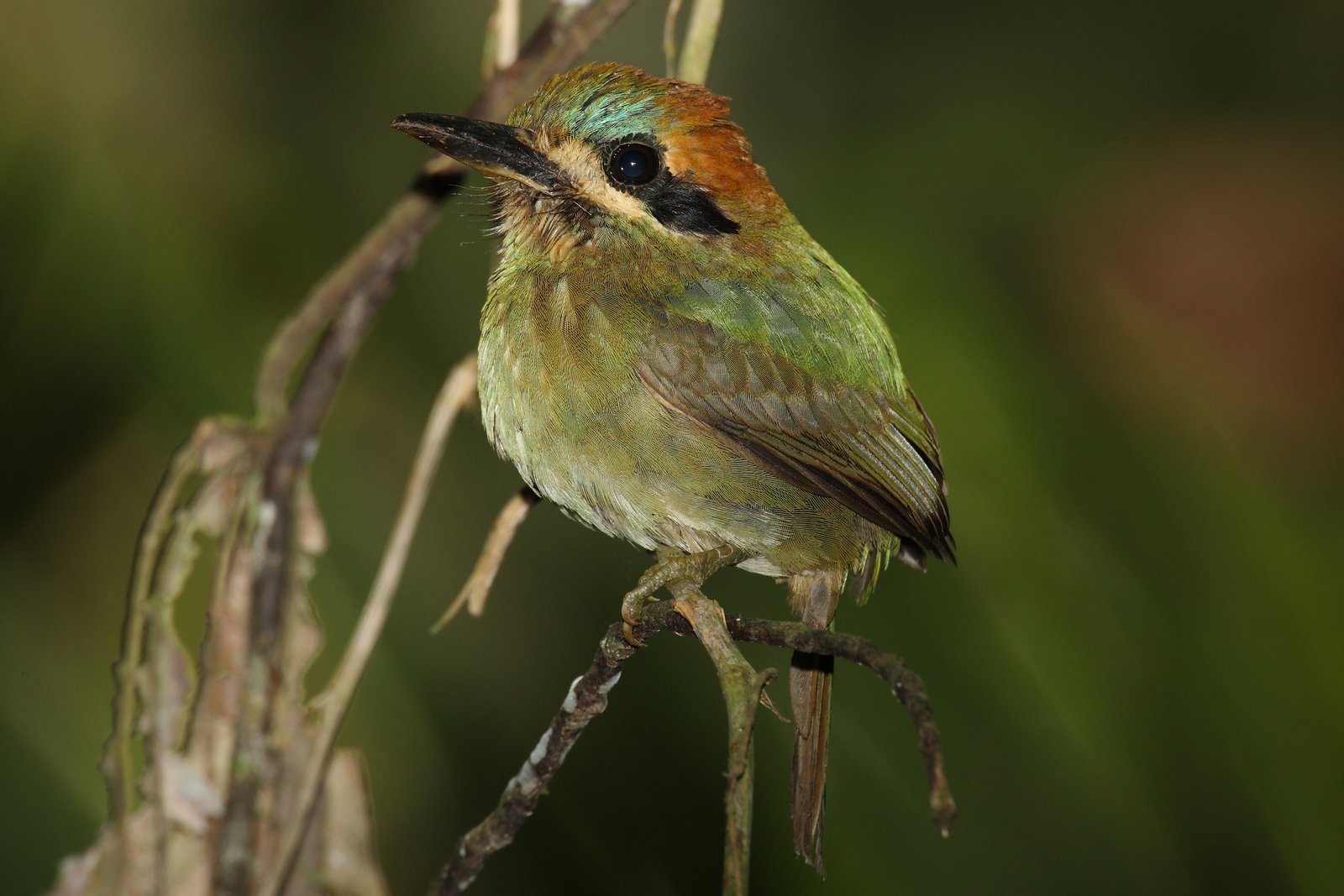
The Tody Motmot is the smallest motmot, a compact, green bird with a rufous crown and a short tail without the racquets of the other motmots. It sits motionless for long periods in the understorey of humid forest and is usually first noticed by its call. In the guide area it reaches only north-western Colombia, the southern limit of its range.
Voice
A series of hollow, nasal notes that carries over long distances, like kwa-kwa-kwa-kwa, mainly in the early morning. It often calls from a hidden perch in the understorey.
Recording: Manuel Grosselet - Josue de Leon — CC BY-NC-SA 4.0 · xeno-canto
Identification
17–19 cm, with a large head, a broad, flat bill and a short, straight tail. The upperparts and tail are green, the crown and nape rufous. Behind the eye is a black patch, with a short turquoise stripe above it and a pale, bluish-white stripe below it. The throat is whitish, the breast and flanks olive-green to brownish, and the belly whitish. The sexes are alike; juveniles are duller.
Confusion species
Broad-billed Motmot Electron platyrhynchum is much larger, with an all-rufous head and breast and a long, racquet-tipped tail. Whooping Motmot Momotus subrufescens is also much larger, with a blue ring around a black crown, a red iris and a long, racquet-tipped tail. Other small green understorey birds lack the combination of rufous crown, black ear patch and broad, flat bill.
Habitat
The understorey of humid lowland and foothill forest, also old secondary forest, in Colombia from the lowlands up to about 1000 m. It sits still on a branch for long periods and sallies for insects, spiders and other invertebrates on leaves and twigs. It nests in a self-dug tunnel in an earth bank.
Where the bird is most at home, classified by the vegetation units of the Andes and the west coast.


Range and movements
In the guide area only in north-western Colombia, in northern Chocó near the Panama border and in northern Antioquia and Córdoba. Absent from Ecuador, Peru, Bolivia and the Galápagos. Outside the guide area from southern Mexico through Central America to Panama.
- Resident
- dark = core range, pale = thinly spread
How and when to look
In the early morning, listen in humid forest in north-western Colombia for the series of hollow notes, then scan the understorey. The bird often stays on the same branch for a long time.
Conservation status
Least Concern. In the guide area it is confined to a small region, where it depends on forest that is shrinking through deforestation.
Scientific name
Hylomanes momotula | Lichtenstein, 1839
Lichtenstein described the species in 1839 and placed it straight away in the genus where it still stands. He introduced the genus Hylomanes in that same work. The genus name comes from Greek hulomanēs, from hulē, 'woodland', and -manēs, 'fond of': 'passionately fond of the woods'. The species name momotula is a diminutive of the genus Momotus: 'little motmot'. The specimen the first description was based on came from Valle Real, Mexico.