All species › Trogons › Trogons › Resplendent Quetzal
Resplendent Quetzal | Pharomachrus mocinno
Quetzal | Quetzal mesoamericano | Quetzal-resplandecente
The Resplendent Quetzal is the quetzal of the cloud forests of Central America; the male carries a train of elongated uppertail coverts that reaches far beyond the tail. In the guide area the species has no established population and counts at most as an exceptional vagrant in north-western Colombia, close to its breeding range in western Panama.
Voice
A repeated, deep and full two-note whistle, often in a series; also a cackling wek-wek and a dry chatter.
Recording: Paul Driver — CC BY-NC-SA 4.0 · xeno-canto
Identification
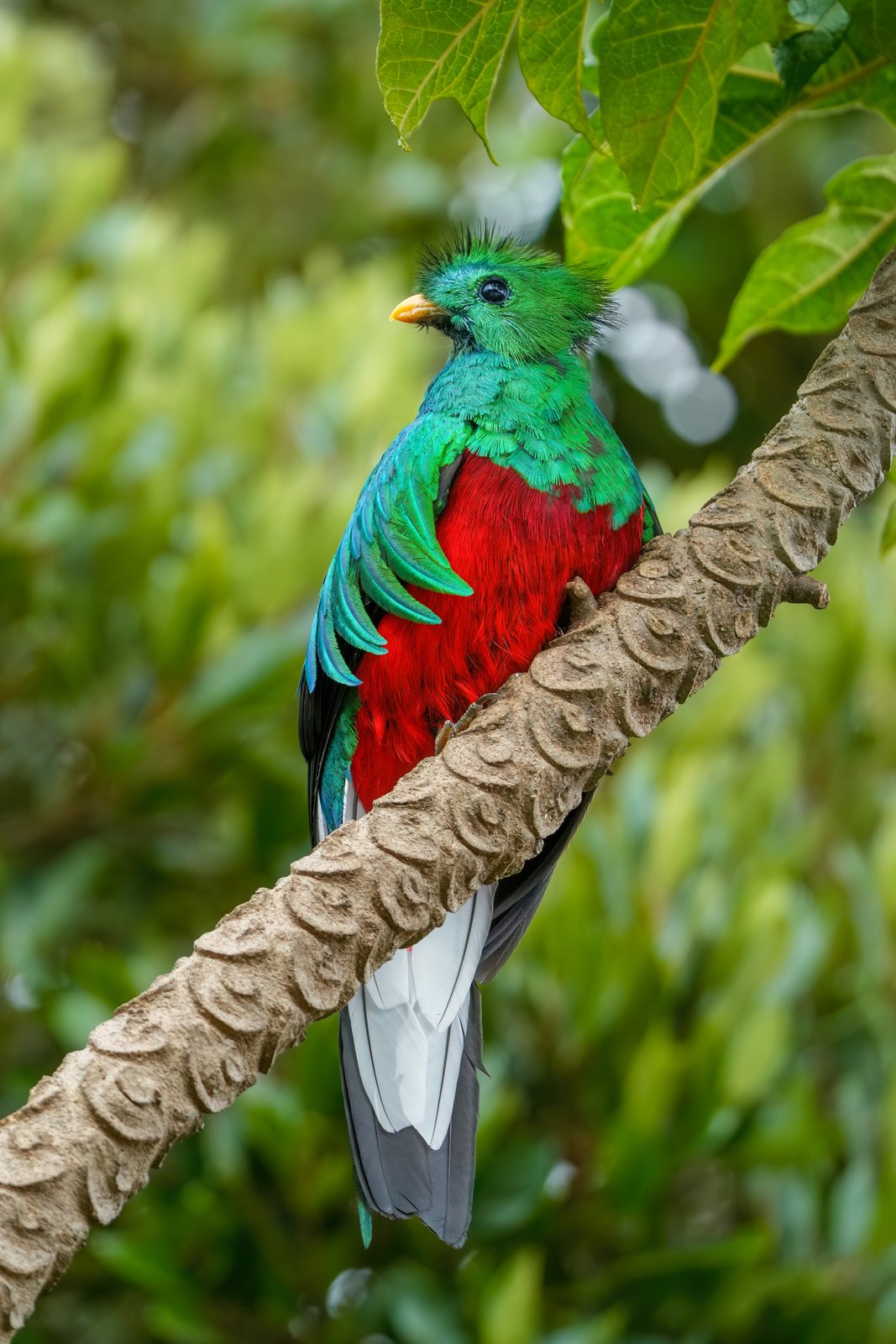
36–40 cm; the male adds a train of up to about 65 cm. The male is glossy metallic green, with a rounded, bristly crest on the head, long green wing coverts draped over the wing, a crimson belly and a white undertail. The bill is yellow. The female has no train and no full crest, is duller green with a grey-brown breast, red only on the lower belly and undertail coverts, a black-and-white barred undertail and a dark bill.
Confusion species
Golden-headed Quetzal Pharomachrus auriceps lacks the crest and train and has an all-black tail from below. Crested Quetzal Pharomachrus antisianus has a short crest over the bill and, in the male, a white undertail, but no train; females of both species resemble the female Resplendent Quetzal and need attention to head, breast and undertail.
Habitat
Humid cloud forest and upper montane forest, also forest edges and clearings with fruiting trees, in the breeding range roughly between 1200 and 3000 m. It eats mainly fruit, often wild avocados and other laurels, plucked while hovering, and also insects and small lizards. It nests in a cavity in a rotten tree trunk. After the breeding season many birds move to lower slopes.
Where the bird is most at home, classified by the vegetation units of the Andes and the west coast.


Range and movements
No established population in the guide area; at most to be expected as an exceptional vagrant in north-western Colombia, on the border with Panama. Absent from Ecuador, Peru, Bolivia and the Galápagos. Outside the guide area in the mountains from southern Mexico to western Panama.
How and when to look
A Resplendent Quetzal in the guide area is exceptional; document any sighting with photographs or sound recordings and check the differences from Golden-headed and Crested Quetzals.
Conservation status
Near Threatened. The population is declining through clearing and fragmentation of cloud forest in Central America.
Scientific name
Pharomachrus mocinno | de la Llave, 1832
De la Llave described the species in 1832 and placed it straight away in the genus where it still stands. He introduced the genus Pharomachrus in that same work. The genus name comes from Greek pharos, 'mantle', and makros, 'long', after the long covert feathers. Named after José Mariano Mociño (1757–1820), Mexican naturalist who took part in a scientific expedition to Guatemala. The specimen the first description was based on came from Guatemala and Chiapas, Mexico.