All species › Trogons › Trogons › Masked Trogon
Masked Trogon | Trogon personatus
Maskertrogon | Trogón enmascarado | Surucuá-mascarado
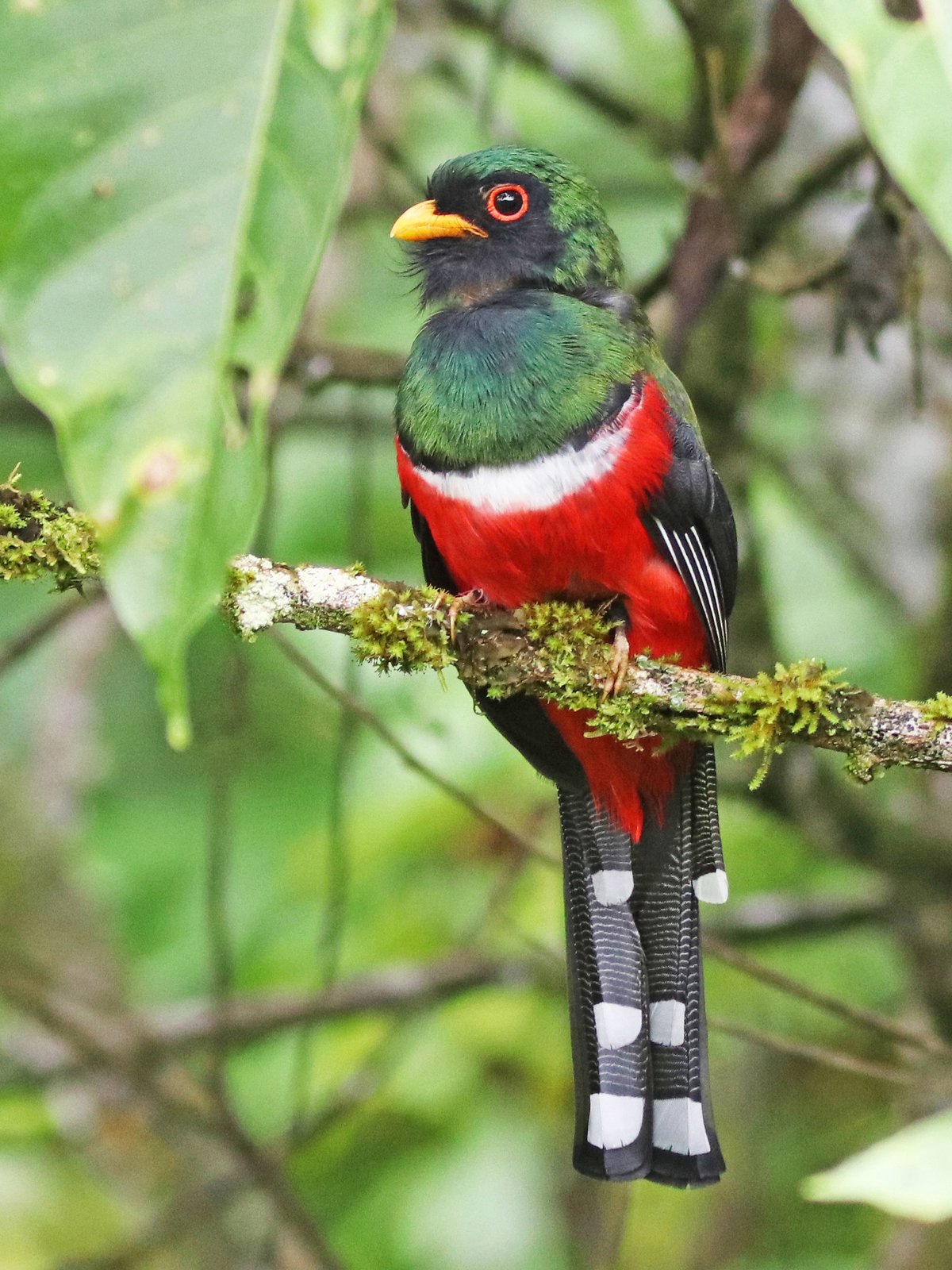
The Masked Trogon is the trogon of Andean montane forest and cloud forest, and ranges higher than the other trogons of the guide area. It resembles Collared Trogon, but has a more extensive black mask and a more finely barred undertail. It often sits still for long periods in the middle levels of the forest and sometimes moves with mixed flocks.
Voice
The song is a series of four to eight even, somewhat hoarse kwa notes at a regular pace, repeated at intervals. The call is a dry, rattling chatter.
Recording: Juan Freile — CC BY-NC-SA 4.0 · xeno-canto
Identification
25–27 cm. The male is glossy green on the head, breast and back, with a black mask over the forehead, face and throat, a red eye-ring and a yellow bill. A white band separates the green breast from the red belly. The undertail is very finely barred black and white, so that it looks grey, with broad white tips. The female is brown on the head, breast and back, with a blackish mask, a red belly, a narrow white breast band and a yellowish bill with a dark upper mandible; her undertail is finely barred grey. In high-elevation forms the undertail is darker and the white tips narrower.
Confusion species
Collared Trogon Trogon collaris has a less extensive black mask and a more coarsely barred black-and-white undertail; the female lacks the black mask. It lives on average lower. Golden-headed Quetzal Pharomachrus auriceps and Crested Quetzal Pharomachrus antisianus are larger, with long uppertail coverts and no white breast band.
Habitat
Humid montane forest and cloud forest, also forest edges and tall elfin woodland near the treeline, mostly between 1200 and 3000 m, locally to about 3500 m. It perches in the middle levels of the forest. It eats insects and fruit, taken in a short sally. It nests in a cavity in rotten wood or a tree stump.
Where the bird is most at home, classified by the vegetation units of the Andes and the west coast.


Range and movements
In Colombia in all three cordilleras, the Serranía de Perijá and the Sierra Nevada de Santa Marta. In Ecuador on the western and eastern slopes of the Andes. In Peru mainly on the eastern slope, in the north also on the western slope. In Bolivia on the eastern slope of the Andes. Absent from the Galápagos. Outside the guide area in the Andes and coastal mountains of Venezuela and on the tepuis of southern Venezuela, Guyana and northern Brazil.
- Resident
- dark = core range, pale = thinly spread
How and when to look
Along mountain roads and trails through cloud forest, such as around Mindo and in the Tandayapa Valley in Ecuador or along the road to Manu in Peru. Listen for the regular series of kwa notes; the bird often sits motionless on a branch in the middle level and sometimes joins mixed flocks.
Conservation status
Least Concern. The range is large, but the species is declining locally through deforestation on the Andean slopes.
Scientific name
Trogon personatus | Gould, 1842
Gould described the species in 1842 and placed it straight away in the genus where it still stands. The genus Trogon was introduced in 1760 by Brisson. The genus name comes from Greek trōgōn, 'nibbling', from trōgō, 'to gnaw'; trogons gnaw out their nest holes in rotten wood. Personatus is Latin for 'masked', from persona, 'actor's mask', after the male's black face. The specimen the first description was based on came from Bogotá, Colombia.