All species › Nightjars › Nightjars and nighthawks › Rufous Nightjar
Rufous Nightjar | Antrostomus rufus
Rosse nachtzwaluw | Chotacabras rojizo | João-corta-pau
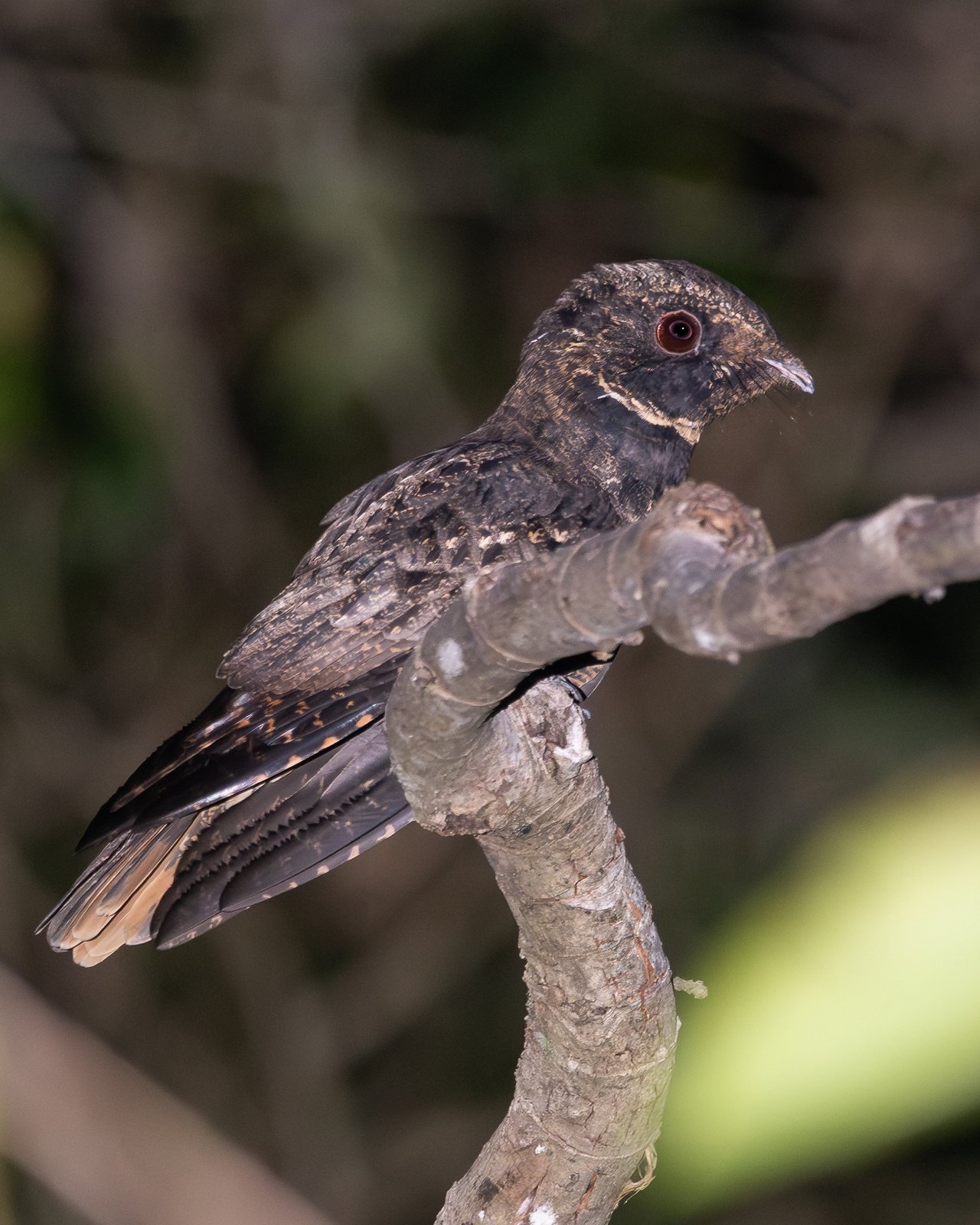
The Rufous Nightjar is a large, almost entirely rufous-brown nightjar of dry and semi-humid forest in tropical South America. It is closely related to the Chuck-will's-widow and resembles it in song. In the guide area the species has a fragmented range, with the largest numbers in Colombia and Bolivia.
Voice
A quick, rhythmic series chuk, wick-wick-weeoo, repeated many times from a perch up to about 20 m high, mainly at dusk and in moonlight in the breeding season.
Recording: Fabrício Grigolin — CC BY-NC-SA 4.0 · xeno-canto
Identification
25–30 cm, with a large head and a long, rounded tail. The plumage is warm rufous-brown, with dark brown streaks on the upperparts and dark spots and bars on the wings, without white in the wing. There is a buff collar on the hindneck and a white band below the throat. The male has large white spots at the tips of the three outer pairs of tail feathers; in the female the tail tips are pale buff. Birds in southern Bolivia are greyer.
Confusion species
Chuck-will's-widow Antrostomus carolinensis is larger and paler buff, with a less distinct throat band, and occurs only as a winter visitor in Colombia. Silky-tailed Nightjar Antrostomus sericocaudatus is darker and lives in humid forest in Amazonia. Pauraque Nyctidromus albicollis is smaller and greyer, with a white wing band in the male.
Habitat
Dry and semi-humid forest, forest edges, scrub and savanna with woodland patches, from dry Chaco woodland to humid lowland forest, locally on the lower slopes of the Andes. It catches insects in sallies from a perch. By day it rests on the forest floor; the eggs are laid without a nest on the ground among the leaves.
Where the bird is most at home, classified by the vegetation units of the Andes and the west coast.


Range and movements
In Colombia mainly in the north: the Caribbean lowlands, the lower valleys and, east of the Andes, the llanos. In Ecuador and Peru local and scarce, mainly in the lowlands and foothills east of the Andes. In Bolivia in the lowlands and dry forests of the east and south, also in the Andean foothills. Absent from the Galápagos. Outside the guide area from Costa Rica and Panama through Venezuela, Trinidad and the Guianas to Brazil, Paraguay and northern Argentina, also on St Lucia.
- Resident
- dark = core range, pale = thinly spread
How and when to look
Listen at dusk along forest edges in dry forest for the rhythmic song. Singing birds often sit on a branch above the trail and can be found with a torch.
Conservation status
Least Concern. The species has a large range; locally the conversion of dry forest to farmland reduces its habitat.
Scientific name
Antrostomus rufus | (Boddaert, 1783)
Boddaert described the species in 1783 as Caprimulgus rufus; because it was later moved to another genus, the author and year stand in brackets. The genus Antrostomus was introduced in 1838 by Bonaparte. The genus name combines Greek antron, 'cavern', with stoma, 'mouth', after the wide gape. The specific name comes from Latin rufus, 'red, rufous', after the reddish-brown plumage. The specimen the first description was based on came from Cayenne, French Guiana.