All species › Nightjars › Nightjars and nighthawks › Silky-tailed Nightjar
Silky-tailed Nightjar | Antrostomus sericocaudatus
Zijdestaartnachtzwaluw | Chotacabras coladeseda | Bacurau-rabo-de-seda
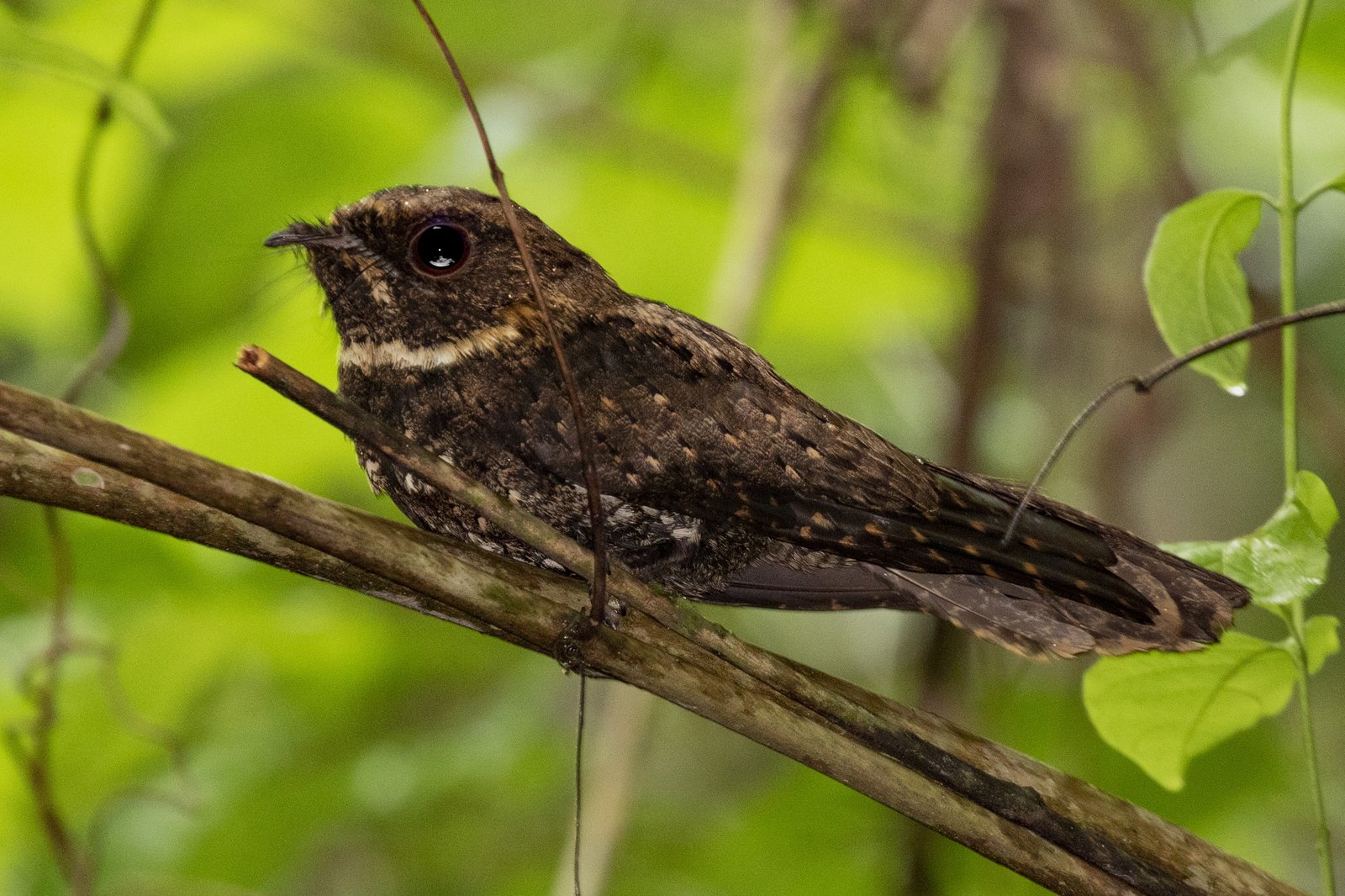
The Silky-tailed Nightjar is a large, dark nightjar of the interior of lowland forest. It is named for the soft, silky texture of its tail feathers. In the guide area it is known only from south-western Amazonia, where it is identified mainly by its song.
Voice
A clear, whistled phrase of two or three notes, rising at the end, repeated at short intervals at night from a low branch in the forest. It sings mainly at dusk, before dawn and in moonlight.
Recording: JAYRSON ARAUJO DE OLIVEIRA — CC BY-NC-SA 4.0 · xeno-canto
Identification
27–30 cm, with a long, rounded tail and relatively short, rounded wings. The plumage is dark rufous-brown to chocolate-brown, densely spotted and barred black, with a narrow pale band across the throat. There is no white patch in the wing. The male has narrow white tips to the outer tail feathers; in the female these tips are smaller and buff or absent. Juveniles are paler and less contrastingly marked.
Confusion species
Rufous Nightjar Antrostomus rufus is paler and warmer rufous-brown, with a shorter tail and a clearer pale collar, and lives mainly in drier forest and along forest edges. Pauraque Nyctidromus albicollis has a white band across the primaries and much white in the tail, and often sits on trails and in clearings. Short-tailed Nighthawk Lurocalis semitorquatus has a short tail and long, pointed wings and hunts high above the canopy.
Habitat
The interior of humid terra firme lowland forest, also bamboo forest and old secondary forest, in the lowlands and lower foothills. By day it roosts on the forest floor among dead leaves. At night it hunts flying insects from a low branch or from the ground. The eggs are laid without a nest on the leaf litter of the forest floor.
Where the bird is most at home, classified by the vegetation units of the Andes and the west coast.


Range and movements
In Peru in the south-eastern lowlands, including Ucayali (Purús) and Madre de Dios. In Bolivia in the north, in Pando and northern Beni. In Colombia first reported in 2024, in Amazonia. Not known from Ecuador; absent from the Galápagos. Outside the guide area in western Brazil and, as a separate population, in the Atlantic Forest of south-eastern Brazil, eastern Paraguay and north-eastern Argentina.
- Resident
- dark = core range, pale = thinly spread
How and when to look
After sunset, listen in the forest interior for the whistled song; the bird sings from low branches and can then be searched for with a lamp. By day it sometimes flushes from the forest floor along a trail.
Conservation status
Least Concern. The Amazonian population is little studied; the southern population in the Atlantic Forest has been fragmented by deforestation.
Scientific name
Antrostomus sericocaudatus | Cassin, 1849
Cassin described the species in 1849 and placed it straight away in the genus where it still stands. The genus Antrostomus was introduced in 1838 by Bonaparte. The genus name combines Greek antron, 'cavern', with stoma, 'mouth', after the wide gape. The specific name comes from Latin sericus, 'silken', and caudatus, 'tailed': silky-tailed. The specimen the first description was based on came from South America.