All species › Nightjars › Nightjars and nighthawks › Chuck-Will's-Widow
Chuck-Will's-Widow | Antrostomus carolinensis
Carolinanachtzwaluw | Guabairo americano | Bacurau-da-carolina
The Chuck-will's-widow is the largest nightjar of North America and winters in the Caribbean, Central America and northern South America. In the guide area it is a scarce winter visitor to Colombia. Its name imitates the song.
Voice
Usually silent in the wintering area. The song, often heard on the breeding grounds, is a strong, rhythmic chuck-will-wid-oo with a soft first note; wintering birds sometimes sing shortly before departure in spring. When disturbed a low quok.
Recording: steve — CC BY-SA 4.0 · xeno-canto
Identification
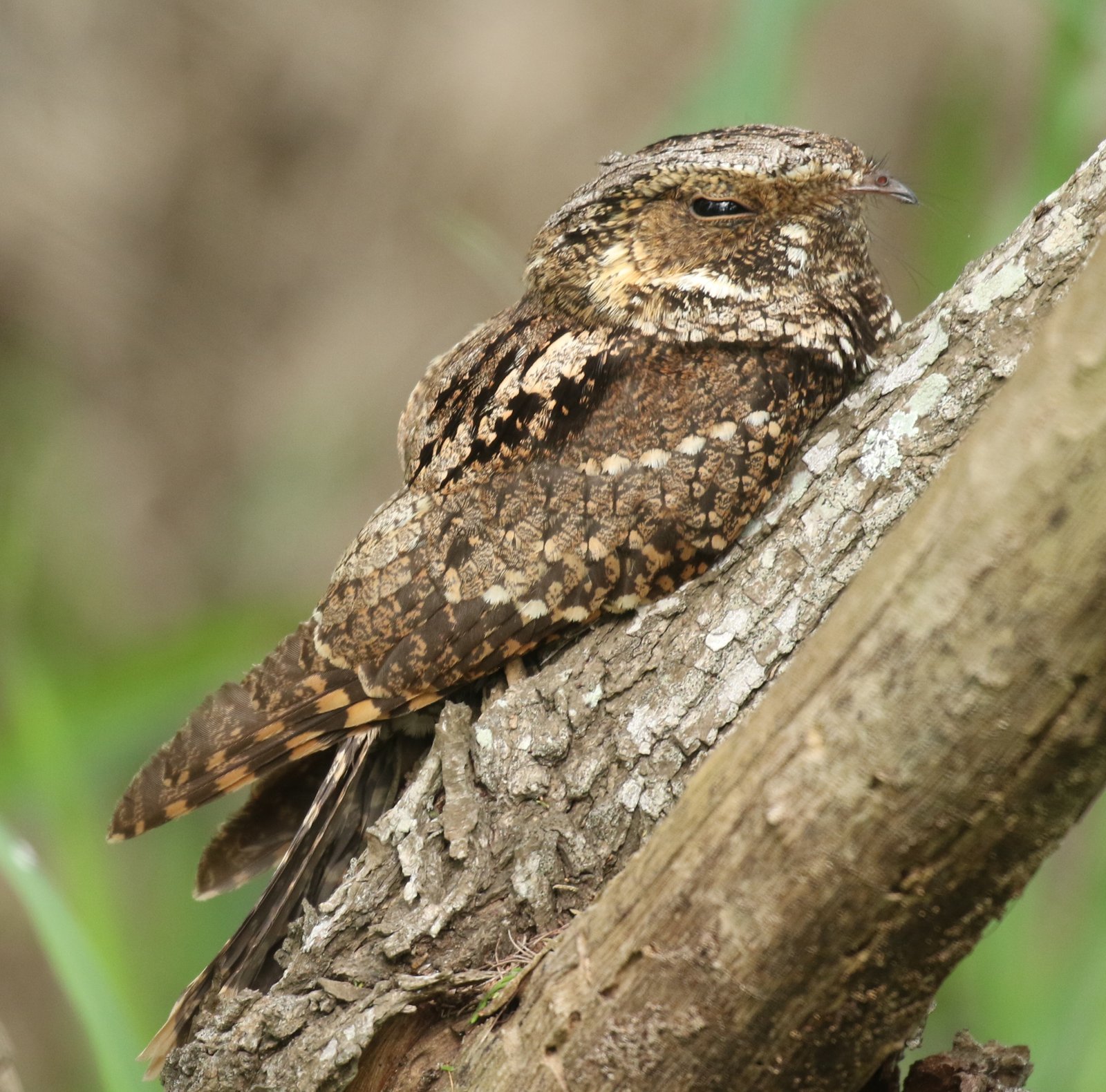
28–32 cm, large and heavy, with a large, flat head, a wide gape with long bristles and a long, rounded tail. The plumage is warm rufous-brown to buff, finely spotted and streaked with black, with a brown throat, a narrow pale throat band and a dark, spotted breast. There is no white wing band. The male has white inner webs to the outer tail feathers; in the female these are buff.
Confusion species
Rufous Nightjar Antrostomus rufus is smaller and darker rufous-brown, with a more distinct white throat band, and is resident in Colombia. Pauraque Nyctidromus albicollis is smaller and greyer, with a white wing band in the male. Short-tailed Nighthawk Lurocalis semitorquatus has long, pointed wings and a very short tail.
Habitat
In winter at forest edges, in secondary forest, semi-open wooded country, shaded coffee and cacao plantations and dry forest, in the lowlands and on lower mountain slopes. It catches large flying insects in sallies from a perch and sometimes swallows small birds or bats. By day it rests on a branch or on the ground.
Where the bird is most at home, classified by the vegetation units of the Andes and the west coast.


Range and movements
In Colombia a scarce winter visitor, mainly in the north and west: the Caribbean lowlands, the Pacific lowlands and the valleys and lower slopes of the Andes. Elsewhere in the guide area not or barely recorded. Breeds in the eastern and southern United States; also winters in the Caribbean, Mexico, Central America and north-western Venezuela.
- Winter visitor (c. Oct–Mar)
- Passage (Mar–Apr, Oct–Nov)
- dark = core range, pale = thinly spread
How and when to look
Wintering birds are usually silent and are often found by chance, by day at a roost or at night in headlights along roads through forest edges and plantations. In Colombia, look for a large, rufous-brown nightjar without a wing band.
Conservation status
Near Threatened. The breeding population has been declining for decades, probably through habitat loss, road kills and a decrease in large insects.
Scientific name
Antrostomus carolinensis | (Gmelin, 1789)
Gmelin described the species in 1789 as Caprimulgus carolinensis; because it was later moved to another genus, the author and year stand in brackets. The genus Antrostomus was introduced in 1838 by Bonaparte. The genus name combines Greek antron, 'cavern', with stoma, 'mouth', after the wide gape. The specific name refers to Carolina in the south-eastern United States. The specimen the first description was based on came from South Carolina, United States.