All species › Nightjars › Nightjars and nighthawks › Scissor-tailed Nightjar
Scissor-tailed Nightjar | Hydropsalis torquata
Spiesstaartnachtzwaluw | Atajacaminos tijera | Bacurau-tesoura
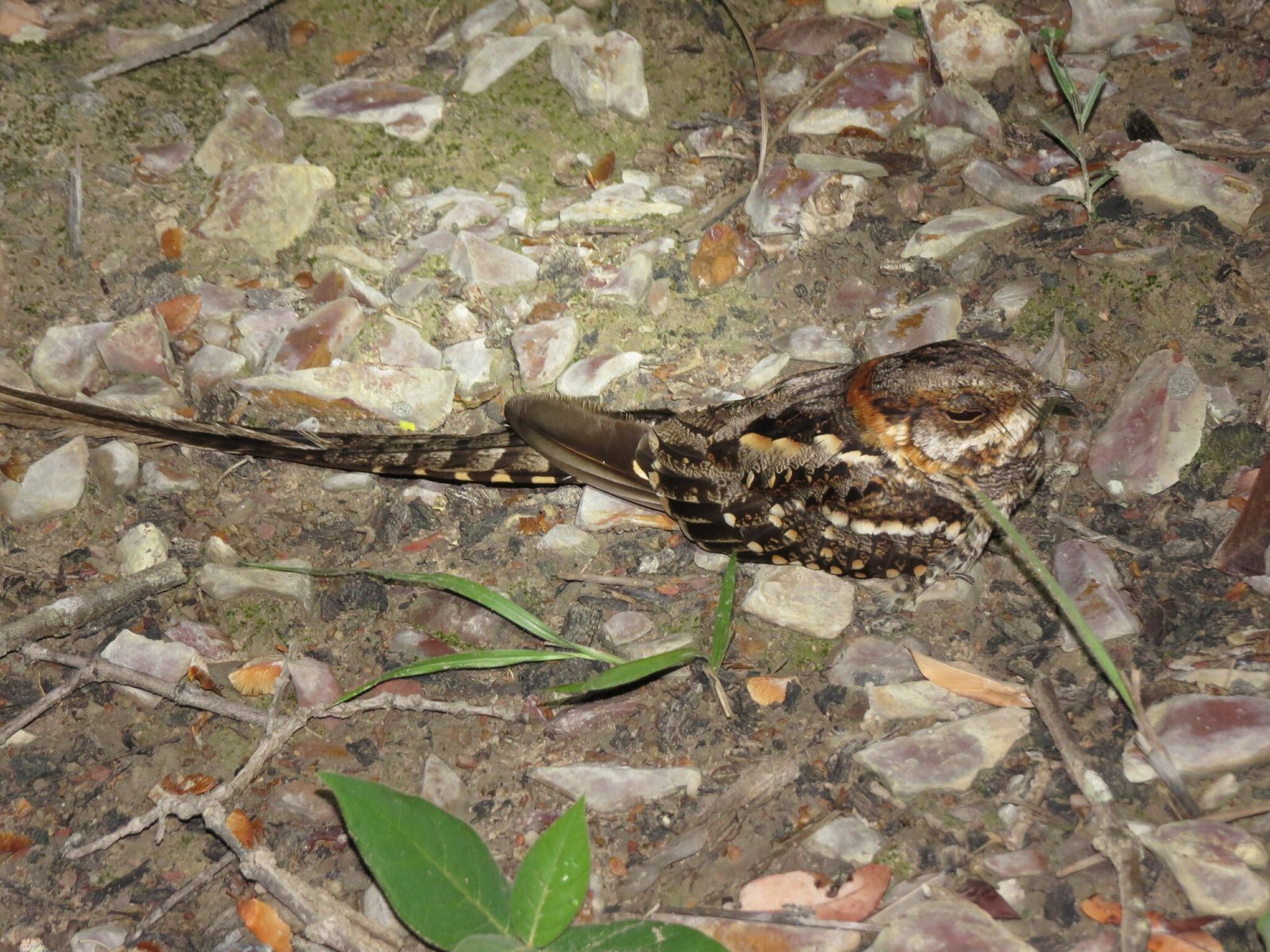
The Scissor-tailed Nightjar is a nightjar of open, grassy landscapes in central and southern South America. The male has a deeply forked tail with very long outer feathers, well over the length of the body. In the guide area the species occurs mainly in the savannas of Bolivia.
Voice
A high, thin tsip or tsik, often repeated in series from the ground or a low perch, and soft calls in flight. In display the male makes short flights around the female with its long tail.
Recording: Franco Vushurovich — CC BY-NC-SA 4.0 · xeno-canto
Identification
Female 25–30 cm; with its long tail the male measures up to about 55 cm. The upperparts are greyish brown with black streaks and buff spots, with a rufous collar on the hindneck. The throat has a pale band; the breast and belly are buff with fine brown barring. In the male the outer tail feathers are greatly elongated, with white inner webs, so that the tail forms an open pair of scissors. The female has a shorter, less deeply forked tail without white.
Confusion species
Lyre-tailed Nightjar Uropsalis lyra and Swallow-tailed Nightjar Uropsalis segmentata also have long tail feathers, but are darker and live in montane forest in the Andes. The male Ladder-tailed Nightjar Hydropsalis climacocerca has a white wing band and a graduated tail with elongated central feathers, and lives along rivers. Females resemble those of Pauraque Nyctidromus albicollis, which is larger, with a rounded tail and rufous ear-coverts.
Habitat
Open and semi-open grassland, savanna, marsh edges, pastures with scattered shrubs and forest edges in the lowlands, locally higher in dry Andean valleys. It catches insects in short sallies from the ground or a post. The eggs are laid without a nest on bare ground.
Where the bird is most at home, classified by the vegetation units of the Andes and the west coast.


Range and movements
In Bolivia in the savannas and open landscapes of the lowlands, mainly in Beni and Santa Cruz, locally into the Andean valleys. In Peru only in the south-east, in the savannas of Madre de Dios, with a few records of migrants elsewhere in Amazonia. Absent from Colombia, Ecuador and the Galápagos. Outside the guide area in Suriname and French Guiana, and from eastern and central Brazil to Paraguay, Uruguay and northern Argentina.
- Resident
- dark = core range, pale = thinly spread
How and when to look
Drive at dusk along roads through savanna and pastures in eastern Bolivia and look for birds on the road or on fence posts. In headlights the long tail feathers of the male stand out when it flies up.
Conservation status
Least Concern. The species has a large range and also occurs in grazed, open landscapes.
Scientific name
Hydropsalis torquata | (Gmelin, 1789)
Gmelin described the species in 1789 as Caprimulgus torquatus; because it was later moved to another genus, the author and year stand in brackets. The genus Hydropsalis was introduced in 1832 by Wagler. The genus name combines Greek hudro-, 'water-', with psalis, 'pair of scissors', after the long forked tail. The species name comes from Latin torquatus, 'collared', after the rufous collar. The specimen the first description was based on came from Brazil.