All species › Nightjars › Nightjars and nighthawks › Ladder-tailed Nightjar
Ladder-tailed Nightjar | Hydropsalis climacocerca
Trapstaartnachtzwaluw | Chotacabras coliescalera | Acurana
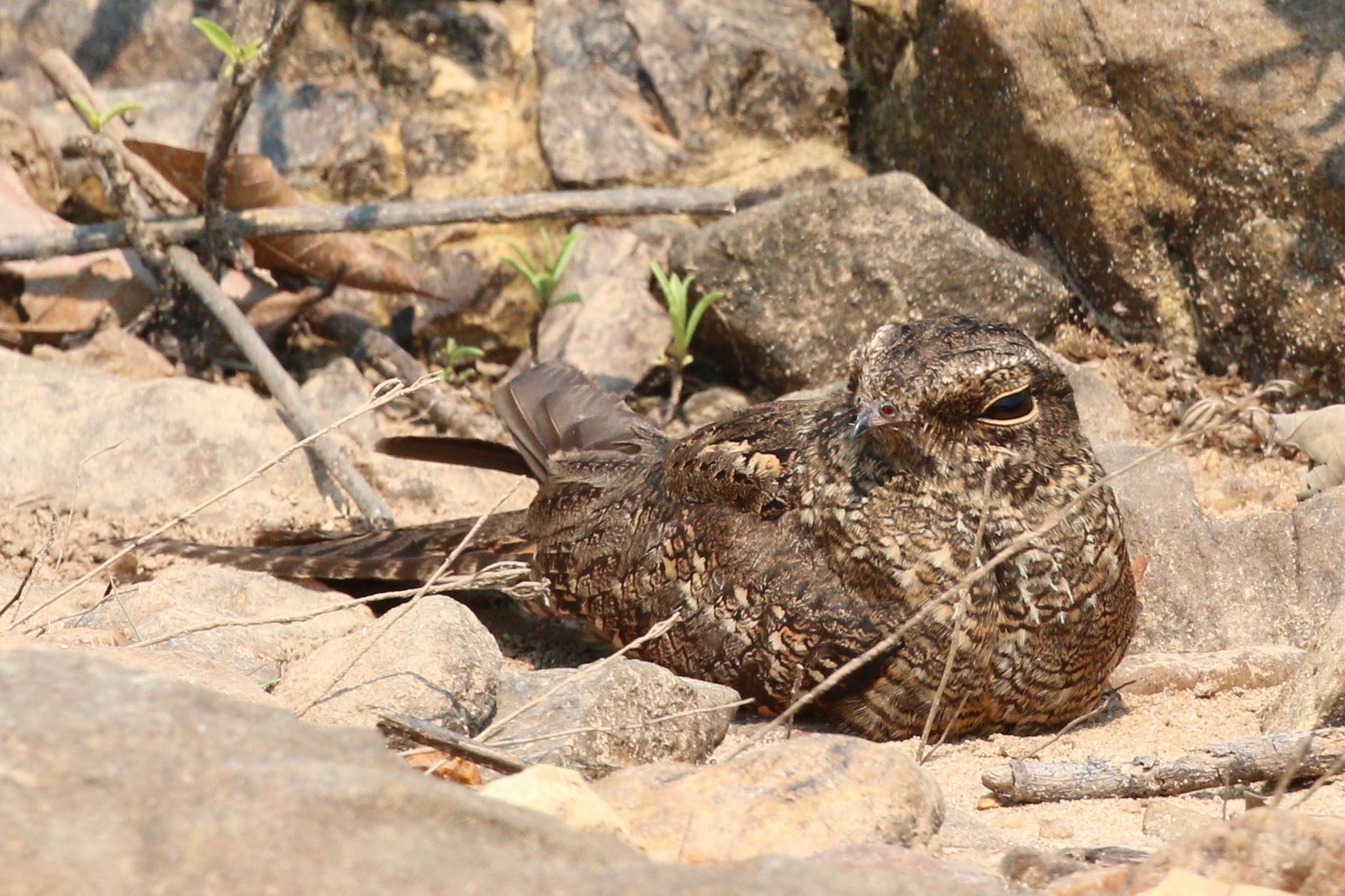
The Ladder-tailed Nightjar is the nightjar of sandbars and riverbanks in Amazonia. The male has a graduated tail in which the central feathers project well beyond the others and the outer ones show much white. By day it rests on sandbars, on driftwood or low in bushes along the water.
Voice
A short, high, sharp tsip or tsjip, repeated at intervals from a sandbar or in flight over the river, mainly at dusk.
Recording: GABRIEL LEITE — CC BY-NC-SA 4.0 · xeno-canto
Identification
22–27 cm; the male is longer than the female because of its elongated central tail feathers. The plumage is pale greyish brown, finely spotted and streaked with black and buff, with pale scapulars. The male has a white band across the primaries, a white throat and much white in the outer tail feathers, which gives the tail a stepped look. The female has a narrower, buff wing band, no white in the tail and a shorter tail.
Confusion species
Band-tailed Nighthawk Nyctiprogne leucopyga also lives along rivers, but is smaller and darker, with a white band across the tail and no wing band; it often hunts in small groups high over the water. Pauraque Nyctidromus albicollis is larger, with a longer, rounded tail and rufous ear-coverts, and lives at forest edges and in open country. Blackish Nightjar Nyctipolus nigrescens is much darker and rests on rocks and sandy spots.
Habitat
Sandbars, river islands and the open banks of large and medium-sized rivers in the lowlands, also around oxbow lakes and young riverside vegetation, mostly below 500 m. It catches insects in short sallies from the ground or a low perch and hunts over the water. The eggs are laid without a nest on bare sand; at high water the species moves to higher banks.
Where the bird is most at home, classified by the vegetation units of the Andes and the west coast.


Range and movements
In Colombia along the rivers east of the Andes, from the llanos into Amazonia. In Ecuador, Peru and northern Bolivia along the rivers of the Amazonian lowlands. Absent west of the Andes and from the Galápagos. Outside the guide area in Venezuela, the Guianas and Amazonian Brazil.
- Resident
- dark = core range, pale = thinly spread
How and when to look
Travel by boat at dusk past sandbars and river islands; birds then fly up from the sand and hunt low over the water. By day they sometimes lie on a sandbar, flushing only at close range.
Conservation status
Least Concern. The species has a large range; disturbance of sandbars by boat traffic and gold mining may play a role locally.
Scientific name
Hydropsalis climacocerca | (Tschudi, 1844)
Tschudi described the species in 1844 as Caprimulgus climacocercus; because it was later moved to another genus, the author and year stand in brackets. The genus Hydropsalis was introduced in 1832 by Wagler. The genus name combines Greek hudro-, 'water-', with psalis, 'pair of scissors', after the long forked tail. The species name comes from Greek klimax, 'ladder', and kerkos, 'tail', after the graduated tail. The specimen the first description was based on came from Peru.