All species › Nightjars › Nightjars and nighthawks › White-tailed Nightjar
White-tailed Nightjar | Hydropsalis cayennensis
Witstaartnachtzwaluw | Chotacabras coliblanco | Bacurau-de-cauda-branca
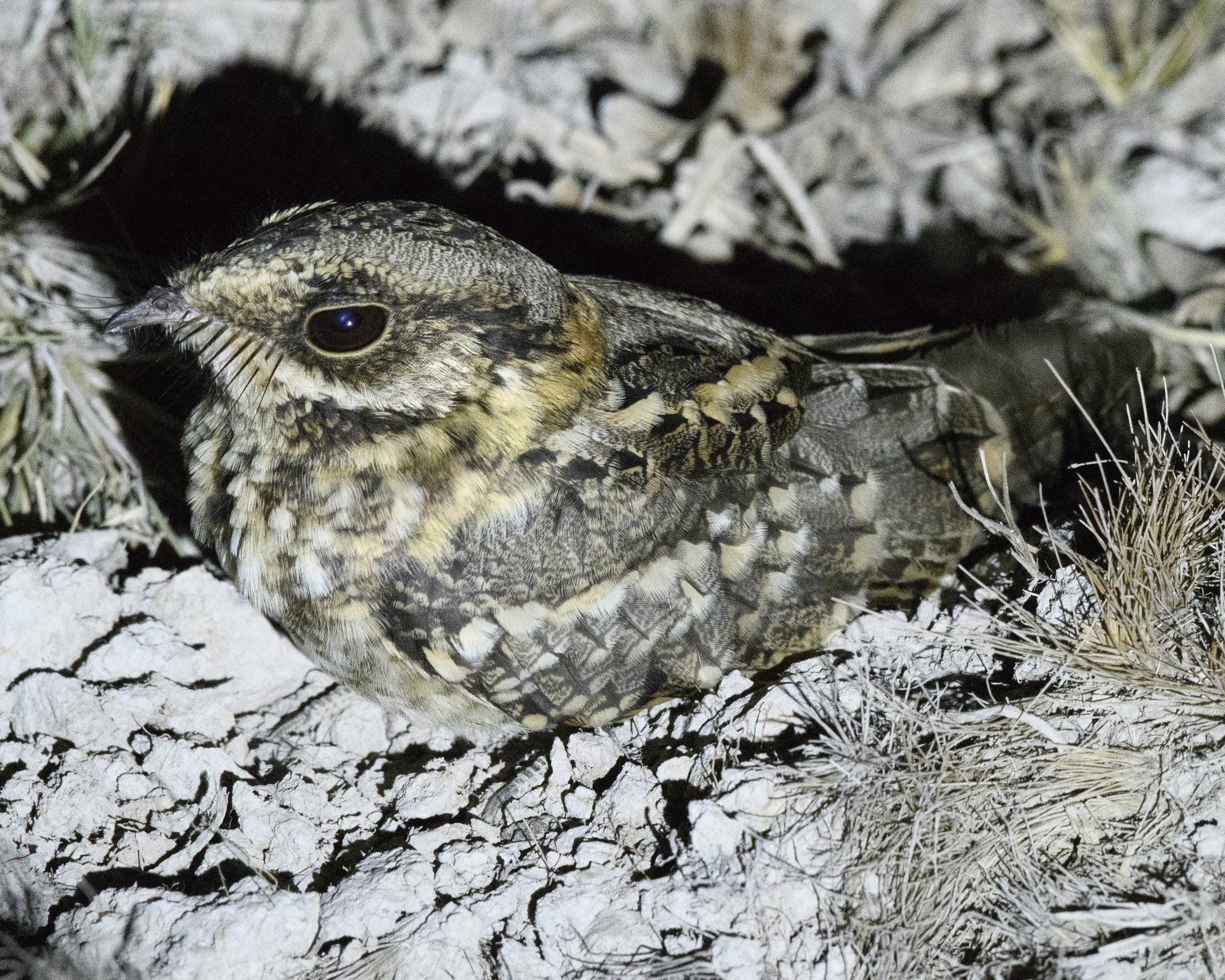
The White-tailed Nightjar is a small, greyish-brown nightjar of open grassland and savanna in northern South America. The male has a white wing band and a tail that is largely white except for the central pair. In the guide area it occurs only in Colombia.
Voice
A high, thin, drawn-out whistle that rises and falls slightly at the end, pt-tsiiiiiu, repeated from dusk well into the night, mainly in the breeding season. In flight a scratchy wheer; when flushed a thin tik-tik.
Recording: José María Loaiza B. — CC BY-NC-SA 4.0 · xeno-canto
Identification
20–23 cm, with a slightly forked tail. The upperparts are greyish brown with brown to blackish-brown speckles and streaks, with a buff collar on the hindneck, a white or buff supercilium and a pale moustachial stripe. The male has a white throat, a buff breast with large white spots, a white belly, a white band across the primaries that also shows on the perched bird, and much white in the tail. The female is darker, without white in the wing and tail, with a buff throat and a buff belly barred with brown.
Confusion species
Pauraque Nyctidromus albicollis is larger, with a longer, rounded tail and rufous ear-coverts, and lives more along forest edges. Spot-tailed Nightjar Antiurus maculicaudus is warmer brown, with a dark head and small white spots on the underside of the tail, and lives in wet savanna. Little Nightjar Setopagis parvula occurs in the guide area only in the south. Females without white resemble those of related species; note the pale, spotted breast and the open grassland.
Habitat
Open savanna, grassland with scattered shrubs, pastures, dry scrub and bushy hillsides, mainly in the lowlands, locally also in dry valleys at higher elevations. It catches insects in short sallies from the ground. By day it rests on the ground among grass or under a shrub; the eggs are laid without a nest on bare ground.
Where the bird is most at home, classified by the vegetation units of the Andes and the west coast.


Range and movements
In Colombia in the Caribbean lowlands, the Magdalena and Cauca valleys and the llanos east of the Andes. In Ecuador at most exceptional; absent from Peru, Bolivia and the Galápagos. Outside the guide area from Costa Rica and Panama through Venezuela and the Guianas to northern Brazil, also on Trinidad, the ABC Islands and Martinique.
- Resident
- dark = core range, pale = thinly spread
How and when to look
Search at dusk along roads through open savanna and pastures in the llanos or the Caribbean lowlands. The male then sings from the ground or a low perch; in the beam of a torch or headlights the white wing bands and white tail show.
Conservation status
Least Concern. The species has a large range and tolerates open, man-made landscapes such as pastures.
Scientific name
Hydropsalis cayennensis | (Gmelin, 1789)
Gmelin described the species in 1789 as Caprimulgus cayennensis; because it was later moved to another genus, the author and year stand in brackets. The genus Hydropsalis was introduced in 1832 by Wagler. The genus name combines Greek hudro-, 'water-', with psalis, 'pair of scissors', after the long forked tail. The species name refers to Cayenne in French Guiana. The specimen the first description was based on came from Cayenne, French Guiana.