All species › Pelicans, herons and ibises › Herons, egrets and bitterns › Great Blue Heron
Great Blue Heron | Ardea herodias
Amerikaanse blauwe reiger | Garza azulada | Garça-azul-grande
The Great Blue Heron is the largest heron of North America. On the Galápagos a separate breeding population of somewhat smaller birds lives; on the mainland of the guide area it is a scarce winter visitor from the north. It hunts standing still or wading slowly in shallow water.
Voice
A deep, croaking kraak or grak-grak, mainly when flushed.
Recording: Jeff Stewart — CC BY-NC-SA 4.0 · xeno-canto
Identification
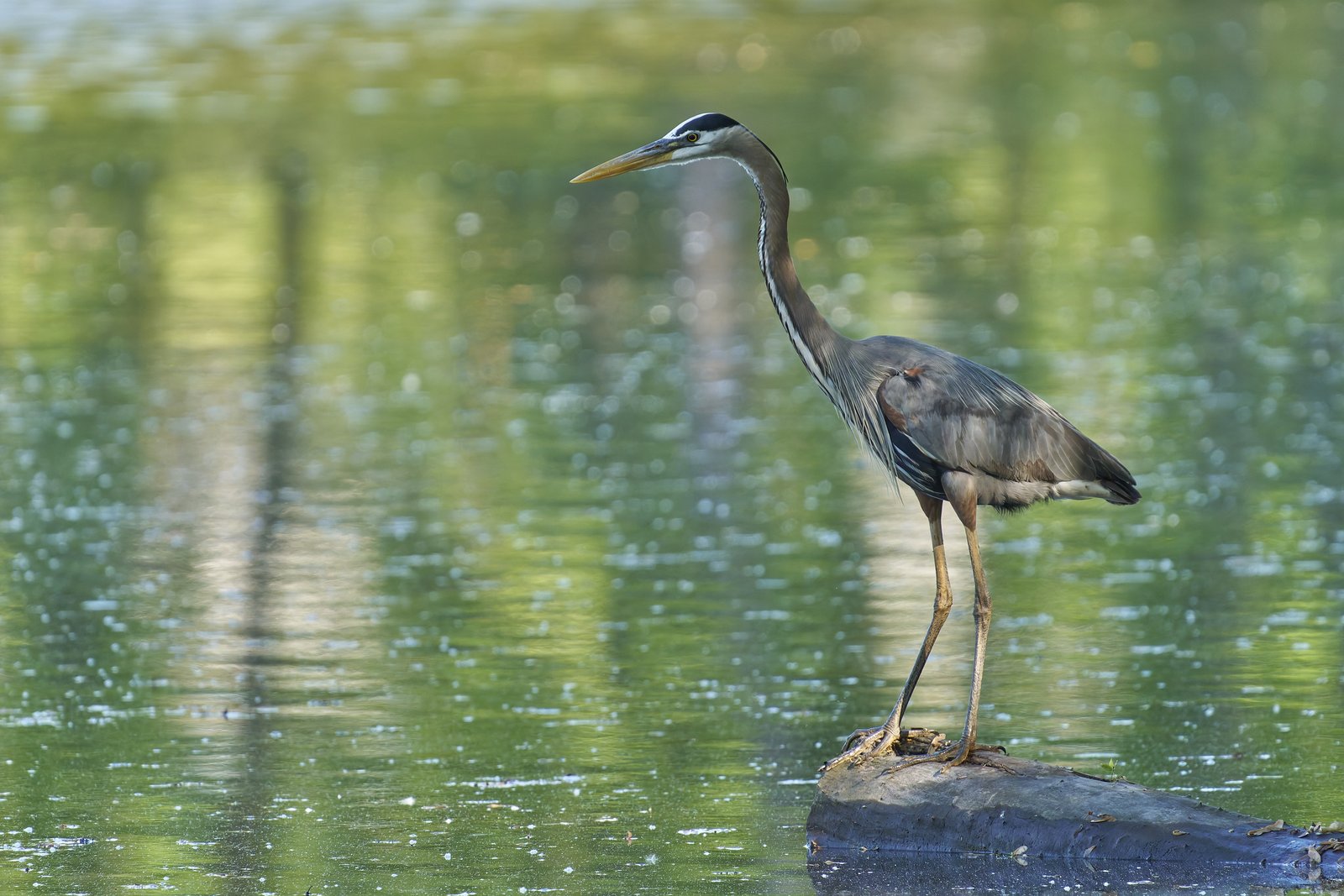
105–125 cm. Very large, with a long neck and legs. Adults are blue-grey, with a white head and a broad black stripe above the eye that ends in black crest plumes, a grey to grey-brown neck with a dark stripe down the foreneck, rufous thighs and a black shoulder patch. The bill is yellowish, the legs are dark. In the breeding season long plumes on back and breast. The sexes are alike. Juveniles have a dark crown without a crest and are browner.
Confusion species
Cocoi Heron Ardea cocoi has an all-black crown, a white neck, white thighs and black on the sides of the belly. Rufescent Tiger Heron Tigrisoma lineatum is smaller, with a rufous head and neck. In flight at a distance it can be confused with Cocoi Heron; check the colour of neck and thighs.
Habitat
On the Galápagos lava shores, lagoons, mangroves and salt pans. On the mainland coastal lagoons, mangroves, mudflats, lakes and marshes, mostly in the lowlands. It eats mainly fish, also crabs, lizards, young birds and small mammals. On the Galápagos it breeds solitarily or in small groups in mangroves or on rocks; the nest is a platform of sticks.
Where the bird is most at home, classified by the vegetation units of the Andes and the west coast.


Range and movements
In Colombia a scarce winter visitor, mainly on the Caribbean coast and in the Magdalena lowlands, rarely in the Andes. In Ecuador rare on the mainland; on the Galápagos a scarce resident on most of the larger islands. A few records are known from Peru, mainly in the north; not known from Bolivia. Outside the guide area it breeds from Canada to Mexico, Central America and the Caribbean and winters south to northern South America.
- Resident
- dark = core range, pale = thinly spread
How and when to look
On the Galápagos it stands along the lava shore and in the lagoons of Santa Cruz, Isabela and Floreana, among others. On the mainland the best chance is between October and April in the lagoons and mangroves of the Caribbean coast of Colombia.
Conservation status
Not Evaluated in the current circumscription of the species; as a whole widespread and numerous. The breeding population on the Galápagos is small and therefore sensitive to disturbance and introduced predators.
Scientific name
Ardea herodias | Linnaeus, 1758
Linnaeus described the species in 1758 and placed it straight away in the genus where it still stands. He introduced the genus Ardea in that same work. The genus name is Latin ardea, 'heron'. The species name comes from Greek erōdios, 'heron'. The specimen the first description was based on came from Hudson Bay, Canada.