All species › Passerines › Tanagers and allies › Rusty Flowerpiercer
Rusty Flowerpiercer | Diglossa sittoides
Kleverberghoningkruiper | Pinchaflor pechicanelo | Fura-flor-ferrugíneo
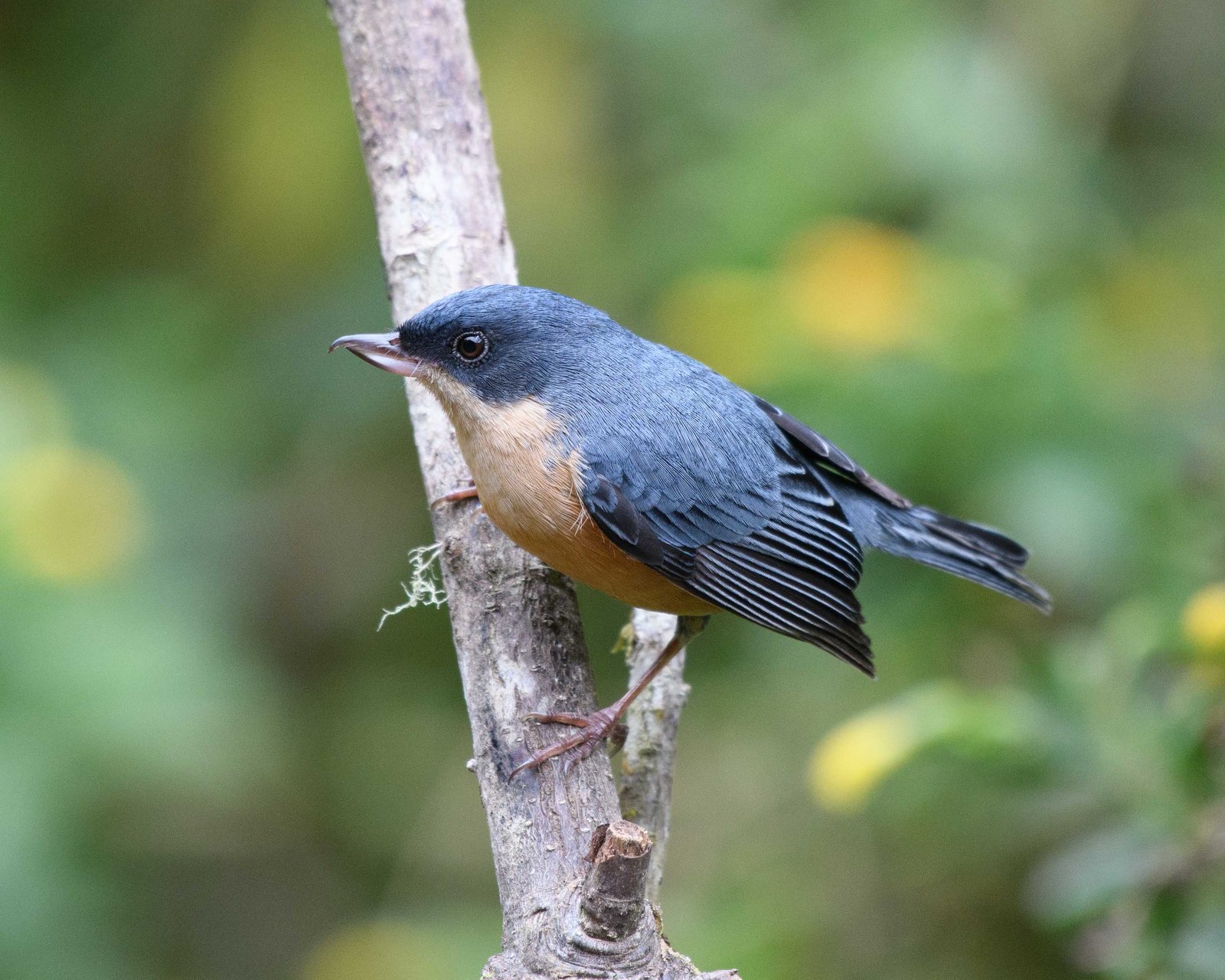
The Rusty Flowerpiercer is a small flowerpiercer with blue-grey upperparts and rusty underparts, found from Colombia to Bolivia over a wide altitudinal range. It lives in forest edges, scrub and gardens, also in drier valleys. The scientific name sittoides means 'nuthatch-like' and refers to its colour pattern.
Voice
The song is a fast, high, dry trill or twittering series of notes; the call is a short tsit.
Recording: Paul Coopmans — CC BY-NC-SA 4.0 · xeno-canto
Identification
11–12 cm, with a fine, upturned bill with a hooked tip. The male is blue-grey above, with a darker head and blackish lores, and cinnamon to rusty below, from throat to undertail. The female is olive-brown above and paler buff below, with faint dark streaks. Juveniles resemble the female.
Confusion species
Blue-backed Conebill Conirostrum sitticolor has a black head and breast and a straight, pointed bill. Cinereous Conebill Conirostrum cinereum is grey with pale underparts and a white wing patch. Chestnut-bellied Flowerpiercer Diglossa gloriosissima in the Western Andes of Colombia is black above. The female resembles the female White-sided Flowerpiercer Diglossa albilatera, which has a white flank tuft.
Habitat
Forest edges, scrub, open woodland, plantations, gardens and parks, in both humid and drier regions, mostly between about 1000 and 3000 m, locally higher. It lives alone or in pairs and takes nectar from flowering shrubs and trees; it also eats insects. The nest is a cup in a shrub.
Where the bird is most at home, classified by the vegetation units of the Andes and the west coast.


Range and movements
In Colombia in all three Andean ranges and in the Sierra de Perijá. In Ecuador along both slopes of the Andes and in the inter-Andean valleys. In Peru widespread along the Andes. In Bolivia in the Andes and the valleys of the eastern slope. Absent from the Galápagos. Outside the guide area in Venezuela and north-western Argentina.
- Resident
- dark = core range, pale = thinly spread
How and when to look
Check flowering shrubs and hedgerows in villages, gardens and along forest edges at middle elevations; the bird often perches briefly in the open and then flies quickly to the next flower.
Conservation status
Least Concern. Widespread and fairly common; the species benefits from semi-open, human-shaped landscapes.
Scientific name
Diglossa sittoides | (d'Orbigny, ACVMD & de Lafresnaye, 1838)
D'Orbigny, ACVMD & de Lafresnaye described the species in 1838 as Serrirostrum sittoides; because it was later moved to another genus, the author and year stand in brackets. The genus Diglossa was introduced in 1832 by Wagler. The genus name comes from Greek diglōssos, 'double-tongued' or 'speaking two languages'. The specific name combines the genus Sitta (nuthatches) with Greek -oidēs, 'resembling': nuthatch-like. The specimen the first description was based on came from Vallegrande, Santa Cruz, Bolivia.