All species › Passerines › Tanagers and allies › Indigo Flowerpiercer
Indigo Flowerpiercer | Diglossa indigotica
Indigoberghoningkruiper | Pinchaflor índigo | Fura-flor-índigo
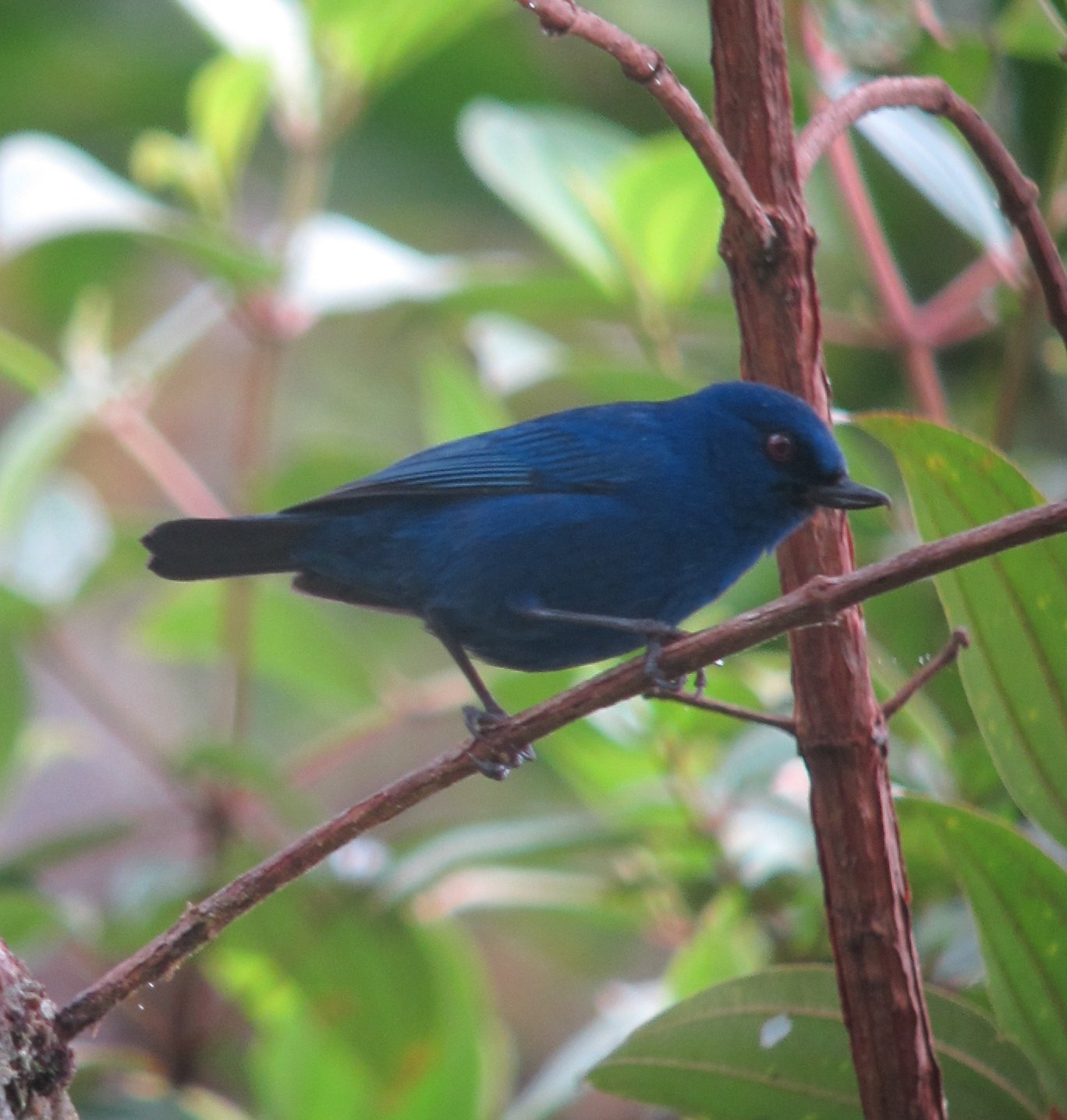
The Indigo Flowerpiercer is a small, bright indigo-blue flowerpiercer of the very wet montane forest of the Chocó, on the western slope of the Andes in Colombia and Ecuador. It lives higher in the trees than most of its relatives and often travels with mixed flocks of tanagers.
Voice
The song is a high, thin, fast series of hissing and chirping notes; the call is a fine tsit.
Recording: Juan Freile — CC BY-NC-SA 4.0 · xeno-canto
Identification
11–12 cm, with a short, upturned bill with a hooked tip. Entirely bright indigo-blue, with black lores around the red eye and blackish wings and tail with blue edges. The sexes are alike; the female is sometimes slightly duller. Juveniles are greyer blue.
Confusion species
Masked Flowerpiercer Diglossa cyanea is larger, with a broad black mask, and usually lives higher. Golden-eyed Flowerpiercer Diglossa glauca is darker blue, with a golden-yellow eye, and lives on the eastern slope. Bluish Flowerpiercer Diglossa caerulescens is duller greyish blue. Blue dacnises (Dacnis) have a straight, pointed bill without a hook.
Habitat
The interior and edges of very wet, mossy montane forest on the Pacific slope, mostly between about 700 and 2200 m. It forages in the middle and upper levels of the trees, often in epiphytes, for nectar and insects and regularly travels with mixed flocks. Little is known about the nest.
Where the bird is most at home, classified by the vegetation units of the Andes and the west coast.


Range and movements
In Colombia on the western slope of the Western Andes, from Antioquia south to Nariño. In Ecuador on the western slope of the Andes in the north-west, south to about Pichincha. Absent from Peru, Bolivia and the Galápagos. Does not occur outside the guide area.
- Resident
- dark = core range, pale = thinly spread
How and when to look
Search mixed flocks in the cloud forest of north-western Ecuador and in the Western Andes of Colombia; look for a small blue bird with a red eye high in the trees.
Conservation status
Least Concern. The range is restricted to the Chocó slope of the Andes, where deforestation is a threat; the species is fairly scarce locally.
Scientific name
Diglossa indigotica | Sclater, 1856
Sclater described the species in 1856 and placed it straight away in the genus where it still stands. The genus Diglossa was introduced in 1832 by Wagler. The genus name comes from Greek diglōssos, 'double-tongued' or 'speaking two languages'. The specific name comes from Modern Latin indigoticus, 'indigo-blue'. The specimen the first description was based on came from Ecuador.