All species › Passerines › Tanagers and allies › White-sided Flowerpiercer
White-sided Flowerpiercer | Diglossa albilatera
Witflankberghoningkruiper | Pinchaflor flanquiblanco | Fura-flor-de-flanco-branco
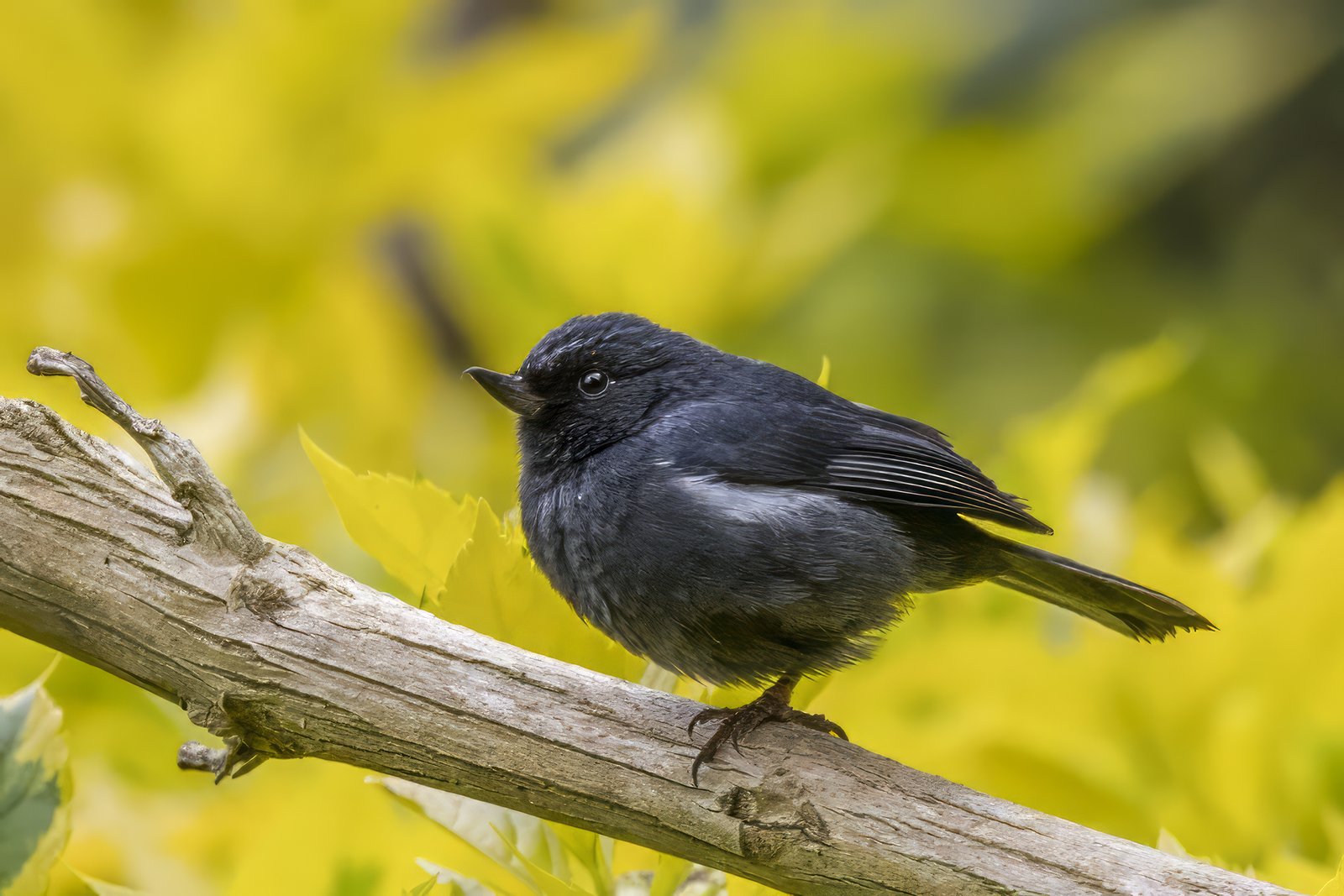
The White-sided Flowerpiercer is a small flowerpiercer of forest edges and scrub in the cloud forest of the northern and central Andes. Male and female differ strongly, but both have a white tuft of feathers on the flanks, which shows when the bird flicks its wings. It often takes nectar from low shrubs.
Voice
The song is a thin, high, trilling series of notes, often long-sustained; the call is a fine tsit.
Recording: Patricio Mena Valenzuela — CC BY-NC-SA 4.0 · xeno-canto
Identification
12–13 cm, with a fine, upturned bill with a hooked tip. The male is slate-grey to blackish, with a white tuft on the flanks and white underwing coverts. The female is olive-brown above and paler buff below, with the same white flank tuft. Juveniles resemble the female but are faintly streaked.
Confusion species
Black Flowerpiercer Diglossa humeralis is larger and blacker and lacks the white flank patch. The female resembles the female Rusty Flowerpiercer Diglossa sittoides, which is yellower below, with faint streaks, and lacks the white flank tuft. Bluish Flowerpiercer Diglossa caerulescens is uniform blue-grey, without a white flank patch, and lives mainly in trees inside forest.
Habitat
Forest edges, shrubby clearings, scrub and gardens in cloud forest and upper montane forest, mostly between about 1800 and 3300 m. It takes nectar from low shrubs and flowers at forest edges and also eats insects. The nest is a cup in a shrub or among moss.
Where the bird is most at home, classified by the vegetation units of the Andes and the west coast.


Range and movements
In Colombia in all three Andean ranges and in the Sierra de Perijá. In Ecuador along both slopes of the Andes. In Peru along the Andes, mainly on the eastern slope, south to about Cusco. Absent from Bolivia and the Galápagos. Outside the guide area in the Andes of western Venezuela.
- Resident
- dark = core range, pale = thinly spread
How and when to look
Look at the edges of cloud forest and along mountain roads at flowering shrubs; when the bird flicks its wings, the white flank tuft becomes visible.
Conservation status
Least Concern. Fairly common and widespread; the species tolerates secondary forest and forest edges.
Scientific name
Diglossa albilatera | de Lafresnaye, 1843
De Lafresnaye described the species in 1843 and placed it straight away in the genus where it still stands. The genus Diglossa was introduced in 1832 by Wagler. The genus name comes from Greek diglōssos, 'double-tongued' or 'speaking two languages'. The specific name comes from Latin albus, 'white', and latus, 'side, flank': white-sided. The specimen the first description was based on came from Bogotá, Colombia.