All species › Passerines › Antpittas › Santa Marta Antpitta
Santa Marta Antpitta | Grallaria bangsi
Santamartamierpitta | Tororoí de Santa Marta | Tovacuçu-de-santa-marta
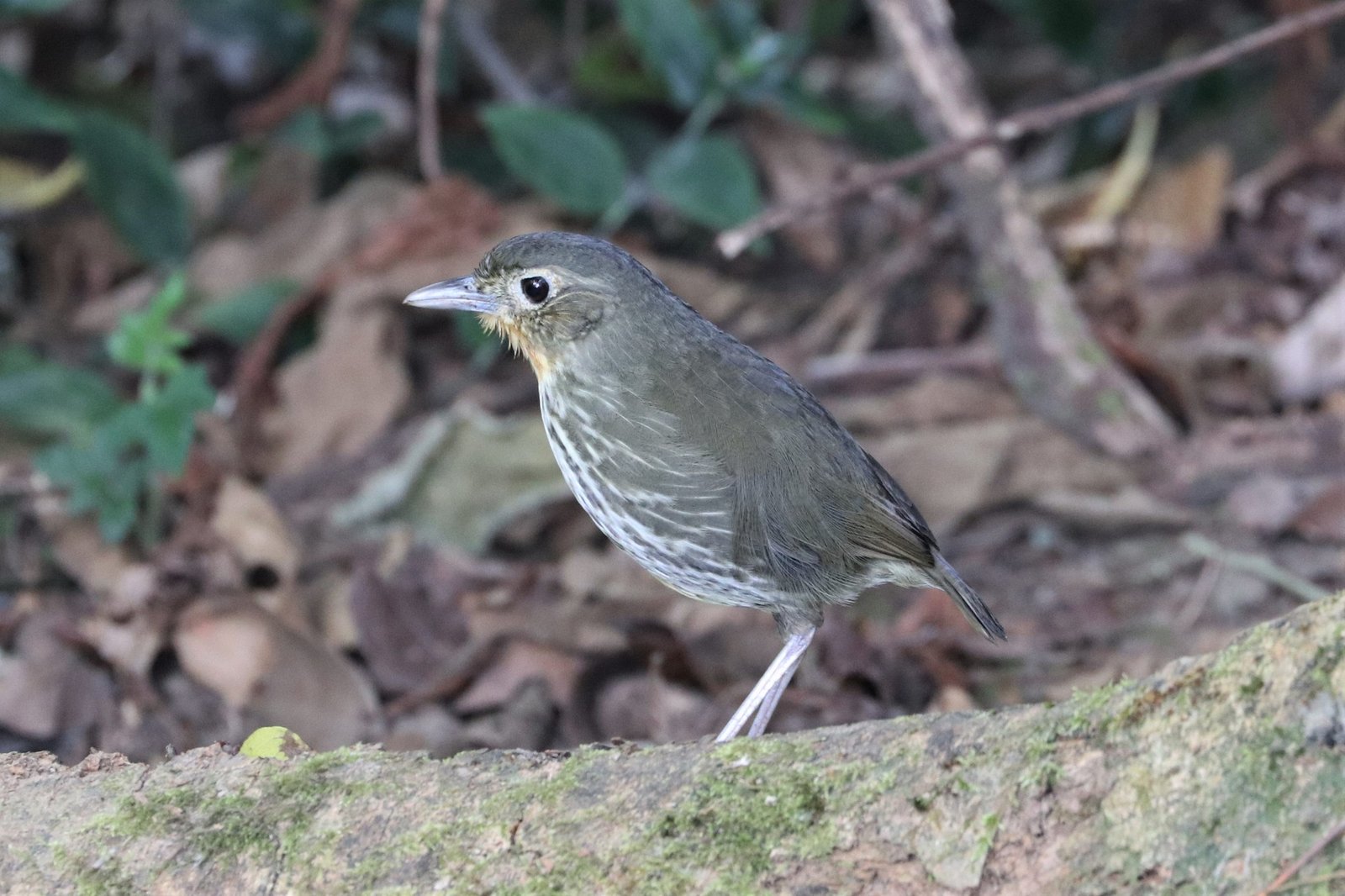
The Santa Marta Antpitta is an olive-brown antpitta with heavily streaked underparts that lives only in the Sierra Nevada de Santa Marta in Colombia. It is the only streaked Grallaria of this isolated massif and is related to the Cundinamarca Antpitta of the Eastern Andes. Unlike many antpittas it also uses forest edges and roadsides.
Voice
The song consists of two or three whistled notes, the last bending upwards as in a question. The call is a single squeaky, rising queet.
Recording: Iván Lau — CC BY-NC-SA 4.0 · xeno-canto
Identification
17–18 cm, round and short-tailed, on long leaden-grey legs. The crown, nape and upperparts are dark olive-brown, the wings and tail slightly browner. The face is olive-brown with white streaks, with pale lores and a narrow buff eye-ring. The throat is deep buff; the rest of the underparts is whitish with broad dark olive-brown streaks. The bill is bluish grey. The sexes are alike.
Confusion species
Sierra Nevada Antpitta Grallaria spatiator lives in the same massif but higher up, and is plain rufous-brown without streaks. Rusty-breasted Antpitta Grallaricula ferrugineipectus is much smaller, with a rusty, unstreaked breast and a pale spot in front of the eye. Cundinamarca Antpitta Grallaria kaestneri is very similar to this species, but lives far away in the Eastern Andes.
Habitat
The floor and understorey of humid cloud forest and mature secondary forest, roughly between 1200 and 2500 m, mostly above 1600 m. It uses both the forest interior and edges, clearings and roadsides. On the ground it mainly takes earthworms, as well as arthropods, seeds and sometimes frogs. It probably breeds from September to January; little is known about the nest.
Where the bird is most at home, classified by the vegetation units of the Andes and the west coast.


Range and movements
In Colombia only in the Sierra Nevada de Santa Marta. Absent from Ecuador, Peru, Bolivia and the Galápagos. Does not occur outside the guide area.
- Resident
- dark = core range, pale = thinly spread
How and when to look
Walk early in the morning along the roads and trails through cloud forest on the north-western slope of the Sierra Nevada, such as above Minca towards the San Lorenzo ridge. Birds there sometimes hop openly across the road or verge; listen for the short, questioning whistles.
Conservation status
Vulnerable. The range is small and the population is declining because forest is cut, burned and converted to farmland, also inside the national park. Within its range the species is locally common.
Scientific name
Grallaria bangsi | Allen, 1900
Allen described the species in 1900 and placed it straight away in the genus where it still stands. The genus Grallaria was introduced in 1816 by Vieillot. The genus name comes from New Latin grallarius, 'stilt-walker', referring to the long legs. The species name honours Outram Bangs (1863–1932), American zoologist and curator of birds at the Museum of Comparative Zoology, Harvard. The specimen the first description was based on came from El Líbano, Sierra Nevada de Santa Marta, Colombia.