All species › Passerines › Ovenbirds and woodcreepers › Scale-throated Earthcreeper
Scale-throated Earthcreeper | Upucerthia dumetaria
Schubkeelaardkruiper | Bandurrita común | Bandurrita-de-garganta-escamosa
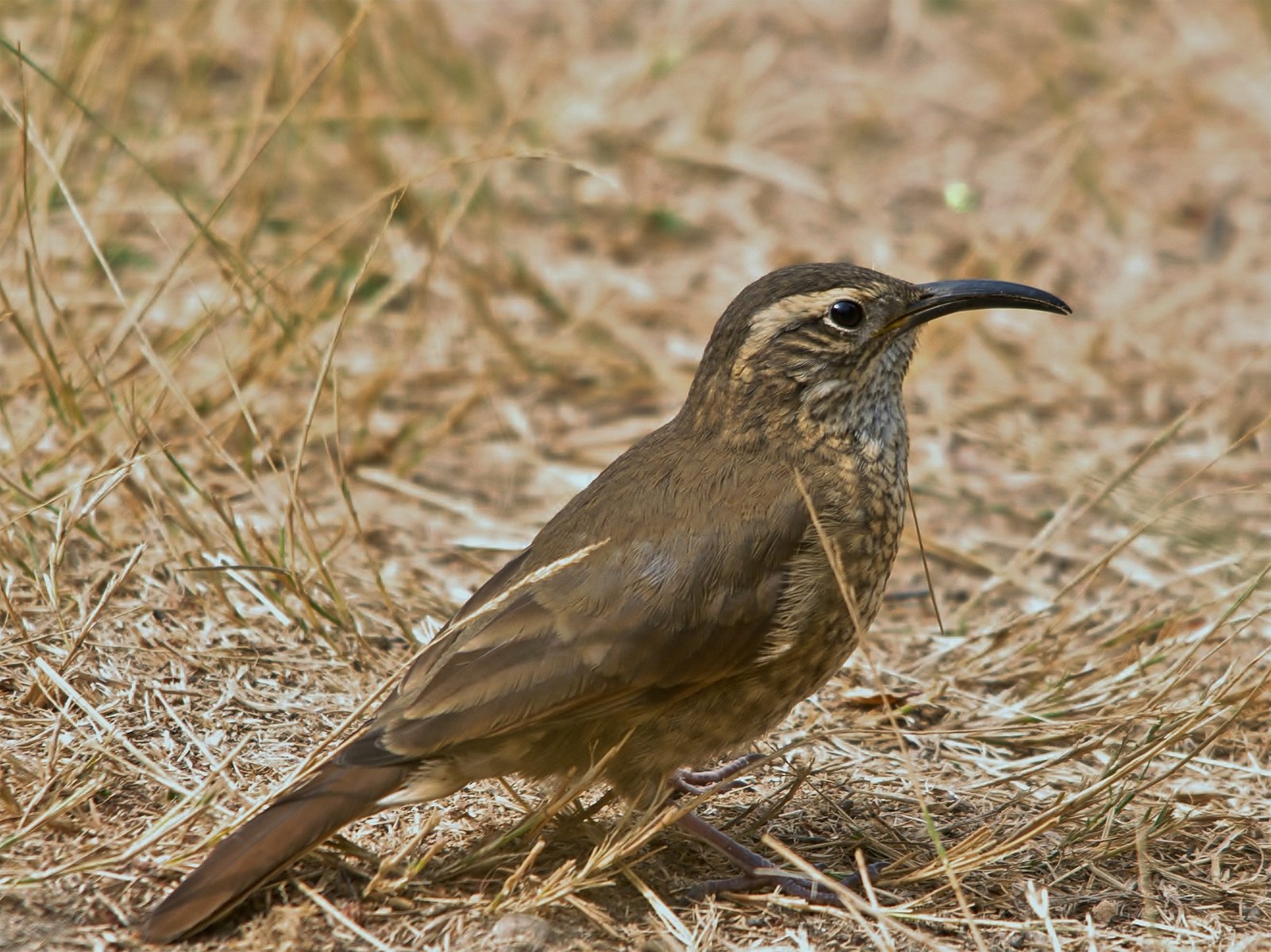
The Scale-throated Earthcreeper is a large, greyish-brown earthcreeper with a long, strongly decurved bill, found over much of southern South America. In the guide area it reaches its northern limit on the altiplano and in the dry Andean valleys of Bolivia and the far south of Peru. The name refers to the scaly pattern on the throat and breast.
Voice
The song is a series of rapid, harsh notes running into a trill, from a bush or rock. The call is a short, sharp cheep.
Recording: Cristian Pinto — CC BY-NC-SA 4.0 · xeno-canto
Identification
21–23 cm, with a long, strongly decurved bill. The upperparts are greyish brown, the tail dark brown with paler outer feathers. A pale supercilium. The throat and breast are whitish with dark scaling, the belly pale buff. In flight a rufous wing band is visible. The sexes are alike.
Confusion species
Buff-breasted Earthcreeper Upucerthia validirostris has a buff, unscaled breast and a more rufous tail. White-throated Earthcreeper Upucerthia albigula of southern Peru has a clean white throat and a rufous rump and tail. Miners (Geositta) have a shorter bill and a shorter tail.
Habitat
Dry scrub, puna with scattered shrubs, rocky slopes and field edges, in the guide area mostly between 2500 and 4000 m. It forages on the ground beneath shrubs for insects and larvae, probing the soil with its long bill. The nest is at the end of a self-dug tunnel in a bank.
Where the bird is most at home, classified by the vegetation units of the Andes and the west coast.


Range and movements
Absent from Colombia, Ecuador and the Galápagos. Peru: only in the far south. Bolivia: in the Andes and on the altiplano from La Paz and Oruro south to Potosí and Tarija. Outside the guide area in Chile and Argentina, south to Tierra del Fuego.
- Resident
- dark = core range, pale = thinly spread
How and when to look
Walk along shrubby slopes on the Bolivian altiplano and in the dry valleys of the south; the bird often runs between bushes and hops onto a rock when disturbed.
Conservation status
Least Concern. Overgrazing locally degrades the shrub vegetation.
Scientific name
Upucerthia dumetaria | Geoffroy Saint-Hilaire, 1832
Geoffroy Saint-Hilaire described the species in 1832 and placed it straight away in the genus where it still stands. He introduced the genus Upucerthia in that same work. The genus name is a blend of the genus names Upupa (hoopoes) and Certhia (treecreepers). The species name comes from Latin dumetum 'thicket', meaning 'of thickets', after the habitat. The specimen the first description was based on came from Río Negro, Patagonia, Argentina.