All species › Passerines › Ovenbirds and woodcreepers › White-throated Earthcreeper
White-throated Earthcreeper | Upucerthia albigula
Witkeelaardkruiper | Bandurrita de Arica | Bandurrita-de-garganta-branca
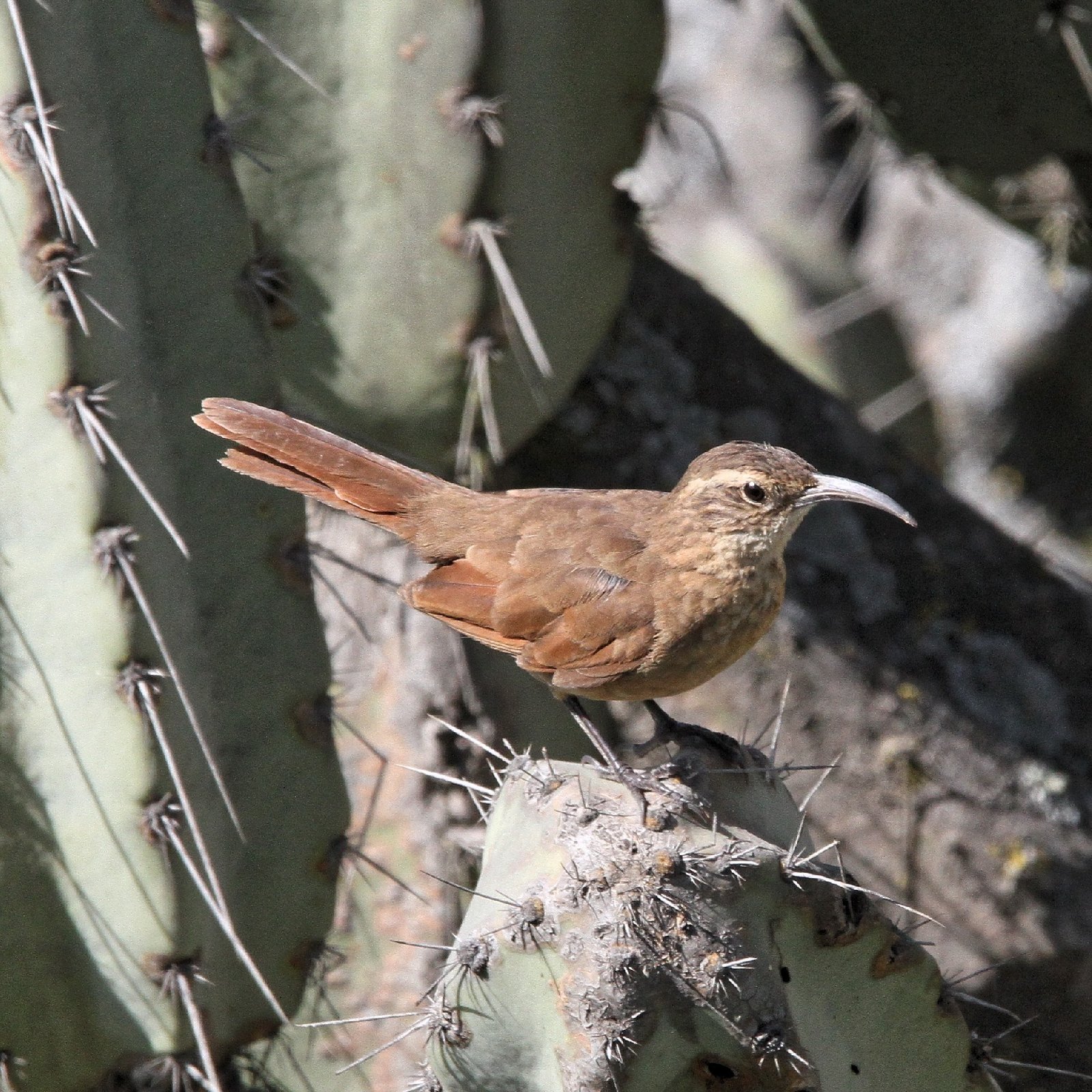
The White-throated Earthcreeper is a grey-brown earthcreeper with a long, decurved bill of dry mountain slopes on the Pacific side of the southern Andes. Its small range lies in south-western Peru and the far north of Chile. It forages on the ground, probing with its bill into the soil and under stones.
Voice
The song is a series of fast, loud notes that accelerate, often given from a rock or shrub. It also gives short, sharp calls.
Recording: Niels Krabbe — CC BY-NC-SA 3.0 · xeno-canto
Identification
19–20 cm, with a long, distinctly decurved, dark bill and a fairly long tail. The upperparts are plain grey-brown, with a pale eyebrow. The throat is pure white and contrasts with the grey to grey-brown breast; the belly is paler, the flanks and undertail coverts browner. Rump and tail are rufous. The sexes are alike.
Confusion species
Scale-throated Earthcreeper Upucerthia dumetaria has a scaled throat and breast and a less rufous tail. Buff-breasted Earthcreeper Upucerthia validirostris has a buffy throat and breast without a contrasting white throat and usually lives higher, in the puna. Straight-billed Earthcreeper Ochetorhynchus ruficaudus has a straight bill.
Habitat
Dry scrub with cacti and scattered shrubs on steep, rocky slopes and in ravines on the western slope of the Andes, roughly between 2500 and 4000 m, also along the edges of terraces and fields. It searches the ground for insects and other invertebrates. The nest is placed in a burrow in an earth bank or in a rock crevice.
Where the bird is most at home, classified by the vegetation units of the Andes and the west coast.


Range and movements
Peru: only on the Pacific side of the Andes in the south-west, from Arequipa through Moquegua to Tacna. Absent from Colombia, Ecuador, Bolivia and the Galápagos. Outside the guide area in the far north of Chile (Arica).
- Resident
- dark = core range, pale = thinly spread
How and when to look
Search shrubby, rocky slopes along the roads that climb into the Andes from Tacna, Moquegua and Arequipa. In the early morning the bird sings from a rock or the top of a shrub.
Conservation status
Least Concern. The range is small, but the species occurs regularly in suitable scrub.
Scientific name
Upucerthia albigula | Hellmayr, 1932
Hellmayr described the species in 1932 and placed it straight away in the genus where it still stands. The genus Upucerthia was introduced in 1832 by Geoffroy Saint-Hilaire. The genus name is a blend of the genus names Upupa (hoopoes) and Certhia (treecreepers). The species name comes from Latin albus 'white' and gula 'throat', after the white throat. The specimen the first description was based on came from Putre, Arica y Parinacota, Chile.