All species › Passerines › Ovenbirds and woodcreepers › Buff-breasted Earthcreeper
Buff-breasted Earthcreeper | Upucerthia validirostris
Bruinborstaardkruiper | Bandurrita andina | Bandurrita-de-peito-ocráceo
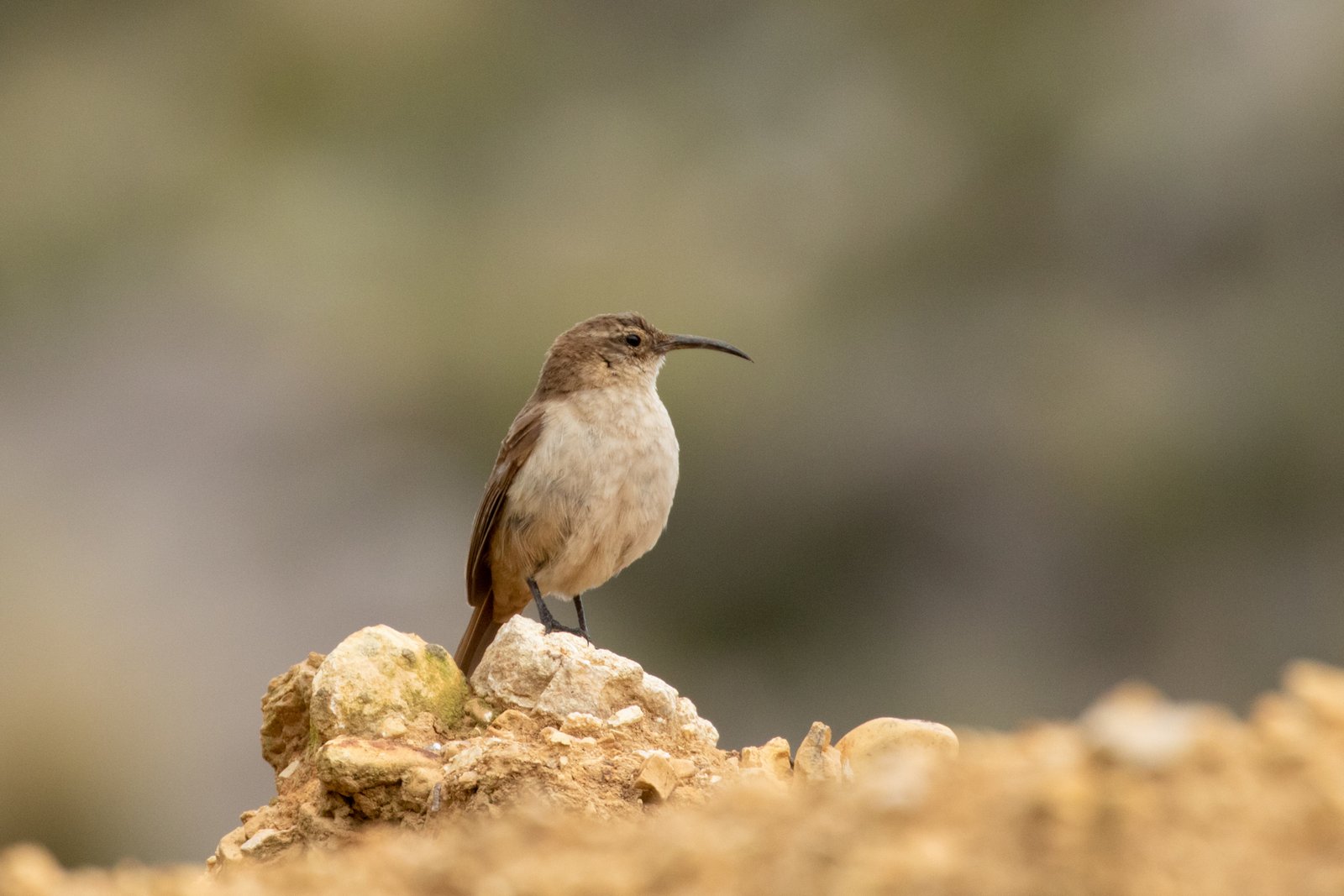
The Buff-breasted Earthcreeper is an earthcreeper of the high plains and slopes of the puna in the central and southern Andes. With its long, decurved bill it probes the ground between grass tussocks, shrubs and stones. The birds of Peru and Bolivia were formerly treated as a separate species.
Voice
The song is a fast, dry series of notes that accelerates and sometimes fades away, often given from a rock or shrub. It gives short, sharp calls.
Recording: Nick Athanas — CC BY-NC-SA 3.0 · xeno-canto
Identification
18–20 cm, with a long, decurved bill and a fairly long tail. The upperparts are plain grey-brown, with a pale buff eyebrow. Throat and underparts are almost unmarked pale buff to ochre, the throat slightly paler. The tail is brown, with rufous outer feathers. The sexes are alike.
Confusion species
Scale-throated Earthcreeper Upucerthia dumetaria has a scaled throat and breast. White-throated Earthcreeper Upucerthia albigula has a pure white throat and a greyer breast and lives lower, on the Pacific side of southern Peru. Striated Earthcreeper Geocerthia serrana has streaked underparts. Common Miner Geositta cunicularia has a shorter bill and a shorter tail.
Habitat
Grassland with shrubs, rocky slopes and field edges in the puna and on the upper slopes of dry Andean valleys, roughly between 3000 and 4600 m. It walks on the ground and probes the soil with its bill for insects and larvae. The nest is at the end of a burrow in an earth bank or among stones.
Where the bird is most at home, classified by the vegetation units of the Andes and the west coast.


Range and movements
Peru: in the Andes from the north-centre (from about La Libertad and Ancash) south to Puno and Tacna. Bolivia: in the western Andes and on the altiplano, from La Paz to Potosí. Absent from Colombia, Ecuador and the Galápagos. Outside the guide area in northern Chile and north-western Argentina.
- Resident
- dark = core range, pale = thinly spread
How and when to look
Walk through shrubby puna and along field edges above 3500 m, for example around Lake Titicaca. The bird often runs off between the shrubs and sings from a raised perch in the early morning.
Conservation status
Least Concern. The species is widespread and tolerates grazing and small-scale farming.
Scientific name
Upucerthia validirostris | (Burmeister, 1861)
Burmeister described the species in 1861 as Ochetorhynchus validirostris; because it was later moved to another genus, the author and year stand in brackets. The genus Upucerthia was introduced in 1832 by Geoffroy Saint-Hilaire. The genus name is a blend of the genus names Upupa (hoopoes) and Certhia (treecreepers). The species name comes from Latin validus 'strong' and rostrum 'bill', after the stout bill. The specimen the first description was based on came from Sierra de Mendoza, Argentina.