All species › Passerines › Ovenbirds and woodcreepers › Henna-hooded Foliage-Gleaner
Henna-hooded Foliage-Gleaner | Clibanornis erythrocephalus
Hennakapbladspeurder | Rascahojas capuchirrufo | Barranqueiro-de-capuz-ruivo
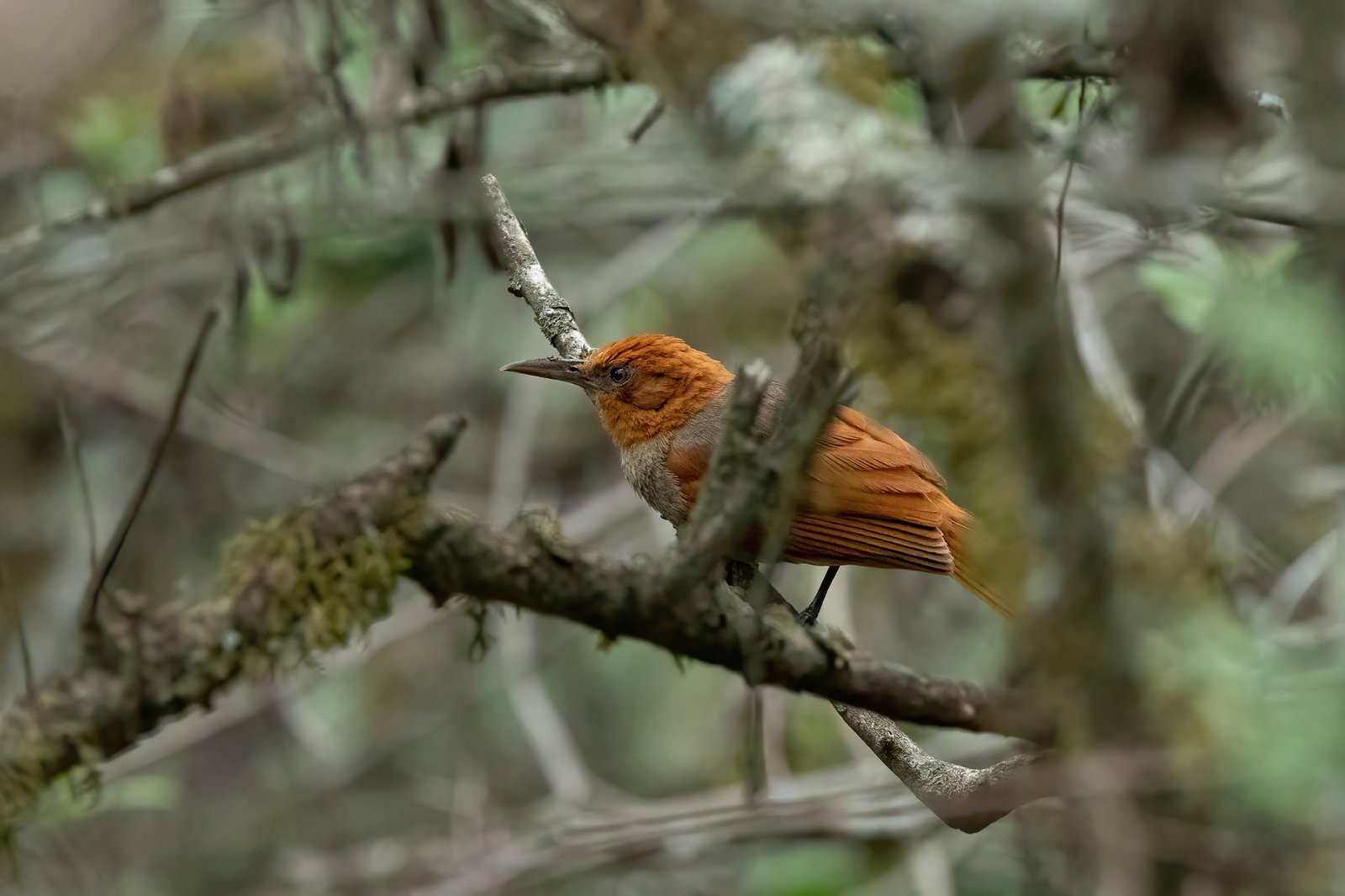
The Henna-hooded Foliage-Gleaner is a robust foliage-gleaner of the dry and semi-humid forests of south-western Ecuador and north-western Peru, with a rusty orange head and neck. It lives in the undergrowth and on the ground, where it turns over leaf litter. Its persistent, rattling song carries far through the forest.
Voice
A far-carrying, persistent, staccato rattling song, often in duet. The call is a short, sharp, high note.
Recording: Lelis Navarrete — CC BY-NC-SA 4.0 · xeno-canto
Identification
21–22 cm, with a fairly long, straight, pale bill. The head and neck are bright rusty orange, like henna, forming a hood. The back is brownish olive, and the wings and tail are rufous. The underparts are pale brownish grey. The sexes are alike. Birds in Piura and Lambayeque are paler rufous, with a greyer back and buff breast and belly.
Confusion species
Ruddy Foliage-Gleaner Clibanornis rubiginosus is dark rufous-brown throughout, without a contrasting hood, and lives in wetter forest. Rufous-necked Foliage-Gleaner Syndactyla ruficollis shares the same area, but has only a rufous neck and supercilium, a pale streaked breast and an upturned bill.
Habitat
Deciduous and semi-humid forest on the lower western slope of the Andes, especially where mallows (Malvaceae) are numerous, also in wooded ravines and older secondary forest, from 400 to about 1800 m. It forages on and just above the ground, turning over leaf litter with its bill in search of insects. It breeds from January to May; both adults dig a tunnel in a shaded earthen bank ending in a chamber lined with rootlets and fibres.
Where the bird is most at home, classified by the vegetation units of the Andes and the west coast.


Range and movements
Ecuador: the south-west, from Manabí and Guayas to Azuay, El Oro and Loja. Peru: the north-west, in Tumbes, Piura and Lambayeque. Absent from Colombia, Bolivia and the Galápagos. Does not occur outside the guide area.
- Resident
- dark = core range, pale = thinly spread
How and when to look
Search dry and semi-humid forest on the lower western slope, especially in the rainy season from January to May, when the birds sing most. Listen for the rattling duet from the undergrowth and wait for movement in the leaf litter.
Conservation status
Near Threatened. The population is estimated at 2500 to 10,000 mature individuals and is declining because of clearing, illegal settlement and grazing of the undergrowth by livestock, also inside protected areas.
Scientific name
Clibanornis erythrocephalus | (Chapman, 1919) (GBIF: Hylocryptus erythrocephalus)
Chapman described the species in 1919 as Hylocryptus erythrocephalus; because it was later moved to another genus, the author and year stand in brackets. The genus Clibanornis was introduced in 1873 by Sclater & Salvin. The genus name comes from Greek klibanos, 'oven', and ornis, 'bird', referring to its relationship with the ovenbirds (Furnarius). The species name comes from Greek eruthros, 'red', and kephalē, 'head', referring to the rufous head. The specimen the first description was based on came from Alamor, Loja, Ecuador.