All species › Passerines › Ovenbirds and woodcreepers › Ruddy Foliage-Gleaner
Ruddy Foliage-Gleaner | Clibanornis rubiginosus
Rosse bladspeurder | Breñero rojizo | Barranqueiro-ferrugem
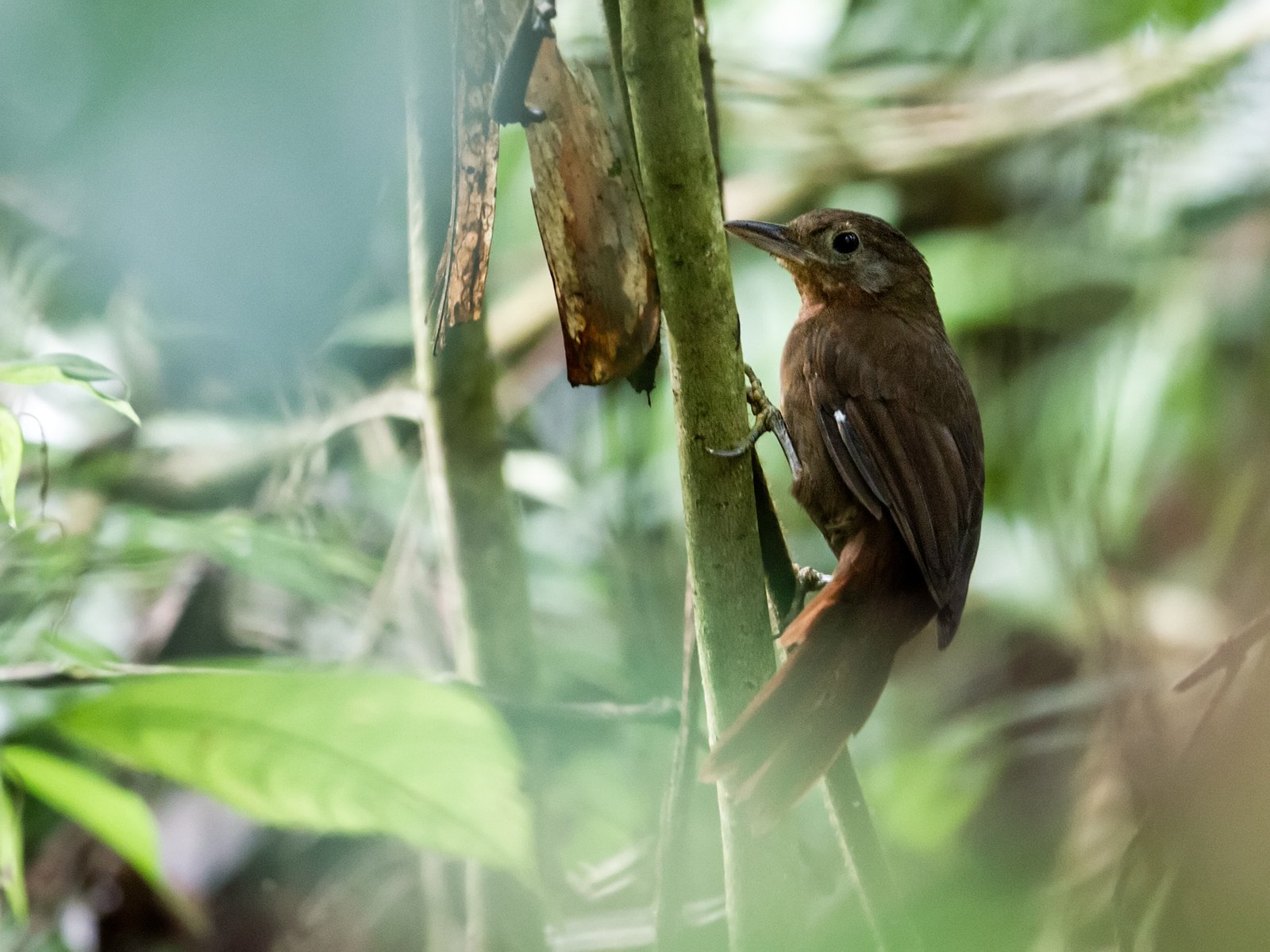
The Ruddy Foliage-Gleaner is a dark rufous-brown foliage-gleaner of the dense undergrowth of humid forest, from Mexico to Bolivia. It keeps hidden in ravines and thick vegetation and is heard far more often than seen. Across its large range, plumage and voice vary strongly by region.
Voice
The call varies by region. In the Andes of Ecuador a persistently repeated, querulous and nasal, upslurred kweeeeahh; in Colombia a repeated, sneering croak reminiscent of an antbird.
Recording: Juan Freile — CC BY-NC-SA 4.0 · xeno-canto
Identification
19–20 cm, with a straight, fairly stout, dark bill. The plumage is mostly dark rufous-brown to chestnut, with a brighter rusty throat and breast. The tail is dark chestnut, almost black in birds of western Colombia and Ecuador. The crown and back are often slightly darker and more olive than the underparts. The sexes are alike.
Confusion species
Henna-hooded Foliage-Gleaner Clibanornis erythrocephalus has a bright rusty orange hood contrasting with an olive-brown back and greyish underparts, and lives in drier forest in the south-west. Ochre-throated Foliage-Gleaner Automolus ochrolaemus is paler brown, with a pale throat and eye-ring. Tawny-throated Leaftosser Sclerurus mexicanus has a shorter tail and a slimmer, slightly decurved bill and lives on the ground. The treehunters Thripadectes are streaked.
Habitat
The undergrowth of humid evergreen lowland, foothill and lower montane forest, roughly up to 1500 m, locally higher; it favours densely vegetated ravine bottoms. It usually forages in pairs low in the vegetation, rarely in mixed-species flocks, searching leaf litter and dead leaves for insects and other arthropods. The nest is a cup of soft fibres at the end of a tunnel in an earthen bank.
Where the bird is most at home, classified by the vegetation units of the Andes and the west coast.


Range and movements
Colombia: the Pacific slope and the Serranía del Baudó, the north-west, the western slope of the Eastern Andes and the eastern foothills. Ecuador: the west and the eastern foothills. Peru: the far north-west (Tumbes) and the eastern Andean slope and adjacent lowlands along the whole length. Bolivia: only western La Paz. Absent from the Galápagos. Outside the guide area from Mexico through Central America to Venezuela, the Guianas and western Brazil.
- Resident
- dark = core range, pale = thinly spread
How and when to look
In the morning listen in forested ravines for the nasal, rising call and wait quietly near dense vegetation; the birds often come close but stay low and in the shade.
Conservation status
Least Concern. The species is widespread, but disappears where the forest undergrowth is cleared or trampled by livestock.
Scientific name
Clibanornis rubiginosus | (Sclater, 1857) (GBIF: Automolus rubiginosus)
Sclater described the species in 1857 as Anabates rubiginosus; because it was later moved to another genus, the author and year stand in brackets. The genus Clibanornis was introduced in 1873 by Sclater & Salvin. The genus name comes from Greek klibanos, 'oven', and ornis, 'bird', referring to its relationship with the ovenbirds (Furnarius). The species name comes from Latin rubiginosus, 'rusty'. The specimen the first description was based on came from Córdoba, Veracruz, Mexico.