All species › Woodpeckers and allies › New World barbets › Scarlet-crowned Barbet
Scarlet-crowned Barbet | Capito aurovirens
Roodkruinbaardvogel | Cabezón oliva | Capitão-de-coroa
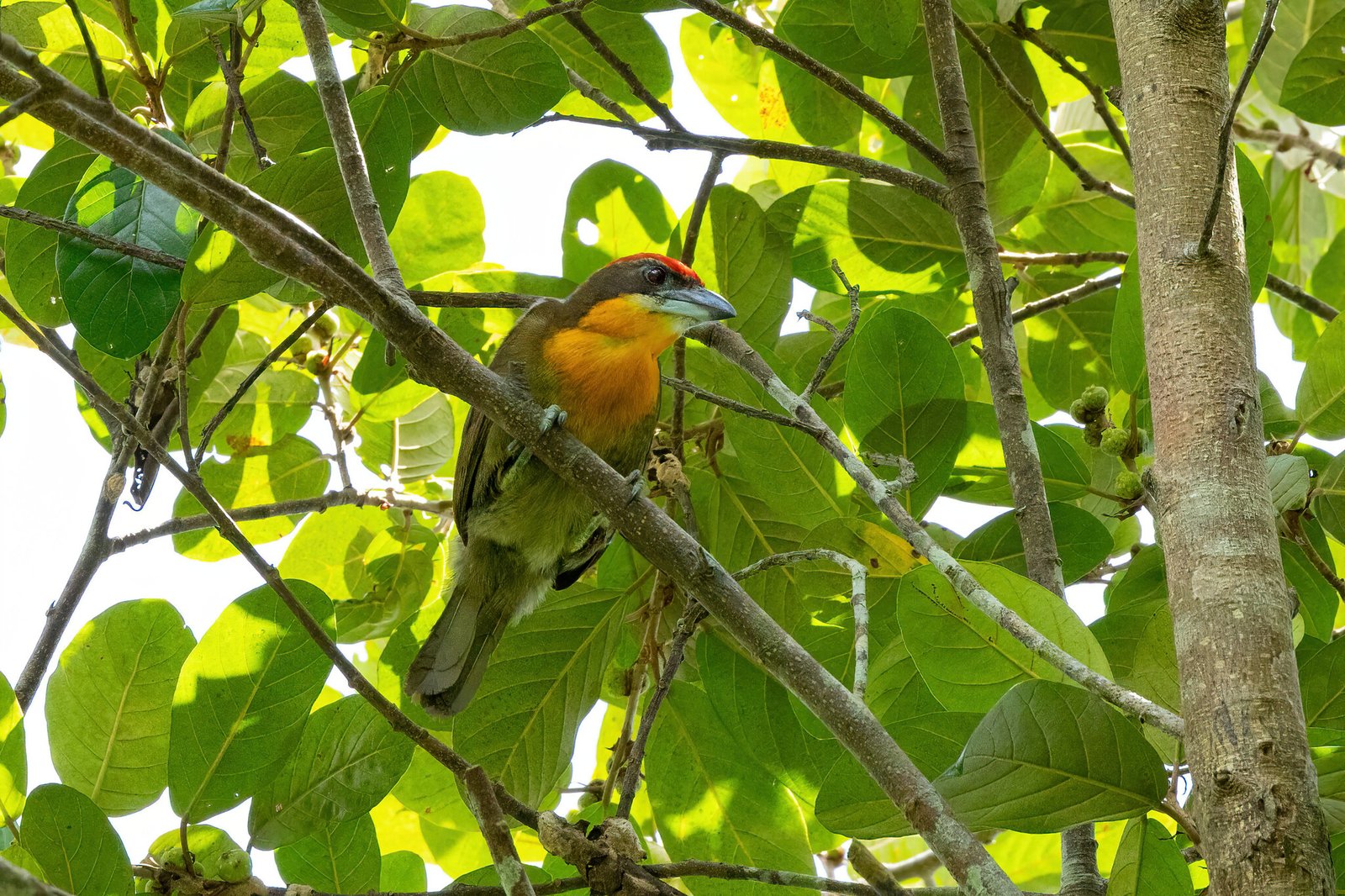
The Scarlet-crowned Barbet is a large, dark barbet of flooded forest along the rivers of the western Amazon basin. In colour it differs from the other Capito species: olive-brown above, without black. The male has a red crown, the female a whitish one.
Voice
A series of low, frog-like, croaking notes, often in duet, and a hoarse rattle.
Recording: Mauricio Cuellar Ramirez (@Birding.travel) — CC BY-NC-SA 4.0 · xeno-canto
Identification
19 cm, robust, with a heavy, conical, greyish bill. The upperparts are dark olive-brown, the throat and breast orange to orange-yellow, the belly olive-brown. The male has a scarlet crown and nape; in the female the crown and nape are whitish to pale grey. Juveniles are duller, with less orange on the breast.
Confusion species
Gilded Barbet Capito auratus has black upperparts with yellow streaks, an orange to yellow throat and spotted flanks, and lives more in terra firme forest. Lemon-throated Barbet Eubucco richardsoni is smaller and green above, with a black or blue-grey face.
Habitat
Várzea forest, forest on river islands and along oxbow lakes, swamp forest and forest edges along rivers, in the lowlands up to about 400 m; rarely in terra firme forest. It eats mainly fruit and also insects, in the middle and upper canopy, sometimes with mixed flocks. It nests in a cavity in dead wood.
Where the bird is most at home, classified by the vegetation units of the Andes and the west coast.


Range and movements
In Colombia in the south-east (Putumayo and Amazonas, along the large rivers). In Ecuador in the eastern lowlands along the Napo, the Aguarico and other rivers. In Peru in the north-eastern lowlands, along the Amazon, the Marañón, the Ucayali and their tributaries, south to about Ucayali. Absent from Bolivia and the Galápagos. Outside the guide area in western Brazil along the Solimões.
- Resident
- dark = core range, pale = thinly spread
How and when to look
Search várzea forest and river islands along the Napo and the Amazon, for example around Iquitos and at the lodges along the Napo; boat trips along banks and islands often give views of the treetops.
Conservation status
Least Concern. The species is fairly common in suitable flooded forest; logging and clearance along the rivers are local threats.
Scientific name
Capito aurovirens | (Cuvier, GLCFD, 1829)
Cuvier, GLCFD described the species in 1829 as Bucco aurovirens; because it was later moved to another genus, the author and year stand in brackets. The genus Capito was introduced in 1816 by Vieillot. The genus name comes from Latin capito, 'big-headed'. The species name combines Latin aurum, 'gold', with virens, 'green', meaning 'golden-green'. The specimen the first description was based on came from Peru.