All species › Woodpeckers and allies › New World barbets › Versicolored Barbet
Versicolored Barbet | Eubucco versicolor
Bonte baardvogel | Cabezón versicolor | Capitão-versicolor
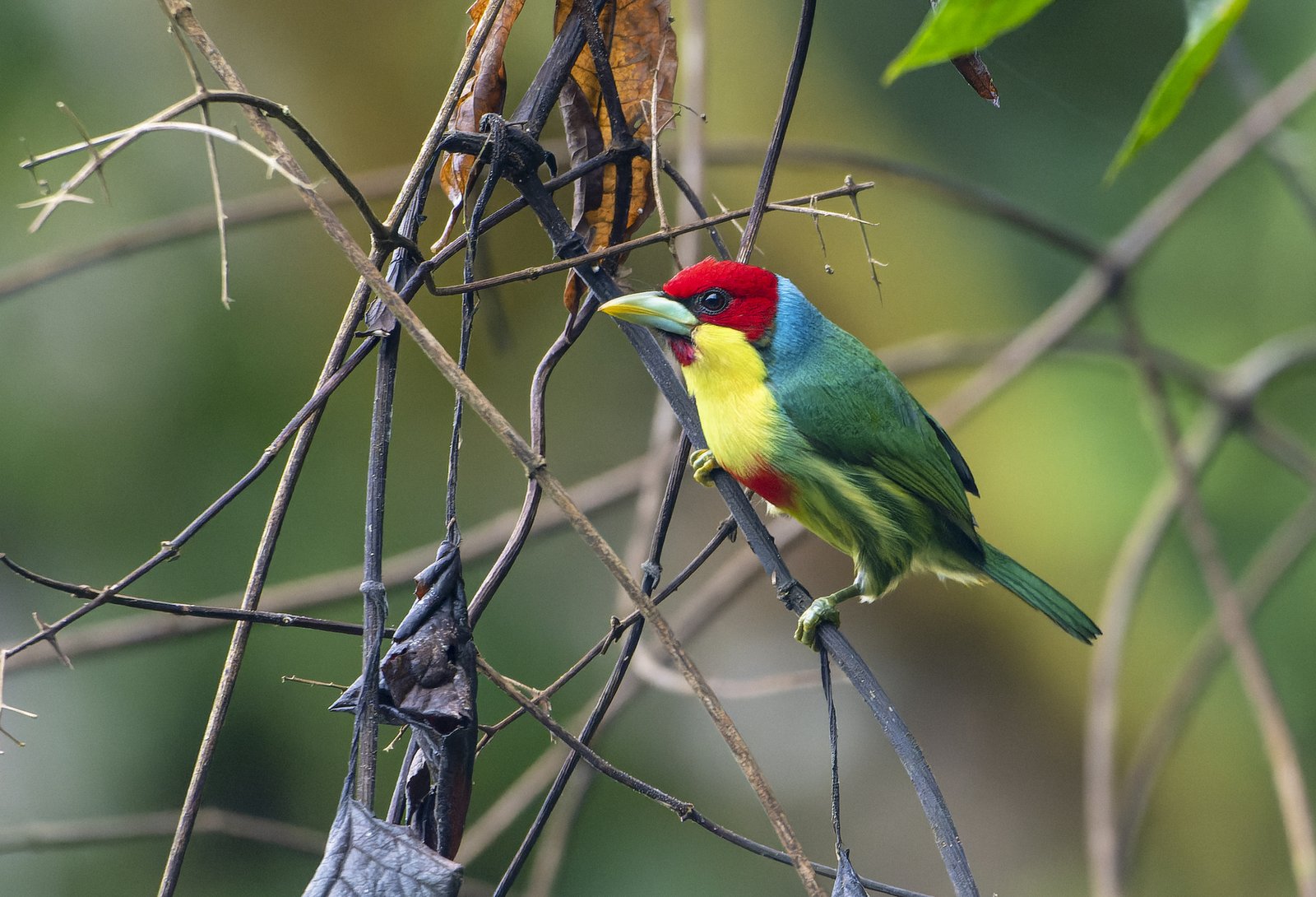
The Versicolored Barbet is the barbet of the montane forests on the eastern slope of the Andes in Peru and Bolivia, where it replaces Red-headed Barbet. The male combines red, blue, yellow and green, and the pattern of the head and breast differs between subspecies. Like its relatives it searches dead leaves for insects.
Voice
Rather quiet. The song is a soft, low, frog-like trill; also hoarse calls.
Recording: Jacob Wijpkema — CC BY-NC-SA 4.0 · xeno-canto
Identification
16 cm, stocky, with a thick, pale, yellowish-green bill. The male has a red crown and throat, blue on the cheeks and hindneck and a yellow or red band below the throat; the upperparts are green and the belly is yellowish green with green streaks on the flanks. The female has a green crown, blue cheeks, a blue-grey to yellowish throat and less red. Juveniles resemble the female. The subspecies differ in the distribution of red, blue and yellow on the head and breast.
Confusion species
Red-headed Barbet Eubucco bourcierii lives further north; the male has an all-red head and breast without blue. Lemon-throated Barbet Eubucco richardsoni lives lower, in the lowlands; the male has a black face and a lemon-yellow throat. Scarlet-hooded Barbet Eubucco tucinkae lives in riverine forest in the lowlands; the male has an all-red head and a yellow nape band.
Habitat
Humid montane forest and cloud forest on the eastern slope, forest edges and tall secondary forest, mostly between 1000 and 2500 m. It forages in the middle and upper canopy in mixed flocks, pulling insects and spiders from dead leaves; it also eats fruit. It nests in a cavity in dead wood.
Where the bird is most at home, classified by the vegetation units of the Andes and the west coast.


Range and movements
In Peru on the eastern slope of the Andes, from the central part of the country south to Puno. In Bolivia on the eastern slope in La Paz, Cochabamba and western Santa Cruz. Absent from Colombia, Ecuador and the Galápagos. Does not occur outside the guide area.
- Resident
- dark = core range, pale = thinly spread
How and when to look
Follow mixed flocks along forest roads in montane forest, for example along the Manu road in Peru or in the Yungas above Coroico in Bolivia. Watch for birds working into dead-leaf clusters.
Conservation status
Not evaluated in its current circumscription. The species has a fairly large range in intact montane forest and appears fairly common locally; deforestation on the eastern slope is the main threat.
Scientific name
Eubucco versicolor | (Müller, 1776)
Müller described the species in 1776 as Bucco versicolor; because it was later moved to another genus, the author and year stand in brackets. The genus Eubucco was introduced in 1850 by Bonaparte. The genus name combines Greek eu, 'good' or 'true', with the genus name Bucco (Latin bucca, 'cheek'). The species name comes from Latin versicolor, 'many-coloured' or 'changing colour'. The specimen the first description was based on came from Maynas, Loreto, Peru.