All species › Passerines › Tanagers and allies › Silver-backed Tanager
Silver-backed Tanager | Stilpnia viridicollis
Zilvertangare | Tangara dorsiplateada | Saíra-de-dorso-prateado
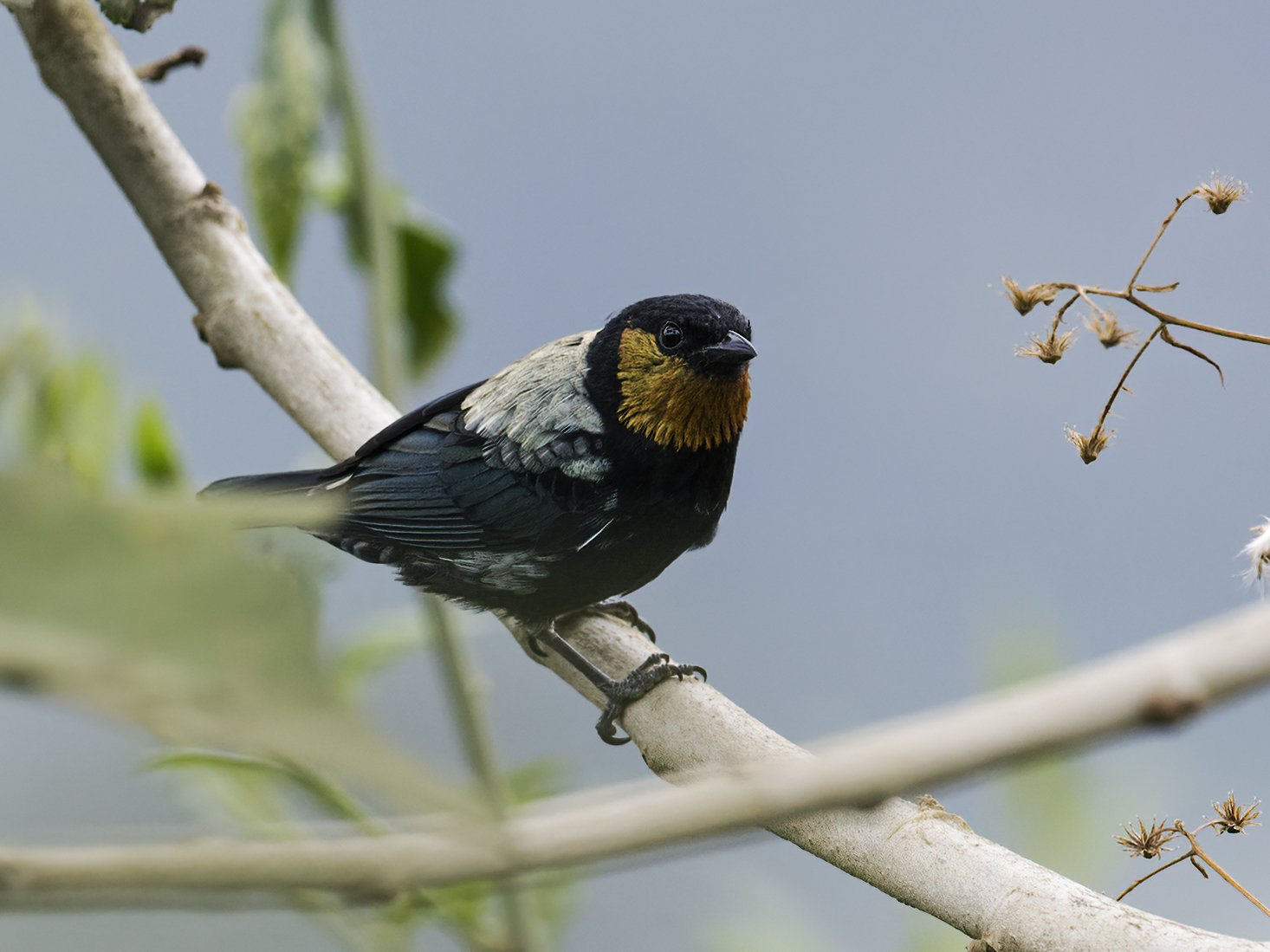
The Silver-backed Tanager is a tanager of the Andes of southern Ecuador and Peru; the male combines a silvery back with a black head and underparts and a golden-yellow to coppery throat. It lives at forest edges and in semi-open montane country, often in pairs.
Voice
The call is a high, sharp tsit; the song is a series of rapid, high chip notes.
Recording: Mitch Lysinger — CC BY-NC-SA 4.0 · xeno-canto
Identification
13 cm. Male: crown, face and underparts black; throat and an ear patch straw yellow to coppery brown; mantle and back silvery straw-grey with a greenish sheen. The wings and tail are black with green-blue edges. Female: greener, with a brownish-green crown, a yellowish-brown throat, green upperparts and greenish underparts. The bill is black. Juveniles resemble the female.
Confusion species
Straw-backed Tanager Stilpnia argyrofenges has a greenish straw-coloured back and throat and lives on the eastern slope of Peru and in Bolivia. Black-capped Tanager Stilpnia heinei has only a black crown and a silvery blue-green, streaked breast, with grey underparts. Blue-necked Tanager Stilpnia cyanicollis has a turquoise-blue head.
Habitat
Edges of humid and semi-humid montane forest, secondary growth, scrubby slopes with scattered trees and gardens, mainly from about 1500 to 3000 m, also in drier valleys. It eats small fruits and searches branches and leaves for insects, usually in pairs or small groups, sometimes with mixed flocks.
Where the bird is most at home, classified by the vegetation units of the Andes and the west coast.


Range and movements
In Ecuador in the south, in the provinces of Loja and Zamora-Chinchipe and adjacent areas. In Peru along the Andes, on both slopes and in the Marañón Valley, south to about Cuzco. Absent from Colombia, Bolivia and the Galápagos. Endemic to the guide area.
- Resident
- dark = core range, pale = thinly spread
How and when to look
Look at forest edges, in scrubby country and in gardens with fruiting trees in the mountains around Loja in Ecuador or in the Andean valleys of northern and central Peru; the birds often sit in the tops of isolated trees.
Conservation status
Least Concern. Locally fairly common and tolerant of altered, semi-open land.
Scientific name
Stilpnia viridicollis | (Taczanowski, 1884)
Taczanowski described the species in 1884 as Calliste argentea viridicollis; because it was later moved to another genus, the author and year stand in brackets. The genus Stilpnia was introduced in 2016 by Burns, Unitt & Mason. The genus name comes from Greek stilpnos, 'glittering' or 'glistening'. The specific name comes from Latin viridis, 'green', and collis, 'neck', referring to the greenish throat and neck. The specimen the first description was based on came from Huiro, Cuzco, Peru.