All species › Passerines › Tanagers and allies › Black-capped Tanager
Black-capped Tanager | Stilpnia heinei
Heines tangare | Tangara coroninegra | Saíra-de-boné-preto
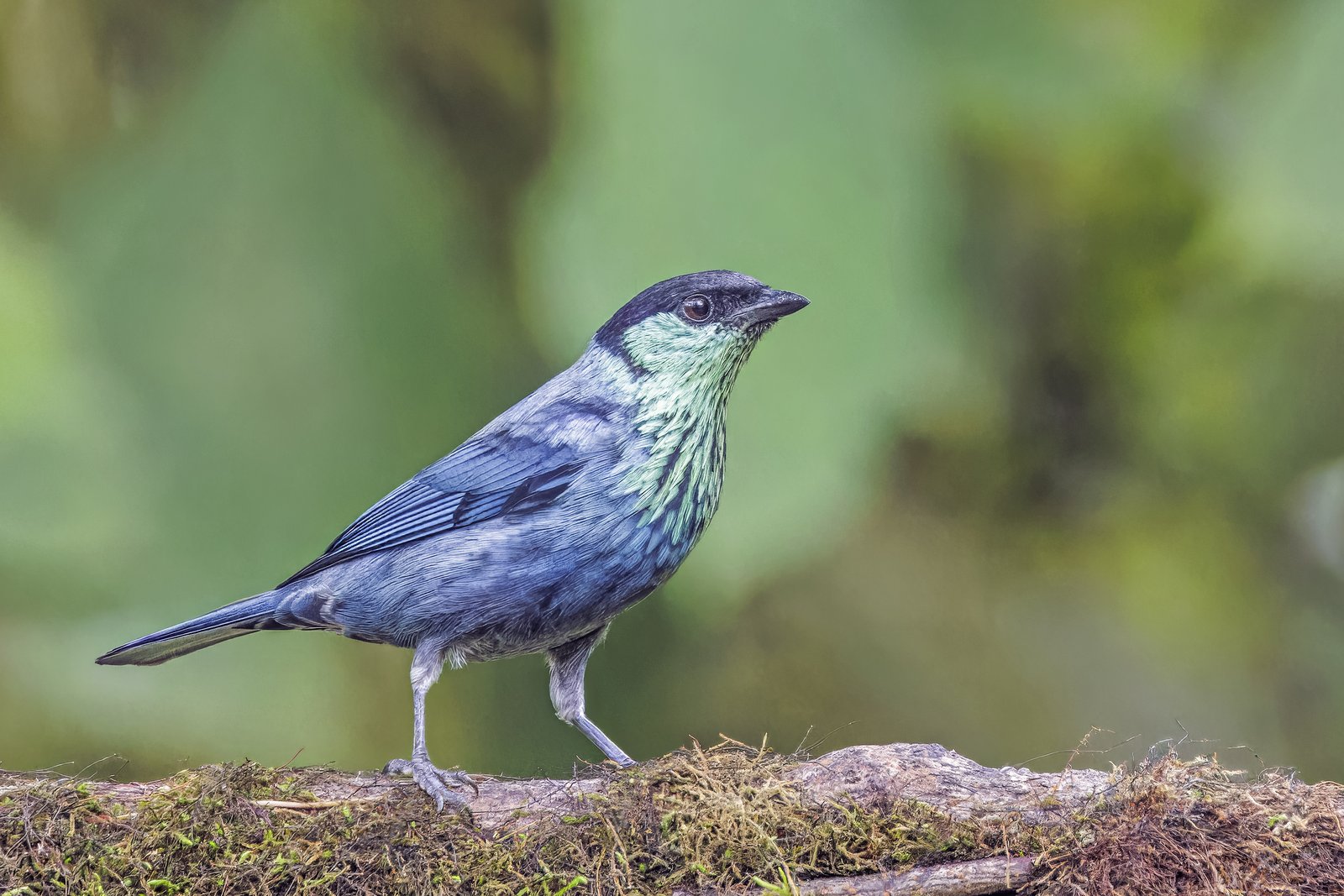
The Black-capped Tanager is a tanager of the northern Andes, from Venezuela and Colombia to the far north of Peru. The male has a black crown, a silvery blue-green, streaked throat and breast and a silvery-grey back. The species lives at forest edges and in semi-open country with trees, also around farms and in gardens.
Voice
The call is a sharp, high tsit; the song is a series of rapid, thin chip notes.
Recording: JUAN ANTONIO ALONSO DE JUAN — CC BY 4.0 · xeno-canto
Identification
13 cm. Male: crown and nape black; throat, cheeks and breast silvery blue-green with fine pale streaks; back silvery bluish grey; belly grey. The wings and tail are blackish with blue edges. Female: green above with a dull dark crown, the throat and breast greenish with pale streaks and the belly greyer. The bill is black. Juveniles resemble the female.
Confusion species
Black-headed Tanager Stilpnia cyanoptera has a full black hood and a pale opalescent body and in Colombia lives only in the north and northeast. Silver-backed Tanager Stilpnia viridicollis has a black head and underparts with a golden-yellow to coppery throat and lives further south. Scrub Tanager Stilpnia vitriolina has a rufous crown and a black mask.
Habitat
Edges of humid montane forest, open woodland, secondary growth, scrubby slopes with scattered trees, gardens and shaded coffee plantations, mainly from about 1000 to 2500 m. It eats small fruits and searches branches and leaves for insects, usually in pairs or small groups, sometimes in mixed flocks.
Where the bird is most at home, classified by the vegetation units of the Andes and the west coast.


Range and movements
In Colombia in all three Andean ranges, in the Serranía de Perijá and the Sierra Nevada de Santa Marta. In Ecuador on both slopes of the Andes and in the valleys between them, mainly in the north. In Peru only in the far north. Absent from Bolivia and the Galápagos. Outside the guide area in the Andes and coastal ranges of Venezuela.
- Resident
- dark = core range, pale = thinly spread
How and when to look
Look at forest edges, along mountain roads and in gardens with fruiting trees in the montane zone of Colombia and northern Ecuador; the birds often sit in the open at the top of an isolated tree.
Conservation status
Least Concern. Fairly widespread and locally fairly common; it tolerates semi-open and cultivated land.
Scientific name
Stilpnia heinei | (Cabanis, 1851)
Cabanis described the species in 1851 as P[rocnias] Heinei; because it was later moved to another genus, the author and year stand in brackets. The genus Stilpnia was introduced in 2016 by Burns, Unitt & Mason. The genus name comes from Greek stilpnos, 'glittering' or 'glistening'. The specific name honours Ferdinand Heine (1809–1894), a German collector whose bird collection (the Museum Heineanum in Halberstadt) was catalogued by Cabanis. The specimen the first description was based on came from Colombia.