All species › Passerines › Tanagers and allies › Straw-backed Tanager
Straw-backed Tanager | Stilpnia argyrofenges
Groenkeeltangare | Tangara dorsipajiza | Saíra-de-dorso-palha
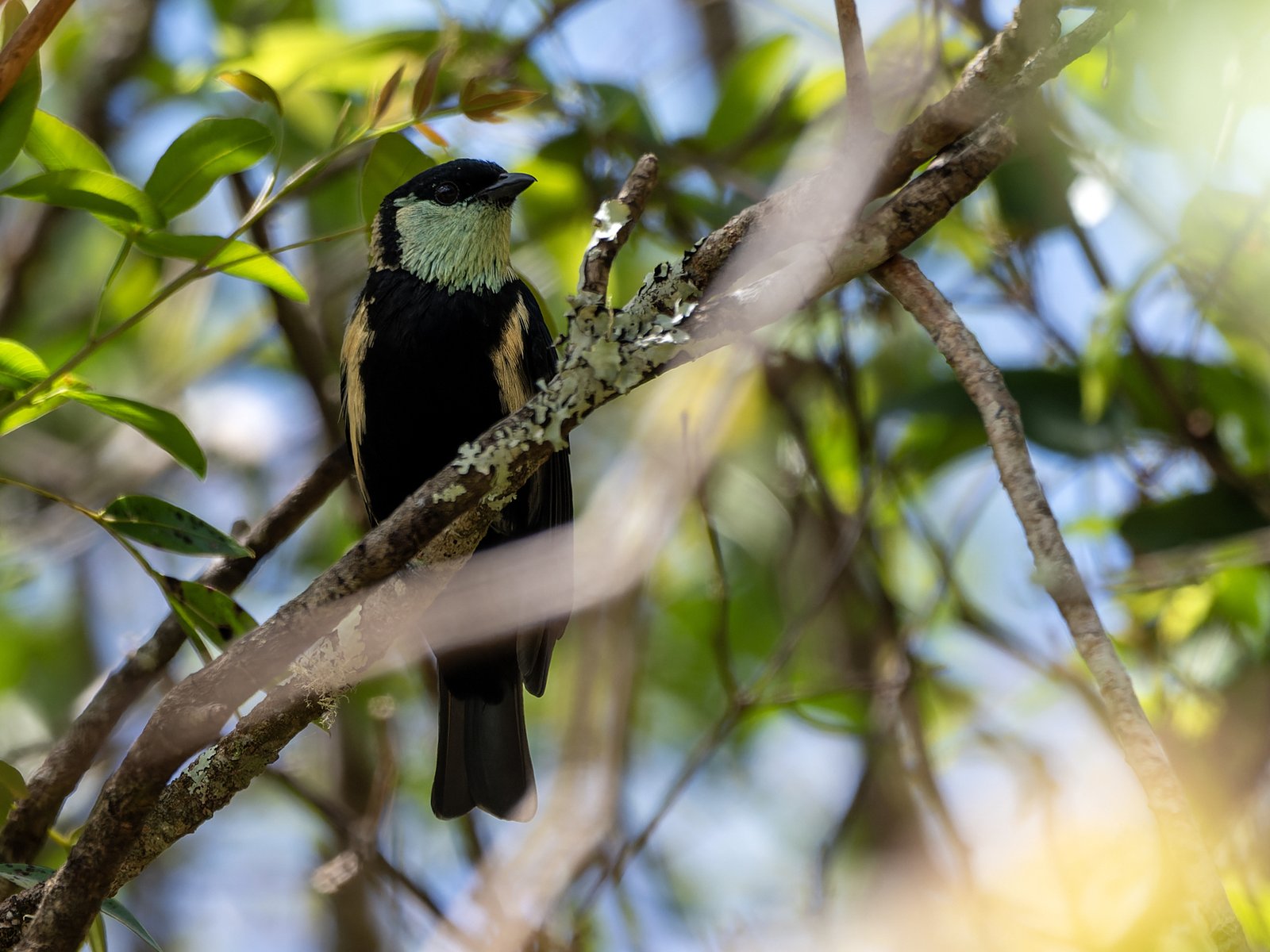
The Straw-backed Tanager is a small tanager of the eastern slope of the Andes in Peru and Bolivia, with a black head, a glistening green throat and a straw-coloured, silvery back. It is very locally distributed, in a few separate areas, and lives in pairs or small groups in the canopy of humid montane forest.
Voice
High, thin tseet calls and a soft, dry chipping; a distinct song has hardly been described.
Recording: Daniel Lane — CC BY-NC-SA 3.0 · xeno-canto
Identification
13 cm. The male has a black crown and face; throat and cheeks glisten green. Back and rump are pale straw-yellow with a silvery sheen. There is a black patch on the breast, and the rest of the underparts are pale straw to greenish. Wings and tail are black with blue-green edges. The female is duller and greener, with less black on head and breast. Juveniles resemble the female.
Confusion species
Silver-backed Tanager Stilpnia viridicollis overlaps in northern Peru; the male is black with a silvery back and a coppery throat, and lacks a green throat. Blue-necked Tanager Stilpnia cyanicollis has a turquoise-blue head and a black body. Golden-naped Tanager Chalcothraupis ruficervix is blue with a golden patch on the nape.
Habitat
Canopy and edges of humid lower montane forest and cloud forest on the eastern slope of the Andes, also in tall secondary forest, roughly between 1000 and 2400 m. It eats small fruits and searches branches and leaves for insects, often in mixed flocks with other tanagers. Little is known about the nest.
Where the bird is most at home, classified by the vegetation units of the Andes and the west coast.


Range and movements
In Peru very locally on the eastern slope of the Andes, in the north (Amazonas, San Martín) and in the south-east. In Bolivia on the eastern slope of the Andes in La Paz and Cochabamba. Does not occur in Colombia, Ecuador or on the Galápagos. Not known outside the guide area.
- Resident
- dark = core range, pale = thinly spread
How and when to look
Search the Yungas of Bolivia and cloud forest on the eastern slope in northern Peru; in mixed canopy flocks, look for a small, pale tanager with a black head and a green throat.
Conservation status
Vulnerable. The population is small and the range is fragmented; the main threat is clearance of montane forest on the eastern slope for agriculture.
Scientific name
Stilpnia argyrofenges | (Sclater & Salvin, 1876)
Sclater & Salvin described the species in 1876 as Calliste argyrofenges; because it was later moved to another genus, the author and year stand in brackets. The genus Stilpnia was introduced in 2016 by Burns, Unitt & Mason. The genus name comes from Greek stilpnos, 'glittering' or 'glistening'. The specific name comes from Greek arguros, 'silver', and phengos, 'brightness', referring to the pale, shining back. The specimen the first description was based on came from Tilotilo, Yungas of La Paz, Bolivia.