All species › Gamebirds › Guans, curassows and chachalacas › Sira Curassow
Sira Curassow | Pauxi koepckeae
Sirahokko | Paujil del Sira | Mutum-do-sira
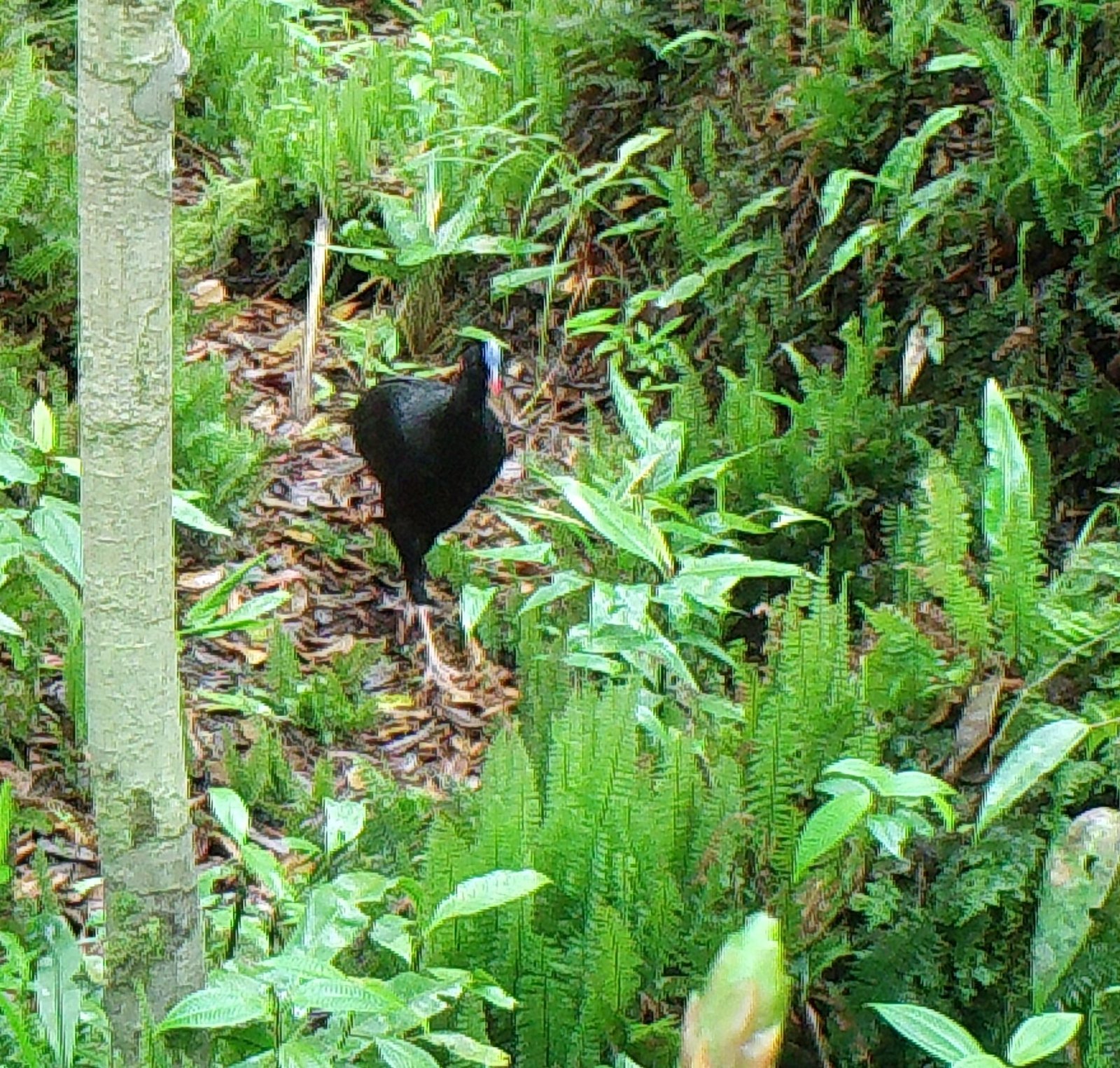
The Sira Curassow is a casqued curassow found only in the Cerros del Sira, an isolated mountain range in central Peru. It was discovered only in 1969 and long regarded as a subspecies of the Horned Curassow of Bolivia. The scientific name honours the ornithologist Maria Koepcke. It is one of the rarest birds of the guide area.
Voice
A very low humming, as in other casqued curassows; the vocalizations are hardly described.
Recording: Andrew Whitworth — CC BY-NC-SA 4.0 · xeno-canto
Identification
85–90 cm. Glossy black with a white lower belly and undertail and a white tail tip; the bill is red. On the forehead sits a grey-blue casque that is shorter, rounder and lower than the upright horn of the Horned Curassow. There is no crest. The sexes are alike.
Confusion species
Razor-billed Curassow Mitu tuberosum lives lower in the Amazonian lowlands and has a deep red bill without a casque and a chestnut lower belly. Horned Curassow Pauxi unicornis of Bolivia has a longer, upright horn; their ranges do not overlap. Guans such as Andean Guan Penelope montagnii are smaller, brown and more often in the trees.
Habitat
Humid montane and cloud forest on the steep slopes of the Cerros del Sira, mainly between about 1100 and 1450 m. Its diet and breeding behaviour are almost unknown; presumably similar to other curassows, which forage on the ground for fruit and seeds.
Where the bird is most at home, classified by the vegetation units of the Andes and the west coast.


Range and movements
Endemic to Peru: only in the Cerros del Sira, on the border of Huánuco, Pasco and Ucayali. Absent from Colombia, Ecuador and Bolivia.
How and when to look
Its habitat lies in a remote, protected area that can only be reached by expedition. Records are scarce and mostly the result of targeted research.
Conservation status
Critically Endangered. The population is very small, probably fewer than a few hundred birds, and confined to a single mountain range. Hunting is the main threat; the habitat lies within the El Sira Communal Reserve.
Scientific name
Pauxi koepckeae | Weske & Terborgh, 1971
Weske & Terborgh described the species in 1971 and placed it straight away in the genus where it still stands. The genus Pauxi was introduced in 1813 by Temminck. The genus name comes from 'Pauxi' of Nieremberg (1635) and Hernández (1651), after Spanish paují, 'peacock', a name for various large gamebirds in tropical America. The species name honours Maria Koepcke (1924–1971), German-Peruvian ornithologist. The specimen the first description was based on came from Río Llullapichis, Huánuco, Peru.