All species › Gamebirds › Guans, curassows and chachalacas › Helmeted Curassow
Helmeted Curassow | Pauxi pauxi
Helmhokko | Paujil copete de piedra | Mutum-de-capacete
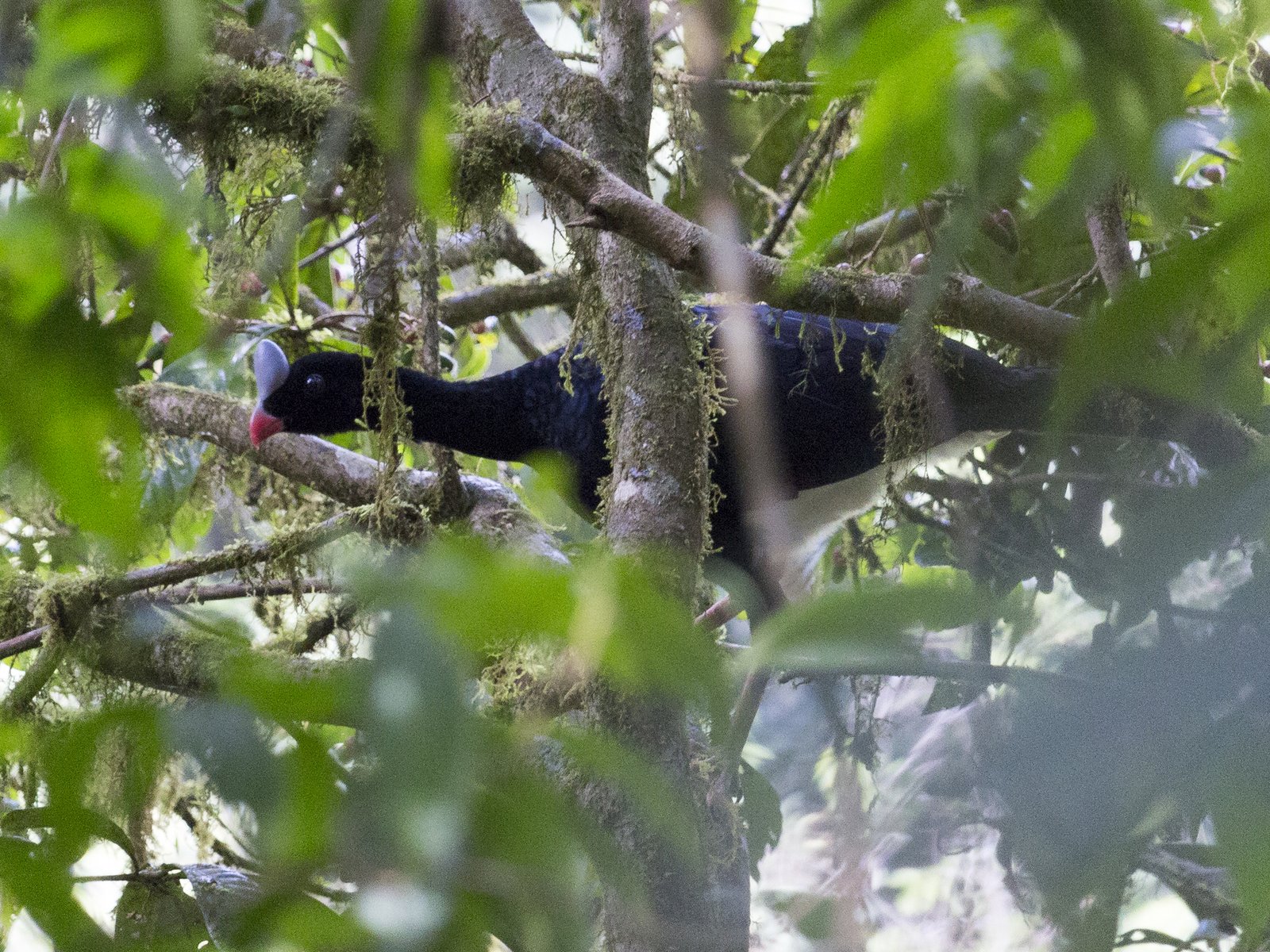
The Helmeted Curassow is a curassow of steep montane forest in the northern Andes, with a large, grey-blue casque on top of the bill. In the guide area it lives only in north-eastern Colombia. The species is shy and inhabits remote, undisturbed mountain slopes.
Voice
The male gives a very low, humming mmm-mmm-mmm that is hard to locate; mainly in the early morning in the breeding season.
Recording: Jacob Socolar — CC BY-NC-SA 4.0 · xeno-canto
Identification
85–91 cm. Glossy black with a white lower belly and undertail and a white tail tip. A large, fig-shaped, grey-blue casque rises from the forehead; the bill is red, the legs reddish. There is no crest. The female usually resembles the male; a rufous, barred form occurs rarely. Young birds have a smaller casque.
Confusion species
No other curassow in the guide area has a casque. Blue-billed Curassow Crax alberti and Yellow-knobbed Curassow Crax daubentoni have a curled crest and a coloured knob or cere and live lower down. Wattled Guan Aburria aburri is smaller and slimmer, black with a yellow dewlap, and usually sits in the trees.
Habitat
Humid, undisturbed montane and cloud forest on steep slopes and in ravines, roughly between 500 and 2200 m. It forages on the ground and in the lower forest layers for fruit, seeds, leaves and small animals. The nest is a cup of twigs in a tree.
Where the bird is most at home, classified by the vegetation units of the Andes and the west coast.


Range and movements
In Colombia in the Serranía del Perijá and the northern Eastern Andes, near the Venezuelan border. Absent from Ecuador, Peru and Bolivia. Outside the guide area in the Andes and coastal cordillera of Venezuela.
- Resident
- dark = core range, pale = thinly spread
How and when to look
The species lives in remote, steep forest and is mostly heard. In the early morning in the breeding season the low humming of the male is the best clue.
Conservation status
Vulnerable. The population is small and fragmented and is declining through hunting, partly for the casque, and through clearance of montane forest for farming.
Scientific name
Pauxi pauxi | (Linnaeus, 1766)
Linnaeus described the species in 1766 as Crax Pauxi; because it was later moved to another genus, the author and year stand in brackets. The genus Pauxi was introduced in 1813 by Temminck. The genus name comes from 'Pauxi' of Nieremberg (1635) and Hernández (1651), after Spanish paují, 'peacock', a name for various large gamebirds in tropical America. The species name comes from Spanish paují, 'peacock', a name used by early settlers in tropical America for various large gamebirds; it appears as 'Pauxi' in Nieremberg (1635) and Hernández (1651). The specimen the first description was based on came from Venezuela.