All species › Gamebirds › Guans, curassows and chachalacas › Bare-faced Curassow
Bare-faced Curassow | Crax fasciolata
Maskerhokko | Pavón muitú | Mutum-de-penacho
The Bare-faced Curassow is the curassow of dry forest, gallery forest and savanna in the heart of South America. In the guide area it occurs only in the lowlands of Bolivia. The female, with her heavily white-barred upperparts, is readily told from other curassows.
Voice
The male gives a low, humming sound, mainly in the early morning in the breeding season. Also high whistles as an alarm.
Recording: Robson Silva e Silva — CC BY-NC-SA 4.0 · xeno-canto
Identification
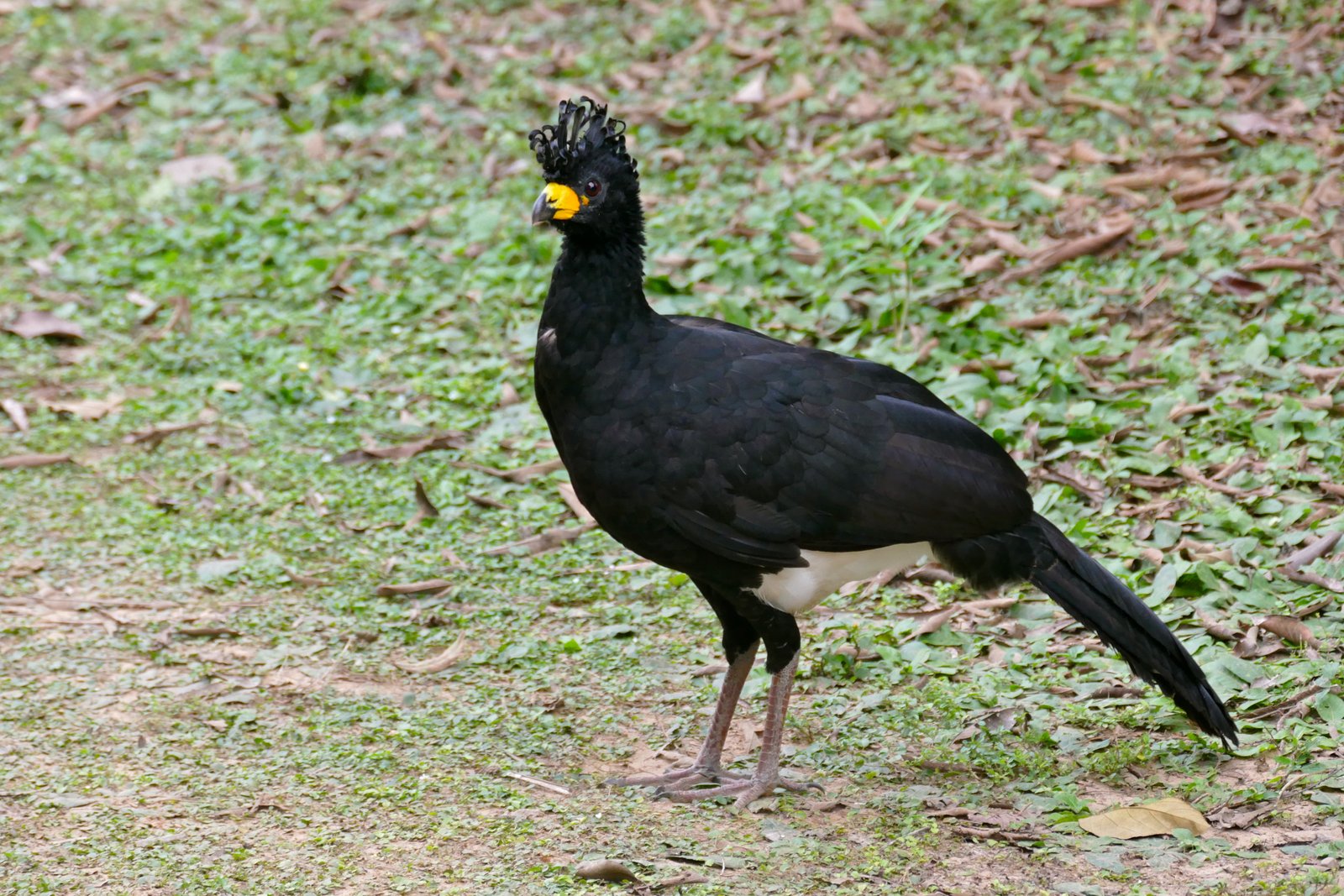
82–85 cm. The male is glossy black with a crest of curled feathers, a white lower belly and undertail and a narrow white tail tip; the cere at the base of the bill is yellow, without a knob. The female is black with dense white or buff barring on the back, wings and tail, a buff belly and a black-and-white barred crest. Young birds resemble the female.
Confusion species
Wattled Curassow Crax globulosa of northern Bolivia has a red knob and wattles, and its female lacks barring on the upperparts. Razor-billed Curassow Mitu tuberosum has a deep red bill and a chestnut lower belly and lives in humid Amazonian forest. Guans such as Spix's Guan Penelope jacquacu are brown, slimmer and have a red dewlap.
Habitat
Gallery forest along rivers, semi-deciduous and dry forest, forest edges and forest islands in savanna, in the lowlands. It forages on the ground for fallen fruit, seeds and small animals. The nest is a cup of twigs in a tree.
Where the bird is most at home, classified by the vegetation units of the Andes and the west coast.


Range and movements
In Bolivia in the lowlands of the north and east, in the Beni and Santa Cruz. Absent from Colombia, Ecuador and Peru. Outside the guide area in central and southern Brazil, including the Pantanal, in Paraguay and in north-eastern Argentina.
- Resident
- dark = core range, pale = thinly spread
How and when to look
In protected areas and on ranches without hunting, birds walk along forest edges and trails in the early morning and late in the day.
Conservation status
Not Evaluated in the taxonomy followed here. The species is declining through hunting and the conversion of dry forest and gallery forest to pasture and fields.
Scientific name
Crax fasciolata | Spix, 1825
Spix described the species in 1825 and placed it straight away in the genus where it still stands. The genus Crax was introduced in 1758 by Linnaeus. The genus name comes from Greek kra, a humorous abbreviation of kranos, 'helmet', for the head feathers. Linnaeus introduced the name in 1744. The species name comes from Latin fasciola, 'small band': 'finely barred'. The specimen the first description was based on came from Pará, Brazil.