All species › Gamebirds › Guans, curassows and chachalacas › Wattled Curassow
Wattled Curassow | Crax globulosa
Knobbelhokko | Pavón carunculado | Mutum-de-fava
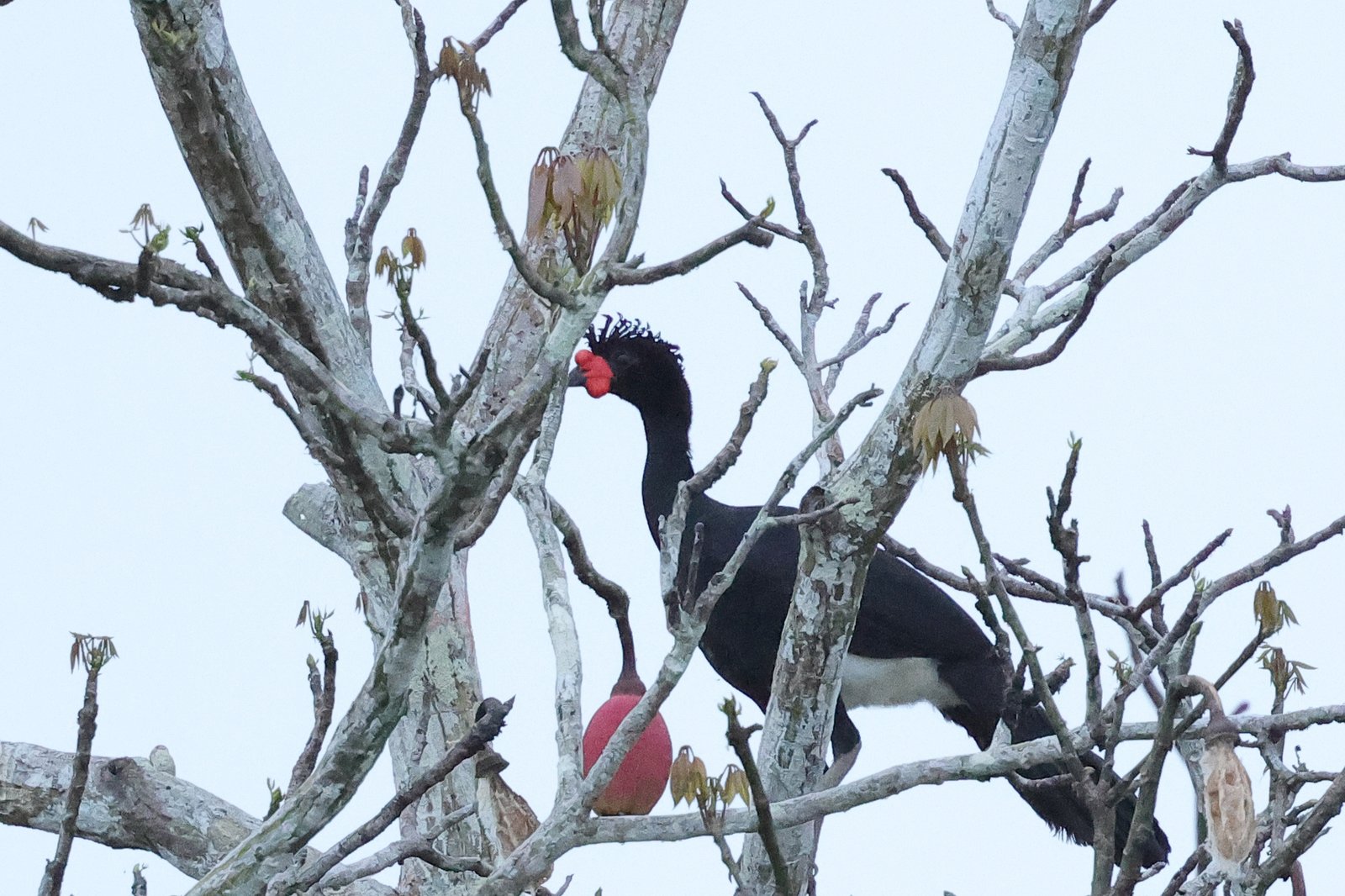
The Wattled Curassow is the curassow of flooded forest along the large rivers of western Amazonia. The male bears a round, red knob and red wattles at the base of the bill. Through hunting the species has disappeared from large parts of its range and now occurs only locally.
Voice
Low humming and high whistles, as in other curassows; the vocalizations are poorly described.
Recording: GABRIEL LEITE — CC BY-NC-SA 4.0 · xeno-canto
Identification
82–89 cm. The male is glossy black with a crest of curled feathers and a white lower belly and undertail; a round, bright red knob and red wattles sit at the base of the bill. The female is black with a rufous belly and undertail, white bars in the crest and a red bill base without a knob. Young birds resemble the female.
Confusion species
Razor-billed Curassow Mitu tuberosum has a deep, laterally compressed red bill without a knob, a chestnut lower belly and a white tail tip, and lives mainly in terra firme forest. Black Curassow Crax alector of eastern Colombia has no knob. Nocturnal Curassow Nothocrax urumutum is much smaller and rufous.
Habitat
Flooded forest (várzea) and forest on river islands and along oxbow lakes in the lowlands, below about 300 m. It forages on the ground and in low vegetation for fruit and seeds, in the wet season also in the trees. The nest is in a tree.
Where the bird is most at home, classified by the vegetation units of the Andes and the west coast.


Range and movements
In Colombia very locally in the south of the Amazon region. In Ecuador in the eastern lowlands, where it is very rare and possibly extirpated. In Peru along the large rivers of the north-east. In Bolivia locally along rivers in the north, in the Beni. Absent from the Galápagos. Outside the guide area in western Brazilian Amazonia.
- Resident
- dark = core range, pale = thinly spread
How and when to look
The largest known numbers live in remote parts of northern Bolivia and along rivers in western Brazil. Birds are mainly seen in the early morning along riverbanks and on river islands, often from a boat.
Conservation status
Endangered. The population is small and fragmented; flooded forest along rivers is readily accessible to hunters, and the species has therefore disappeared from many places.
Scientific name
Crax globulosa | Spix, 1825
Spix described the species in 1825 and placed it straight away in the genus where it still stands. The genus Crax was introduced in 1758 by Linnaeus. The genus name comes from Greek kra, a humorous abbreviation of kranos, 'helmet', for the head feathers. Linnaeus introduced the name in 1744. The species name comes from Latin globulus, 'small ball': 'knobbed', for the knobs at the base of the bill. The specimen the first description was based on came from Rio Solimões, Brazil.