All species › Passerines › Wrens › Southern Chestnut-breasted Wren
Southern Chestnut-breasted Wren | Cyphorhinus thoracicus
Zuidelijke bruinborstwinterkoning | Cucarachero pechicastaño del sur | Uirapuru-de-peito-castanho-do-sul
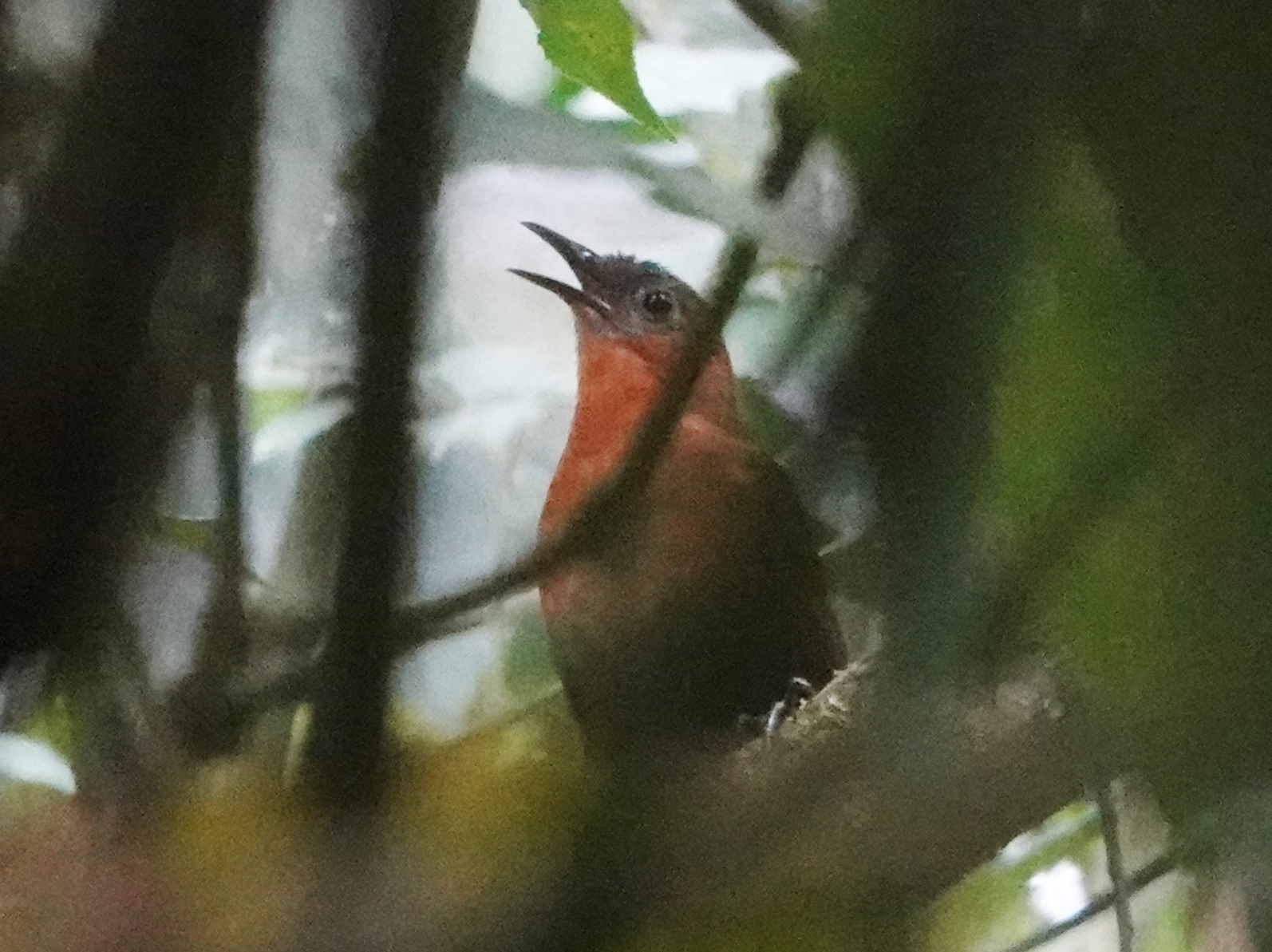
The Southern Chestnut-breasted Wren is a stocky, dark brown wren with an orange-brown throat and breast, of the floor of humid montane Yungas forest in Peru and Bolivia. It was long lumped with Northern Chestnut-breasted Wren, but differs clearly in song. Its varied series of whistles are among the characteristic sounds of cloud forest on the eastern slope.
Voice
The song is a varied, musical series of fluted whistles, followed by faster short whistles or a rapid trill. The call is a low, wooden, frog-like krol.
Recording: Julio Delgado — CC BY-NC-SA 4.0 · xeno-canto
Identification
14–15 cm, stocky, with a fairly short tail and a stout bill with a high culmen. The crown is sooty black, the back and rump deep dark brown, the wings and tail dark brown with fine, dark barring. The sides of the head, the throat and the upper breast are deep orange-brown, the flanks and lower belly dark brown. No bare blue skin around the eye. The sexes are alike; young birds have a paler lower belly.
Confusion species
Northern Chestnut-breasted Wren Cyphorhinus dichrous is practically identical in the field, but sings a simpler series of three or four whistles and has a harsh call; it lives further north. Musician Wren Cyphorhinus arada has black-and-white streaked neck sides and lives in the Amazonian lowlands, below the zone of this species. Wrens of the genus Cinnycerthia are plainer rufous-brown without a contrasting breast and move through the understorey in noisy groups.
Habitat
Floor and low understorey of humid montane forest and cloud forest rich in epiphytes and moss, mostly between 1200 and 2700 m; in the Manu area locally down to 800 m. In pairs or small groups it searches the leaf litter and low vegetation for insects and spiders. As in related species, the nest is presumably a covered structure with a side entrance low in the vegetation.
Where the bird is most at home, classified by the vegetation units of the Andes and the west coast.


Range and movements
In Peru on the eastern slope of the Andes in the centre and south of the country. In Bolivia in the west, in the Yungas of La Paz. Absent from Colombia, Ecuador and the Galápagos. Does not occur outside the guide area.
- Resident
- dark = core range, pale = thinly spread
How and when to look
Along the road through the Kosñipata valley to Manu, in cloud forest between about 1500 and 2500 m; the birds keep to the forest floor in dense vegetation and are mostly detected by song in the early morning.
Conservation status
Least Concern. Locally fairly common in Peru, scarce in Bolivia; the species depends on intact forest and occurs in several protected areas.
Scientific name
Cyphorhinus thoracicus | Tschudi, 1844
Tschudi described the species in 1844 and placed it straight away in the genus where it still stands. The genus Cyphorhinus was introduced in 1844 by Cabanis. The genus name comes from Greek kuphos, 'hump', and rhis, rhinos, 'nose' (here the bill), for the high, arched ridge of the bill. The species name comes from Latin thoracicus, 'of the chest', for the chestnut breast. The specimen the first description was based on came from Peru.