All species › Passerines › Wrens › Song Wren
Song Wren | Cyphorhinus phaeocephalus
Pacifische orpheuswinterkoning | Cucarachero canoro | Uirapuru-cantor
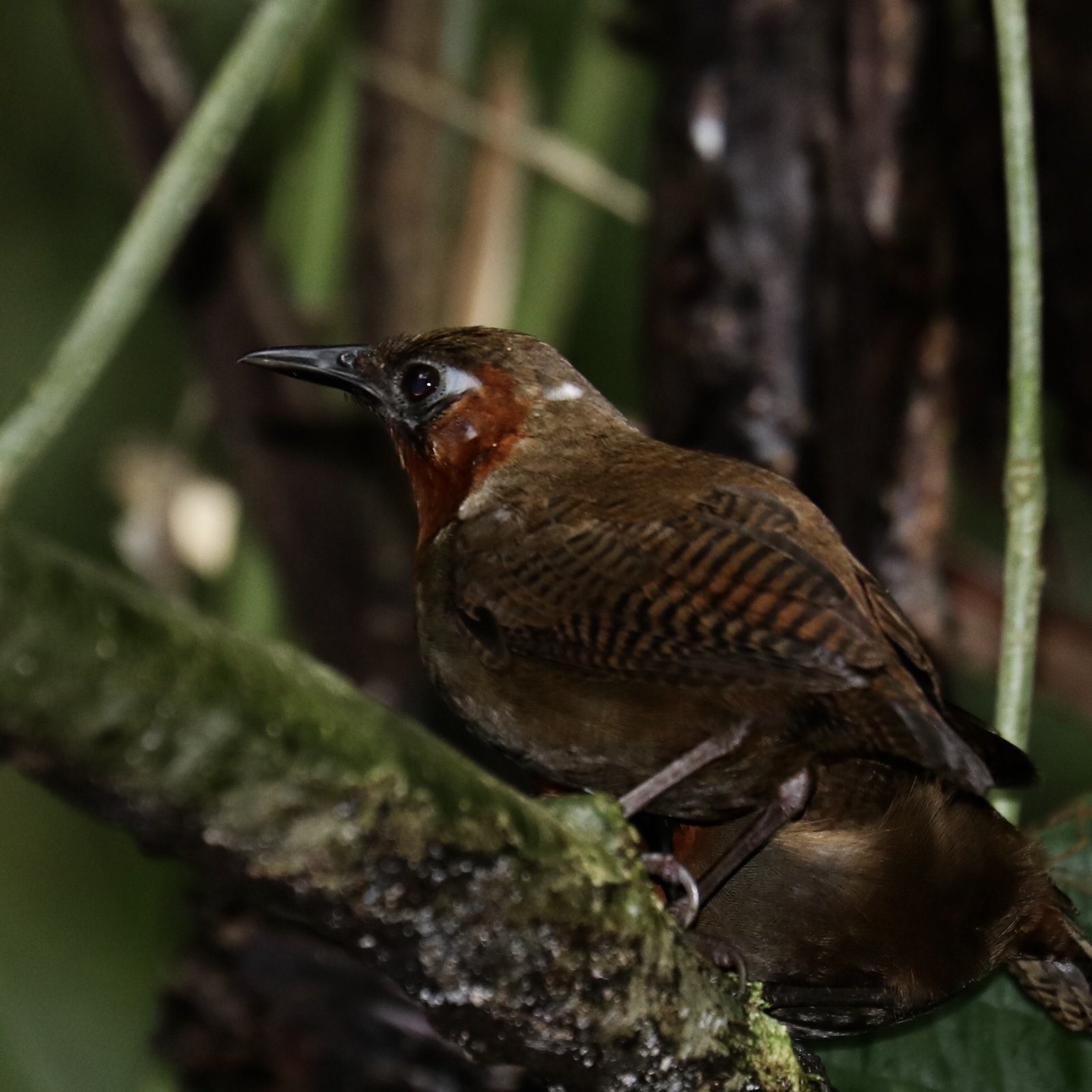
The Song Wren is a stocky, short-tailed wren of the undergrowth of humid lowland forest west of the Andes. Pairs and family groups forage over the forest floor and keep in contact with a song that alternates clear, pure whistles with clucking, cackling sounds. It is the western counterpart of the Musician Wren of Amazonia.
Voice
The song is a series of clear, pure whistles at varying pitch, mixed with dry, clucking and cackling sounds; pairs often sing antiphonally. Call a rasping cherr.
Recording: rudy gelis — CC BY-NC-SA 4.0 · xeno-canto
Identification
12–13 cm, with a heavy bill with a high, arched ridge and a very short tail. The upperparts are dark chocolate brown, the crown slightly darker. The throat, cheeks and breast are warm chestnut-rufous; the belly is greyish brown. Around the eye is bare, pale blue skin. The wings and tail are finely barred black. The sexes are alike; young birds are duller, with a less rufous throat.
Confusion species
Southern Nightingale-Wren Microcerculus marginatus is smaller, with a long, thin bill, a white throat and breast and almost no tail; it constantly bobs its rear end. Bay Wren Cantorchilus nigricapillus has a black head with white streaks and a boldly barred tail and lives in vine tangles at forest edges. Northern Chestnut-breasted Wren Cyphorhinus dichrous lives higher, in montane forest, and lacks the pale blue skin around the eye and the barring on the wings.
Habitat
The undergrowth of humid primary and older secondary lowland and foothill forest, from sea level to about 1000 m. It avoids dry and open places. It searches the forest floor among the leaf litter for spiders and other small invertebrates and sometimes follows army-ant swarms. The nest is a gourd-shaped ball of rootlets and leaf skeletons, often in a small tree; outside the breeding season the birds sleep in similar roosting nests.
Where the bird is most at home, classified by the vegetation units of the Andes and the west coast.


Range and movements
In Colombia along the whole Pacific lowlands and east through the north to the lower Cauca valley and the middle Magdalena valley. In Ecuador in the humid lowlands and foothills of the west, south into the south of the country. Absent from Peru, Bolivia and the Galápagos. Outside the guide area from Honduras to Panama.
- Resident
- dark = core range, pale = thinly spread
How and when to look
In the undergrowth of humid forest in the Chocó or north-western Ecuador, listen for the mix of pure whistles and clucking sounds. The birds stay low and move by walking and hopping over the forest floor.
Conservation status
Least Concern, but tied to closed forest and therefore locally reduced by deforestation in western Colombia and Ecuador.
Scientific name
Cyphorhinus phaeocephalus | Sclater, 1860
Sclater described the species in 1860 and placed it straight away in the genus where it still stands. The genus Cyphorhinus was introduced in 1844 by Cabanis. The genus name comes from Greek kuphos, 'hump', and rhis, rhinos, 'nose' (here the bill), for the high, arched ridge of the bill. The species name comes from Greek phaios, 'dusky', and kephalē, 'head'. The specimen the first description was based on came from Esmeraldas, Ecuador.