All species › Passerines › Wrens › Musician Wren
Musician Wren | Cyphorhinus arada
Orpheuswinterkoning | Cucarachero musical | Uirapuru-verdadeiro
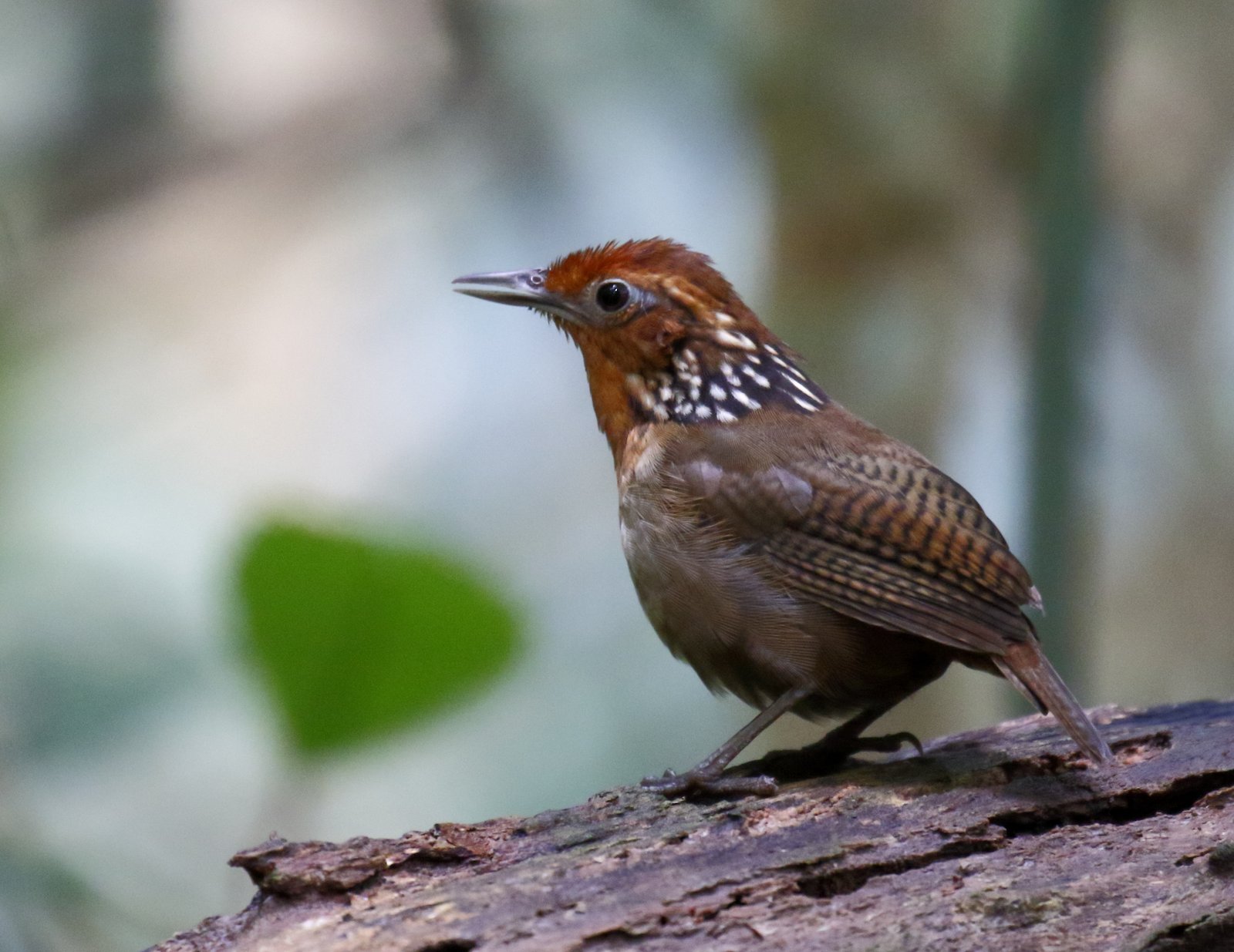
The Musician Wren is a stocky, short-tailed wren of the undergrowth of Amazonian forest. Its song consists of series of pure, whistled notes at varying pitch that sound like musical phrases; both the English and the Dutch names refer to this. In Brazil, under the name uirapuru, it is the subject of folk tales.
Voice
The song is a series of clear, pure whistles at strongly varying pitch, often in repeated phrases, alternating with clucking and gurgling sounds; pairs often sing antiphonally. Call a rasping churk.
Recording: GABRIEL LEITE — CC BY-NC-SA 4.0 · xeno-canto
Identification
12.5–13 cm, with a heavy bill with a high, arched ridge and a short tail. The forms in the guide area are dark rufous-brown to brown above, with a rufous crown; the throat, cheeks and breast are bright orange-rufous and the belly is greyish brown. Around the eye is bare, grey-blue skin. The wings and tail are finely barred black. The black-and-white streaked neck collar of the Guianan form is absent in the guide area. The sexes are alike.
Confusion species
Southern Nightingale-Wren Microcerculus marginatus is smaller, with a long, thin bill, a white throat and breast and almost no tail. Coraya Wren Pheugopedius coraya has black cheeks with white streaks and a boldly barred tail and lives higher in vine tangles and edges. Southern Chestnut-breasted Wren Cyphorhinus thoracicus and Northern Chestnut-breasted Wren Cyphorhinus dichrous live higher, in montane forest of the eastern slope, and lack the barring on the wings. White-breasted Wood Wren Henicorhina leucosticta is smaller, with a white throat and breast and black-and-white streaked sides of the head.
Habitat
The undergrowth of humid lowland forest, mainly on terra firme, locally also in várzea and foothill forest, from sea level to about 1000 m. Pairs and family groups search on and just above the forest floor for insects, spiders and other invertebrates and sometimes follow army-ant swarms. The nest is a ball of leaf skeletons and coarse grass with a funnel-shaped entrance, low in the undergrowth.
Where the bird is most at home, classified by the vegetation units of the Andes and the west coast.


Range and movements
In Colombia in Amazonia and at the foot of the Eastern Andes. In Ecuador throughout the Amazonian lowlands. In Peru in the Amazonian lowlands over most of the country. In Bolivia in the north, in the Amazonian lowlands. Absent west of the Andes and from the Galápagos. Outside the guide area in Venezuela, the Guianas and Brazilian Amazonia.
- Resident
- dark = core range, pale = thinly spread
How and when to look
In the early morning, listen in the undergrowth of tall terra firme forest for the series of pure whistles. The birds stay low, keep to dense undergrowth and sometimes approach a trail while foraging.
Conservation status
Least Concern. The population is suspected to be declining through deforestation, but the range is very large.
Scientific name
Cyphorhinus arada | (Hermann, 1783)
Hermann described the species in 1783 as Myrm[ornis] arada; because it was later moved to another genus, the author and year stand in brackets. The genus Cyphorhinus was introduced in 1844 by Cabanis. The genus name comes from Greek kuphos, 'hump', and rhis, rhinos, 'nose' (here the bill), for the high, arched ridge of the bill. The species name is the name used for this bird by the indigenous people of Cayenne (French Guiana); Hermann based his name on Buffon's 'Arada'. The specimen the first description was based on came from Cayenne, French Guiana.