All species › Passerines › Wrens › Rufous-and-white Wren
Rufous-and-white Wren | Thryophilus rufalbus
Rood-witte winterkoning | Chivirín rojizo | Garrinchão-ruivo-e-branco
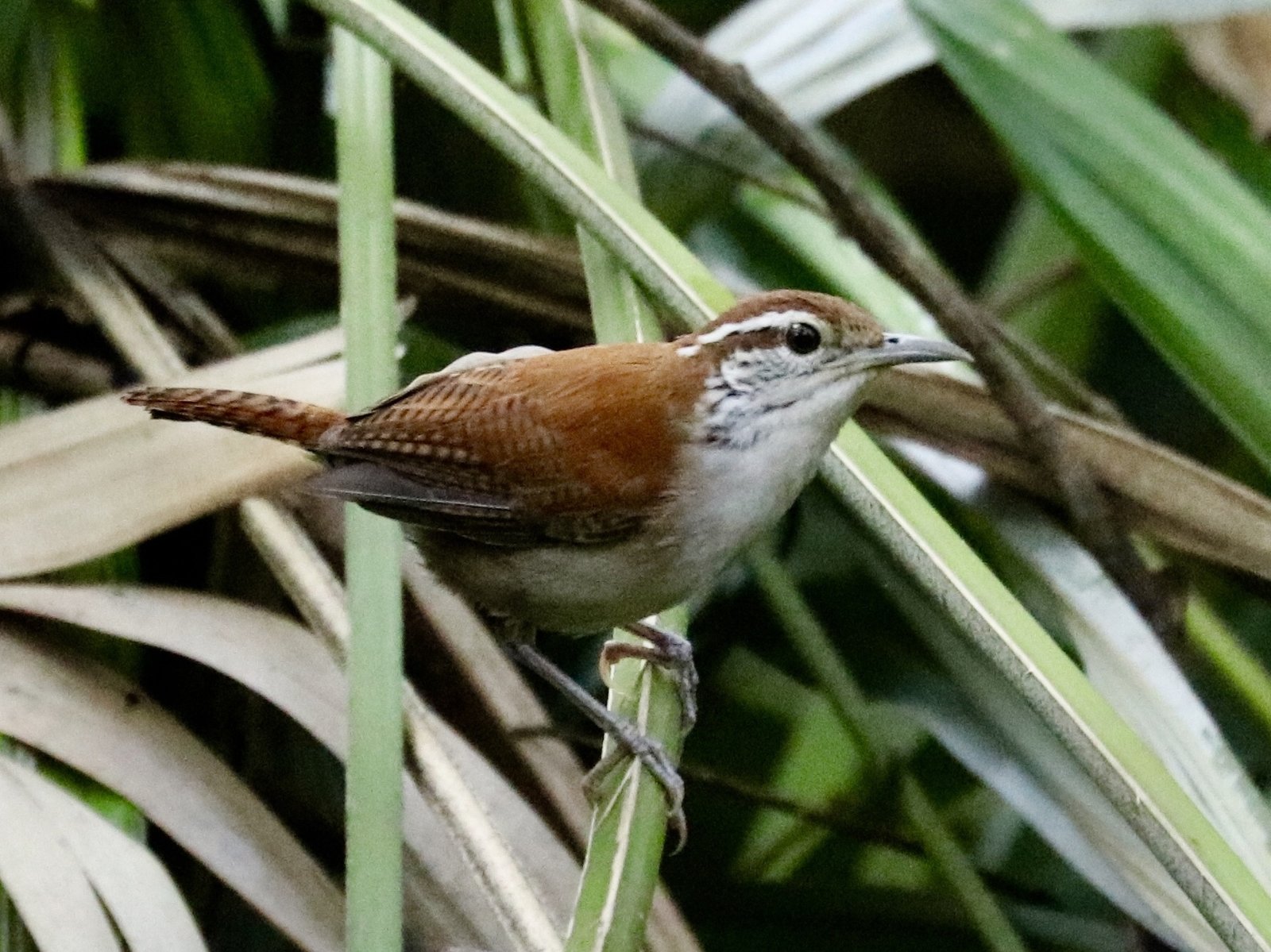
The Rufous-and-white Wren is a fairly large wren with rufous upperparts and white underparts, of dry and semi-humid forest in northern Colombia. It keeps to dense undergrowth and gives itself away mainly by its song: low, hollow whistles reminiscent of the call of a small owl. Two closely related species, the Antioquia Wren and Niceforo's Wren, each live in a dry Andean valley in Colombia.
Voice
The song is a short series of low, hollow, pure whistles, often starting with a fast trill and ending with a few deep notes; pairs often sing antiphonally. Calls are dry, rasping notes.
Recording: Johan Chaves — CC BY-NC-SA 4.0 · xeno-canto
Identification
14–15 cm, with a fairly long, slightly decurved bill. The upperparts are bright rufous, warmest on the rump and tail. A long, white supercilium is bordered by a dark eye-stripe; the cheeks are boldly streaked black and white. The throat and breast are white, the flanks greyish to buffy brown; the undertail coverts are barred black and white. The wings and tail are boldly barred black. The sexes are alike; young birds are duller, with less distinct head markings.
Confusion species
Buff-breasted Wren Cantorchilus leucotis is warm buff rather than white below, less rufous above, and often lives close to water. Rufous-breasted Wren Pheugopedius rutilus has a rufous breast and speckled cheeks. Antioquia Wren Thryophilus sernai and Niceforo's Wren Thryophilus nicefori are duller and less rufous and occur only in the Cauca valley and the Chicamocha valley respectively. Southern House Wren Troglodytes musculus is smaller and plainer, without an obvious white supercilium.
Habitat
The undergrowth of dry and semi-humid forest, gallery forest, thickets, forest edges and shady plantations, from sea level to about 1000 m. It forages low in the vegetation and on the ground for insects and spiders. The nest is a ball or pouch with a side entrance, in a shrub or among vines.
Where the bird is most at home, classified by the vegetation units of the Andes and the west coast.


Range and movements
In Colombia in the Caribbean lowlands, at the foot of the Sierra Nevada de Santa Marta, in the middle Magdalena valley and in the north-east near Cúcuta. Absent from Ecuador, Peru, Bolivia and the Galápagos. Outside the guide area from southern Mexico to Panama and in north-western Venezuela.
- Resident
- dark = core range, pale = thinly spread
How and when to look
In dry forest and scrub in the Caribbean lowlands of Colombia, listen, especially in the early morning, for the low, hollow whistles; the birds hide in dense thickets and are best found by their song.
Conservation status
Least Concern. Tolerates some disturbance, as long as dense undergrowth remains.
Scientific name
Thryophilus rufalbus | (de Lafresnaye, 1845)
De Lafresnaye described the species in 1845 as Thryothorus rufalbus; because it was later moved to another genus, the author and year stand in brackets. The genus Thryophilus was introduced in 1864 by Baird. The genus name combines Greek thruon, 'reed', with philos, 'lover': 'reed-lover'. The species name combines Latin rufus, 'rufous', with albus, 'white', for the rufous upperparts and white underparts. The specimen the first description was based on came from Guatemala.