All species › Passerines › Wrens › Antioquia Wren
Antioquia Wren | Thryophilus sernai
Antioquiawinterkoning | Cucarachero antioqueño | Garrinchão-de-antioquia
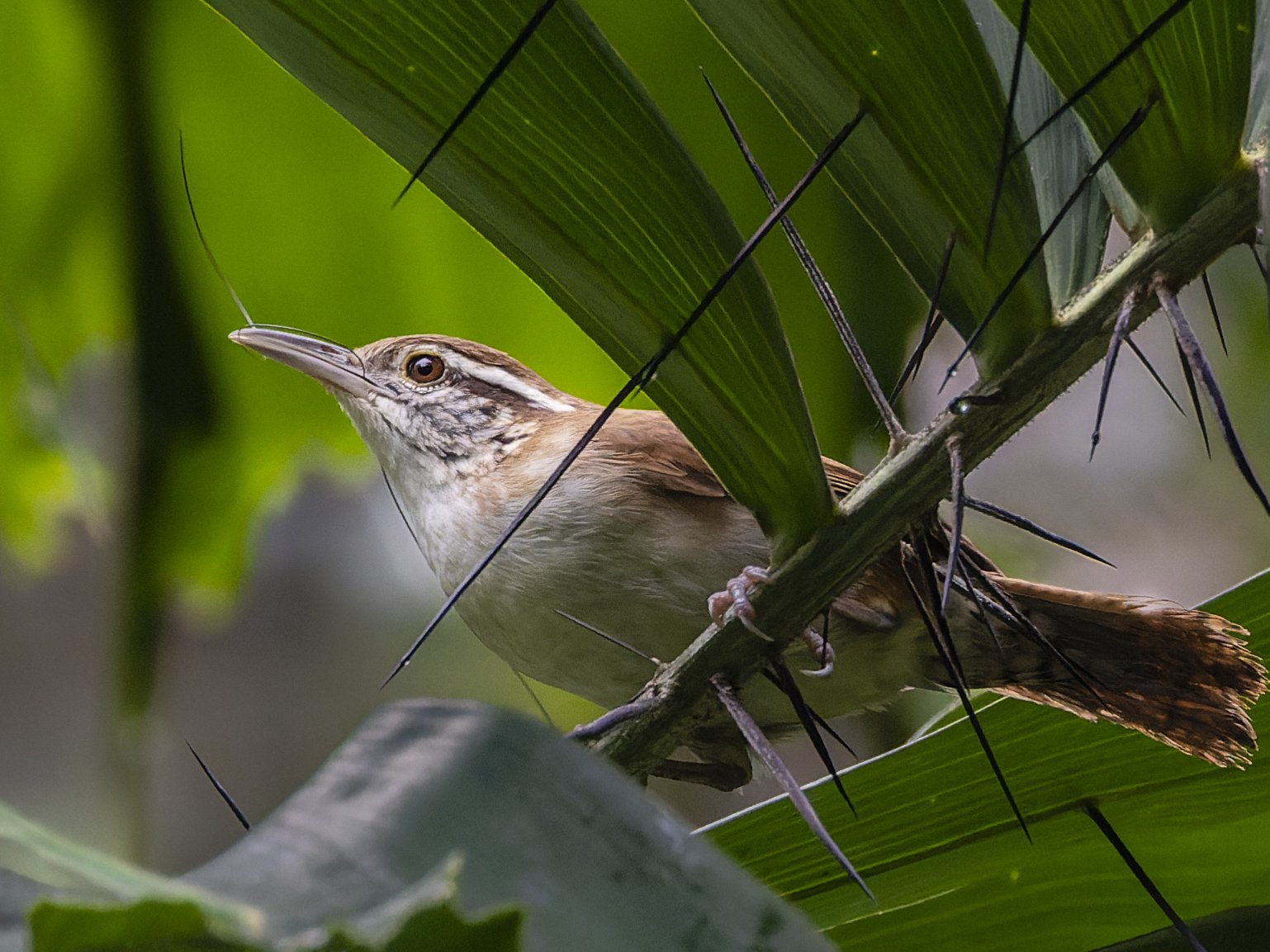
The Antioquia Wren is a wren described in 2012 that occurs only in the dry valley of the Cauca in the department of Antioquia in Colombia. It is closely related to the Rufous-and-white Wren and Niceforo's Wren and was only discovered in 2010, mainly through its different song. The scientific name honours the Colombian naturalist Marco Antonio Serna.
Voice
The song is a series of clear whistles and short trills, more varied and slightly higher than in Rufous-and-white Wren, often ending with a strongly modulated final note; pairs sing in duet.
Recording: Brian Cox — CC BY-NC-SA 4.0 · xeno-canto
Identification
14 cm, with a fairly long, slightly decurved bill. The upperparts are pale cinnamon-brown, less rufous than in Rufous-and-white Wren. A narrow, white supercilium; the cheeks are faintly streaked brown. The underparts are whitish, washed pale brown on the breast and flanks; the undertail coverts are barred dark. The wings and tail are finely barred black, the bars often broken into spots on the tail. The sexes are alike.
Confusion species
Rufous-and-white Wren Thryophilus rufalbus is brighter rufous, with a broader white supercilium, sharply streaked black-and-white cheeks and coarser barring on the wings and tail; it lives lower and not in the Cauca valley of Antioquia. Niceforo's Wren Thryophilus nicefori is darker and colder brown, with heavier black barring, and lives only in the Chicamocha valley. Southern House Wren Troglodytes musculus is smaller and plainer, without an obvious white supercilium.
Habitat
Remnants of dry and semi-deciduous forest, scrub and vegetation along streams in the deep valley of the Cauca, between about 250 and 850 m. It is also seen in hedgerows and live fences along roads. It forages low in the vegetation for insects and other invertebrates. Little is known about the nest.
Where the bird is most at home, classified by the vegetation units of the Andes and the west coast.


Range and movements
Endemic to Colombia: only in the Cauca valley in Antioquia, on both banks, over about 150 km from Ituango in the north to the area of Concordia and Salgar in the south. Absent from the rest of the guide area.
- Resident
- dark = core range, pale = thinly spread
How and when to look
Search around Santa Fe de Antioquia, in vegetation along streams and in remnants of dry forest in the Cauca valley; the birds are best found by their song in the early morning.
Conservation status
Vulnerable. The range is very small and the dry forest of the Cauca valley is highly fragmented. Much of the habitat in the north has been lost to the Hidroituango reservoir; clearance for farming and building is a further threat.
Scientific name
Thryophilus sernai | Lara, Cuervo, Valderrama, Calderón-Franco & Cadena, 2012
Lara, Cuervo, Valderrama, Calderón-Franco & Cadena described the species in 2012 and placed it straight away in the genus where it still stands. The genus Thryophilus was introduced in 1864 by Baird. The genus name combines Greek thruon, 'reed', with philos, 'lover': 'reed-lover'. The species name honours Marco Antonio Serna Díaz (1936–1991), a Colombian naturalist from San Vicente Ferrer, Antioquia. The specimen the first description was based on came from Santa Fe de Antioquia, Antioquia, Colombia.