All species › Passerines › Wrens › Niceforo's Wren
Niceforo's Wren | Thryophilus nicefori
Niceforo's winterkoning | Cucarachero de Nicéforo | Garrinchão-de-nicéforo
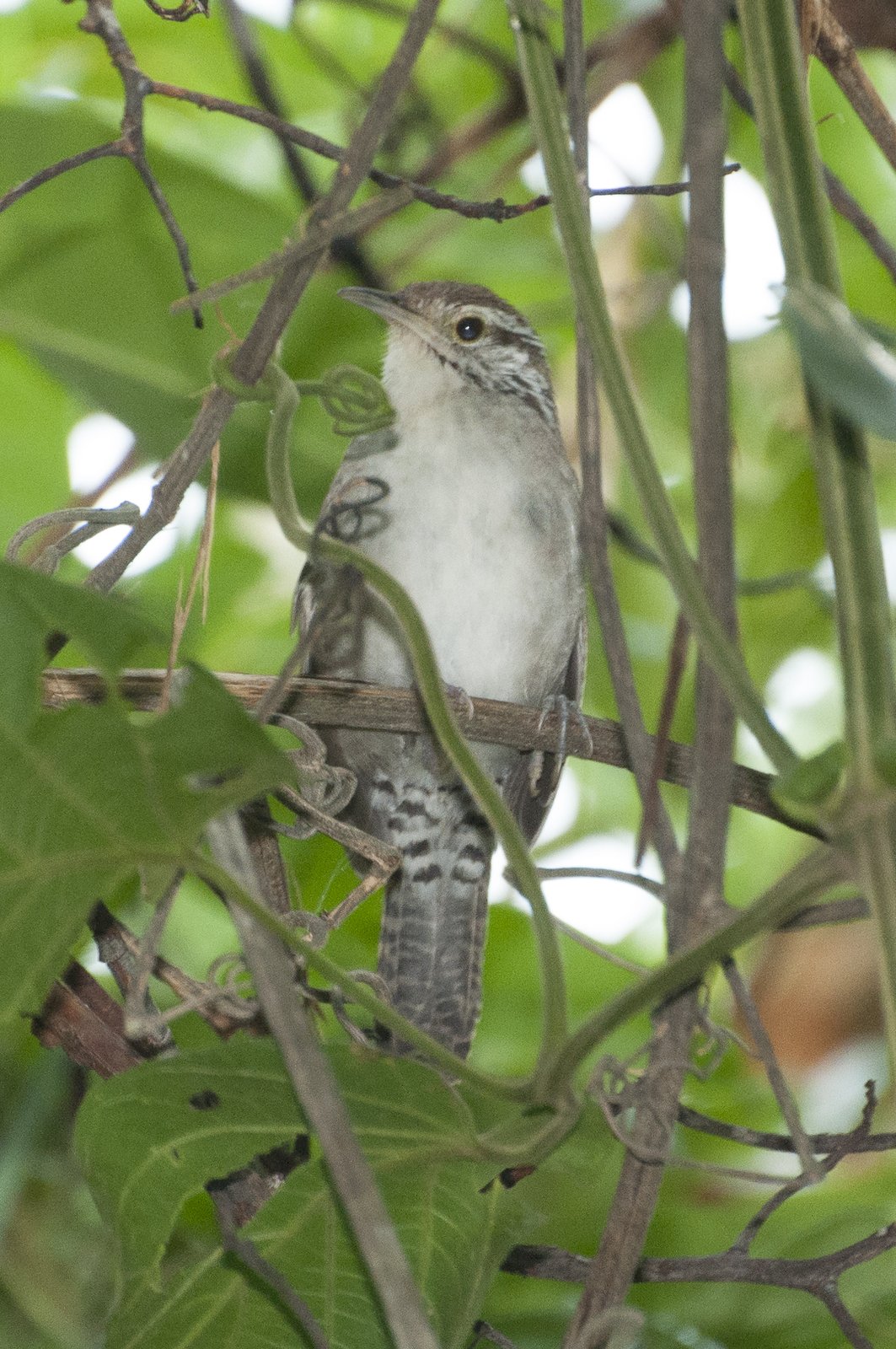
Niceforo's Wren is one of the rarest birds of Colombia and lives only in the dry valley of the Chicamocha and a few adjacent valleys in the Eastern Andes. It was long regarded as a subspecies of Rufous-and-white Wren, but is now recognised as a separate species. The name honours Brother Nicéforo María, a naturalist who worked in Colombia.
Voice
The song consists of series of clear, hollow whistles and trills, similar to those of Rufous-and-white Wren; pairs sing in duet.
Recording: Sergio A. Collazos-González — CC BY-NC-SA 4.0 · xeno-canto
Identification
14.5–15 cm, with a fairly long, slightly decurved bill. The head and back are dull olive-grey to greyish brown, the back slightly rustier, with faint black barring on the back and uppertail coverts. A long, white supercilium with thin black edges; the cheeks are streaked black and white. The underparts are white, greyer on the sides and flanks; the undertail coverts are broadly barred black. The wings are finely, the tail more broadly barred black. The sexes are alike.
Confusion species
Rufous-and-white Wren Thryophilus rufalbus is bright rufous above rather than olive-grey and lives lower, in the Caribbean lowlands and the Magdalena valley. Antioquia Wren Thryophilus sernai is paler and warmer brown, with finer barring, and lives only in the Cauca valley. Southern House Wren Troglodytes musculus is smaller and plain brown, without a white supercilium or streaked cheeks. Rufous-breasted Wren Pheugopedius rutilus has a rufous breast and speckled cheeks.
Habitat
Dry forest with dense undergrowth and a thick litter layer, remnants of riparian woodland with tangled shrubs, thorn scrub and the shady edges of coffee and cacao plantations, between about 1100 and 1850 m. It often occurs at sites with acacias and Pithecellobium dulce. It forages low in the vegetation and in the leaf litter for insects. Little is known about the nest.
Where the bird is most at home, classified by the vegetation units of the Andes and the west coast.


Range and movements
Endemic to Colombia: in the Chicamocha valley and the basins of the Sogamoso, Suárez and Fonce in Santander and Boyacá, with an isolated population near Soatá in Boyacá and one in the Serranía de los Yariguíes. Absent from the rest of the guide area.
- Resident
- dark = core range, pale = thinly spread
How and when to look
Search the Niceforo's Wren reserve near Zapatoca or the dry valleys around San Gil in Santander; in the early morning listen for the song from dense thickets along streams.
Conservation status
Critically Endangered. The world population is estimated at 30–200 mature birds, spread over fragmented sites. Threats are conversion of forest to cropland, grazing by goats that removes the undergrowth, forest fires and the drying up of streams.
Scientific name
Thryophilus nicefori | (Meyer de Schauensee, 1946)
Meyer de Schauensee described the species in 1946 as Thryothorus nicefori; because it was later moved to another genus, the author and year stand in brackets. The genus Thryophilus was introduced in 1864 by Baird. The genus name combines Greek thruon, 'reed', with philos, 'lover': 'reed-lover'. The species name honours Brother Nicéforo María, a Colombian missionary and herpetologist who supplied many specimens to the describer, Rodolphe Meyer de Schauensee. The specimen the first description was based on came from San Gil, Santander, Colombia.