All species › Passerines › New World warblers › Spectacled Whitestart
Spectacled Whitestart | Myioborus melanocephalus
Brilzanger | Candelita de anteojos | Mariquita-de-óculos
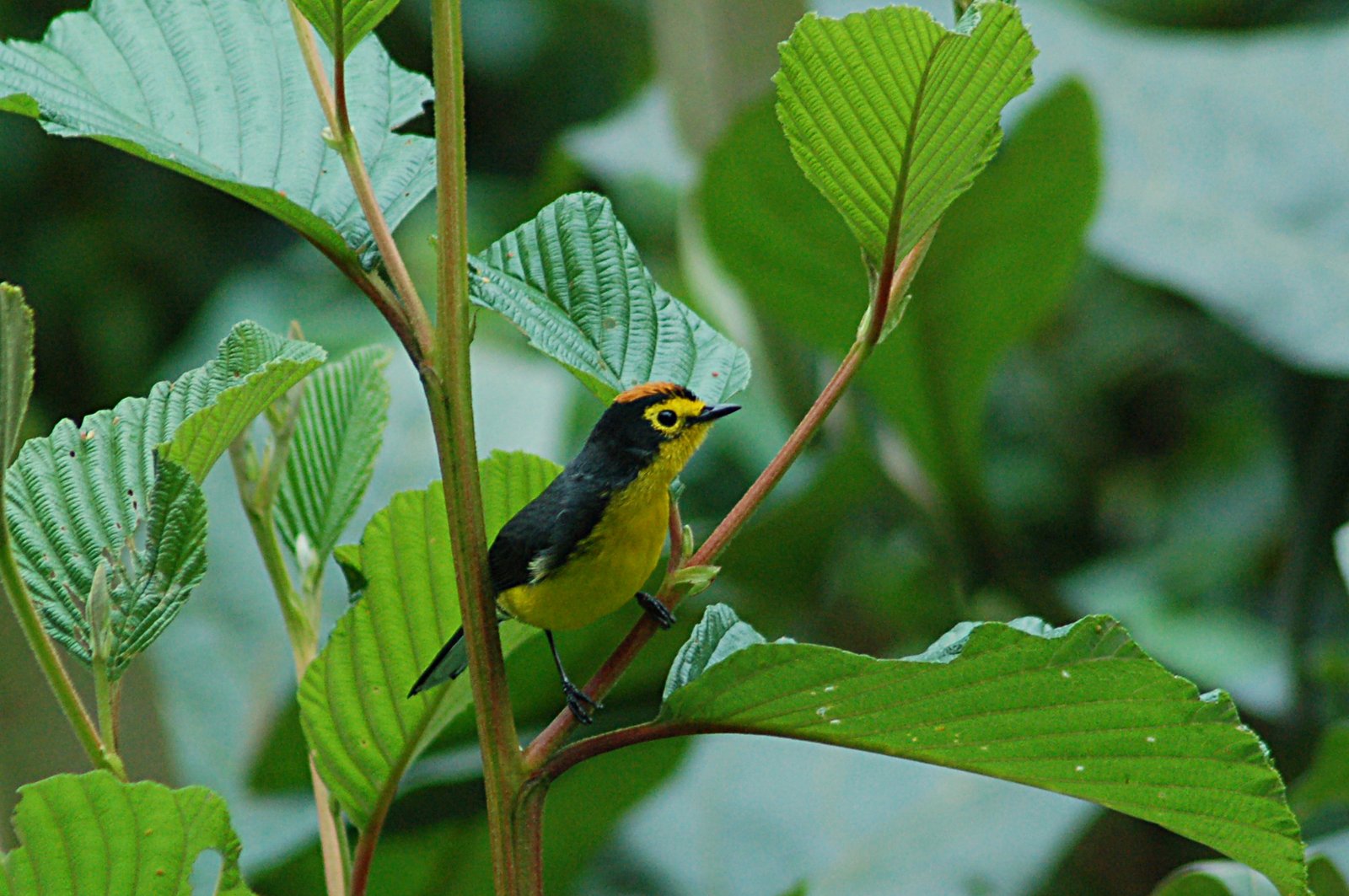
The Spectacled Whitestart is the Myioborus of upper montane forest in the central Andes, from southern Colombia to Bolivia. It lives above the zone of the Slate-throated Whitestart, up to the treeline. The yellow spectacles around the eye are present in all forms, but the crown colour changes from north to south.
Voice
The call is a thin, high tsip. The song is a rapid, somewhat jumbled series of high chip notes and short trills.
Recording: GABRIEL LEITE — CC BY-NC-SA 4.0 · xeno-canto
Identification
13–14 cm, with a long, often fanned tail. The upperparts are grey with an olive tinge; face and sides of the head are blackish, with yellow lores and a yellow eye-ring that together form spectacles. Throat, breast and belly are yellow, the undertail coverts white; the black tail has much white in the outer feathers. In southern Colombia, Ecuador and northern Peru it has a rufous crown; further south in Peru and in Bolivia the crown is black. The sexes are alike. Juveniles are duller and browner, with less distinct spectacles.
Confusion species
Golden-fronted Whitestart Myioborus ornatus in the north has an all-yellow face; intermediates occur in southern Colombia and northern Ecuador. Slate-throated Whitestart Myioborus miniatus lives lower and has a dark throat and no spectacles. In Bolivia, Brown-capped Whitestart Myioborus brunniceps has a grey head with a rufous cap and no yellow spectacles.
Habitat
Cloud forest and upper montane forest, forest edges, Polylepis woodland and shrubbery at the treeline, mainly from about 2000 to 3400 m. It forages in the lower and middle levels and is a regular member of mixed flocks; it fans tail and wings to flush insects and catches them in short sallies. As in related species, the nest is on or near the ground in a bank.
Where the bird is most at home, classified by the vegetation units of the Andes and the west coast.


Range and movements
Colombia: only in the south, mainly in Nariño. Ecuador: on both slopes of the Andes over the whole length of the country. Peru: along the east slope of the Andes over the whole length of the country, and in the north also on the west slope. Bolivia: on the east slope of the Andes in La Paz and Cochabamba. Absent from the Galápagos. Does not occur outside the guide area.
- Resident
- dark = core range, pale = thinly spread
How and when to look
In Ecuador and Peru the Spectacled Whitestart is regularly seen in mixed flocks at forest edges and along mountain roads above 2500 m, for example at Papallacta Pass and on the upper part of the Manu road.
Conservation status
Least Concern. The species is common over a large range and also uses forest edges and secondary growth.
Scientific name
Myioborus melanocephalus | (Tschudi, 1844)
Tschudi described the species in 1844 as Setophaga melanocephala; because it was later moved to another genus, the author and year stand in brackets. The genus Myioborus was introduced in 1865 by Baird. The genus name combines Greek muia, 'fly', with -boros, '-devouring': fly-eater. The species name combines Greek melas, 'black', and -kephalos, '-headed'. The specimen the first description was based on came from Maraynioc, Junín, Peru.