All species › Gamebirds › Guans, curassows and chachalacas › Spix's Guan
Spix's Guan | Penelope jacquacu
Spix' sjakohoen | Pava de Spix | Jacu-de-spix
Spix's Guan is the large guan of the Amazonian lowlands east of the Andes. It lives in pairs or small groups in the tree layers of undisturbed forest and, where hunting is light, is one of the most frequently seen gamebirds. At dawn it makes a rattling sound with its wings that carries far through the forest.
Voice
Loud honking and cackling calls, often in a series that builds up, mainly at dusk. At dawn a dry, rattling wing-drumming during a short glide.
Recording: Daan van der Hoeven — CC BY-NC-SA 4.0 · xeno-canto
Identification
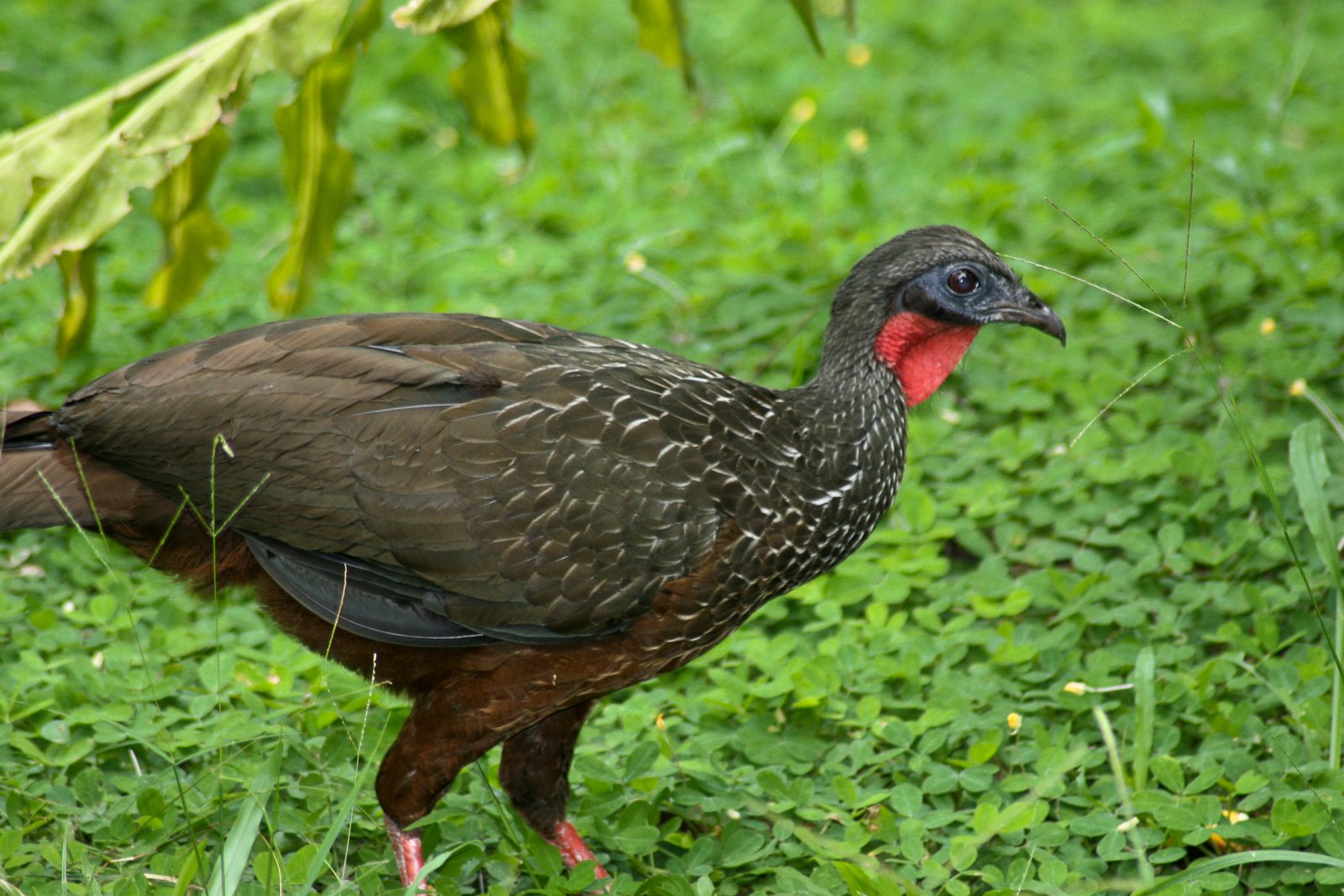
76–89 cm, a large, dark guan with a long tail and a full, bushy crest. The plumage is dark olive-brown with a bronzy-green gloss on the back and wings; the neck, breast and mantle have narrow white feather edges, giving a streaked pattern. The bare skin around the eye is blue-grey and the large dewlap is bright red. The legs are red. The sexes are alike.
Confusion species
Andean Guan Penelope montagnii is much smaller, with a grey-frosted face and a small dewlap, and lives higher in montane forest. Blue-throated Piping Guan Pipile cumanensis is black with a white crest and white wing patches. Wattled Guan Aburria aburri is black with a long yellow wattle and lives on Andean slopes. Rusty-margined Guan Penelope superciliaris in eastern Bolivia is smaller, with rufous wing edges.
Habitat
Humid lowland forest on terra firme and in várzea, gallery forest and the edges of riverine forest, up into foothill forest on the eastern slope of the Andes, mostly below 1200 m, locally higher. It eats fruit, seeds, leaves and flowers, mainly in the middle and upper tree layers. The nest is a platform of twigs in a tree.
Where the bird is most at home, classified by the vegetation units of the Andes and the west coast.


Range and movements
In Colombia in the Amazonian lowlands and the southern Orinoco region. In Ecuador in the eastern lowlands. In Peru throughout the Amazonian lowlands. In Bolivia in the northern and eastern lowlands to the foot of the Andes. Absent from the Galápagos. Outside the guide area in western Brazil, southern Venezuela and Guyana.
- Resident
- dark = core range, pale = thinly spread
How and when to look
Walk trails in undisturbed lowland forest early in the morning or travel by boat along rivers; groups often sit in fruiting trees along the bank. In protected areas with little hunting they allow a close approach.
Conservation status
Least Concern. Hunting and logging have greatly reduced numbers along roads and near settlements; in large, undisturbed forests it remains common.
Scientific name
Penelope jacquacu | Spix, 1825
Spix described the species in 1825 and placed it straight away in the genus where it still stands. The genus Penelope was introduced in 1786 by Merrem. The genus name comes from Greek mythology: Penelope was the daughter of the Spartan king Icarius and the wife of Odysseus. The species name comes from the Tupi name Jacú guacú, 'great fowl', for a guan. The specimen the first description was based on came from Rio Solimões, Amazonas, Brazil.