All species › Gamebirds › Guans, curassows and chachalacas › Crested Guan
Crested Guan | Penelope purpurascens
Kuifsjakohoen | Pava cojolita | Jacu-de-crista
The Crested Guan is the largest guan in the guide area, a bird of the forests west of the Andes that ranges from Mexico to western Ecuador. It lives in pairs or small groups in the canopy and can be recognised at dusk by its loud, honking call.
Voice
A loud, harsh, honking kyonk, often repeated, and a raucous cackle when alarmed. At dawn a rattling wing-drumming during a short flight between trees.
Recording: José María Loaiza B. — CC BY-NC-SA 4.0 · xeno-canto
Identification
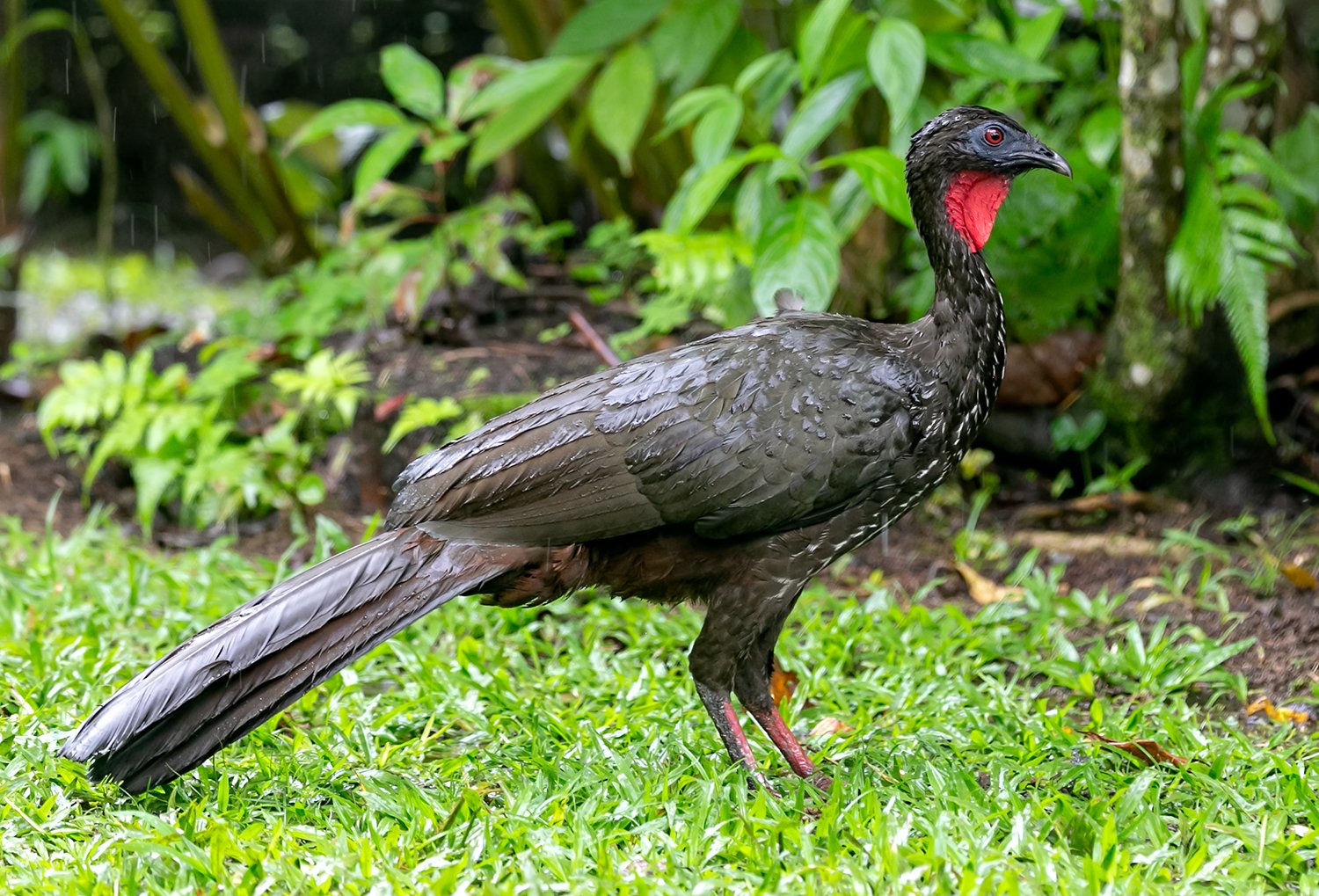
84–91 cm, a large, dark olive-brown guan with a long, broad tail and a full, bushy crest. The neck, breast and mantle have white feather edges, giving a spotted to streaked pattern; the belly is more rufous. The bare skin around the eye is blue-grey and the dewlap is large and bright red. The legs are red. The sexes are alike.
Confusion species
Baudo Guan Penelope ortoni is much smaller and plainer brown, with little white on the breast, and lives in the Chocó. Wattled Guan Aburria aburri is black with a long yellow wattle. The female Great Curassow Crax rubra is heavier, with a curly black-and-white crest and a barred tail. Sickle-winged Guan Chamaepetes goudotii has rufous underparts and lives higher in montane forest.
Habitat
Humid lowland and hill forest, Chocó rainforest, forest edges, gallery forest and drier woodland, from sea level to about 1800 m, locally higher. It eats fruit, berries, leaves and flowers, mostly high in the trees, sometimes on the ground. The nest is a platform of twigs in a tree or in dense vines.
Where the bird is most at home, classified by the vegetation units of the Andes and the west coast.


Range and movements
In Colombia in the Pacific lowlands, the Caribbean lowlands, the Magdalena Valley and the north-east, west and north of the Eastern Andes. In Ecuador in the western lowlands and the lower western slope of the Andes, mainly in the north-west, south to El Oro. Absent from Peru, Bolivia and the Galápagos. Outside the guide area from Mexico through Central America to north-western Venezuela.
- Resident
- dark = core range, pale = thinly spread
How and when to look
Listen at dusk for the loud calls in forested areas of north-western Ecuador or the Chocó; early in the morning birds often sit in the open in bare or fruiting tree crowns.
Conservation status
Near Threatened. The species is declining through the conversion of lowland forest to farmland and through hunting; it has disappeared from heavily hunted areas.
Scientific name
Penelope purpurascens | Wagler, 1830
Wagler described the species in 1830 and placed it straight away in the genus where it still stands. The genus Penelope was introduced in 1786 by Merrem. The genus name comes from Greek mythology: Penelope was the daughter of the Spartan king Icarius and the wife of Odysseus. The species name comes from Latin purpurascens, 'purplish', for the purple gloss of the plumage. The specimen the first description was based on came from Mexico.