All species › Gamebirds › Guans, curassows and chachalacas › Cauca Guan
Cauca Guan | Penelope perspicax
Caucasjakohoen | Pava caucana | Jacu-do-cauca
The Cauca Guan is endemic to Colombia, restricted to the slopes around the Cauca and Patía valleys. After decades without records it was rediscovered in the 1980s. It now survives mainly in a few protected forests, where it also uses secondary forest and plantations with fruiting trees.
Voice
Loud, harsh, honking calls, mainly in the morning and evening, and a raucous cackle when alarmed. At dawn a rattling wing-drumming.
Recording: Mike McCloy — CC BY-NC-SA 4.0 · xeno-canto
Identification
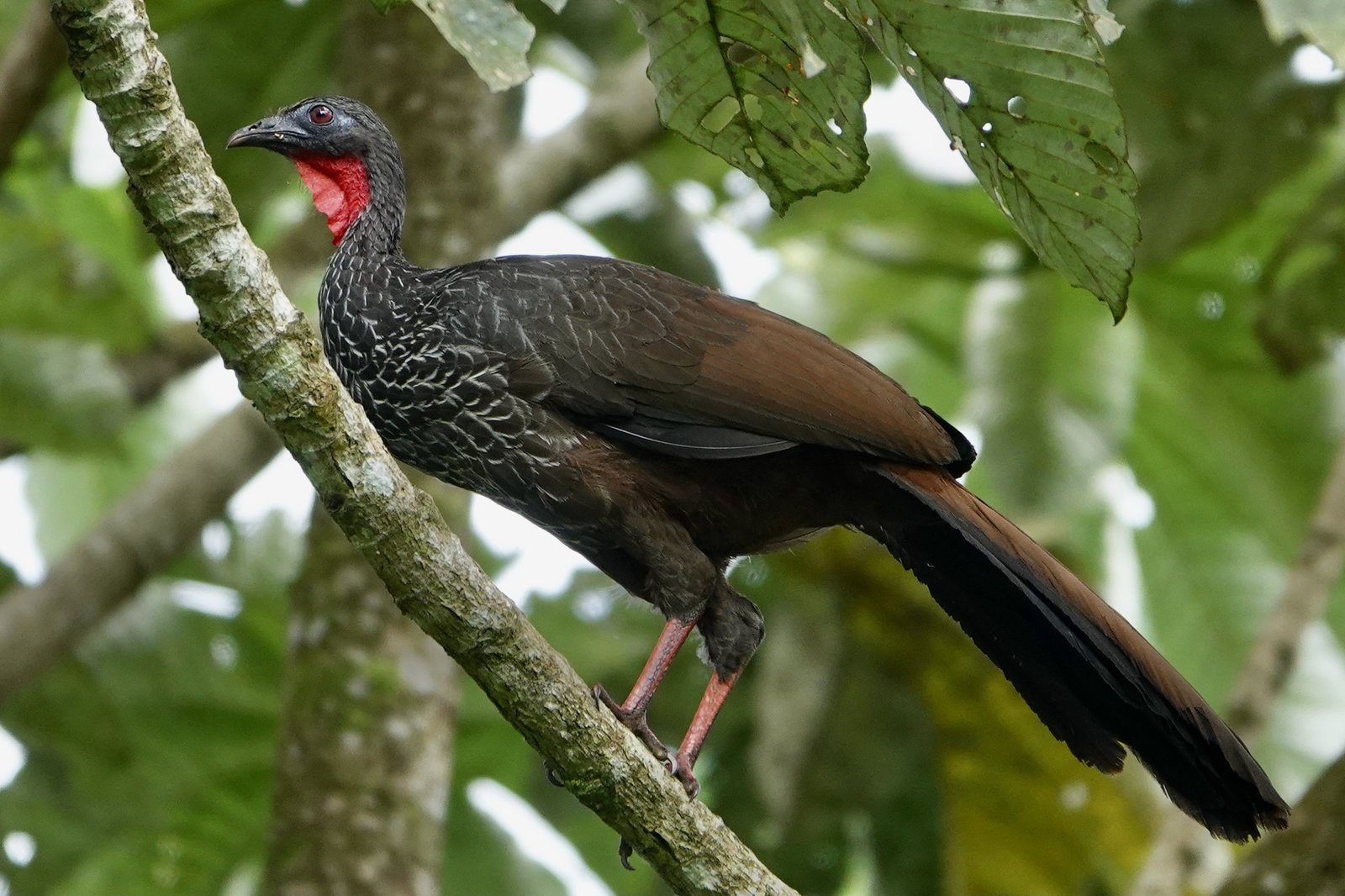
76 cm, a medium-sized guan with a long tail and a short crest. The head, neck and breast are greyish brown, the breast with pale grey feather edges giving a scaled pattern. Towards the rear the plumage becomes warmer: the lower back, rump, belly and tail are chestnut. The bare skin around the eye is blue-grey and the dewlap is red. The legs are reddish. The sexes are alike.
Confusion species
Band-tailed Guan Penelope argyrotis is smaller, with a grey-frosted face and a pale terminal band on the tail, and lacks the chestnut rear body. Andean Guan Penelope montagnii is smaller, with a small dewlap, and usually lives higher. Sickle-winged Guan Chamaepetes goudotii has uniform rufous underparts and blue bare facial skin, without a dewlap. Colombian Chachalaca Ortalis columbiana is much smaller, with a scaled neck and a pale tail tip.
Habitat
Humid and semi-humid montane forest, secondary forest, forest edges and plantations of exotic and native trees, roughly between 1200 and 2600 m. It eats fruit, leaves and flowers, including those of Cecropia and of planted trees. The nest is a platform of twigs in a tree.
Where the bird is most at home, classified by the vegetation units of the Andes and the west coast.


Range and movements
Only in Colombia: on the slopes of the Western and Central Andes along the Cauca and Patía valleys, in Risaralda, Quindío, Valle del Cauca and Cauca. Absent from Ecuador, Peru, Bolivia and the Galápagos.
- Resident
- dark = core range, pale = thinly spread
How and when to look
The Otún-Quimbaya Fauna and Flora Sanctuary and the adjacent Ucumarí Regional Park near Pereira are the best-known sites; birds feed there early in the morning in tree crowns along the road and the river.
Conservation status
Vulnerable. Almost all forest in the Cauca Valley has been converted to sugar cane, pasture and coffee; the species survives in a small number of forest areas and is still hunted locally. Protected areas and reforestation have, however, strengthened the population there.
Scientific name
Penelope perspicax | Bangs, 1911
Bangs described the species in 1911 and placed it straight away in the genus where it still stands. The genus Penelope was introduced in 1786 by Merrem. The genus name comes from Greek mythology: Penelope was the daughter of the Spartan king Icarius and the wife of Odysseus. The species name comes from Latin perspicax, 'sharp-sighted'. The specimen the first description was based on came from San Luis, Bitaco Valley, Valle del Cauca, Colombia.