All species › Gamebirds › Guans, curassows and chachalacas › White-winged Guan
White-winged Guan | Penelope albipennis
Witvleugelsjakohoen | Pava aliblanca | Jacu-de-asa-branca
The White-winged Guan is endemic to north-western Peru and was considered extinct for more than a century until it was rediscovered in 1977 in the dry ravines of the Tumbesian region. It is the only guan with white primaries. Captive-bred birds have been released in the Chaparrí reserve.
Voice
Loud, hoarse calls, mainly at dawn and dusk, and a rattling wing-drumming at twilight. Usually silent during the day.
Recording: Fernando Angulo — CC BY-NC-SA 4.0 · xeno-canto
Identification
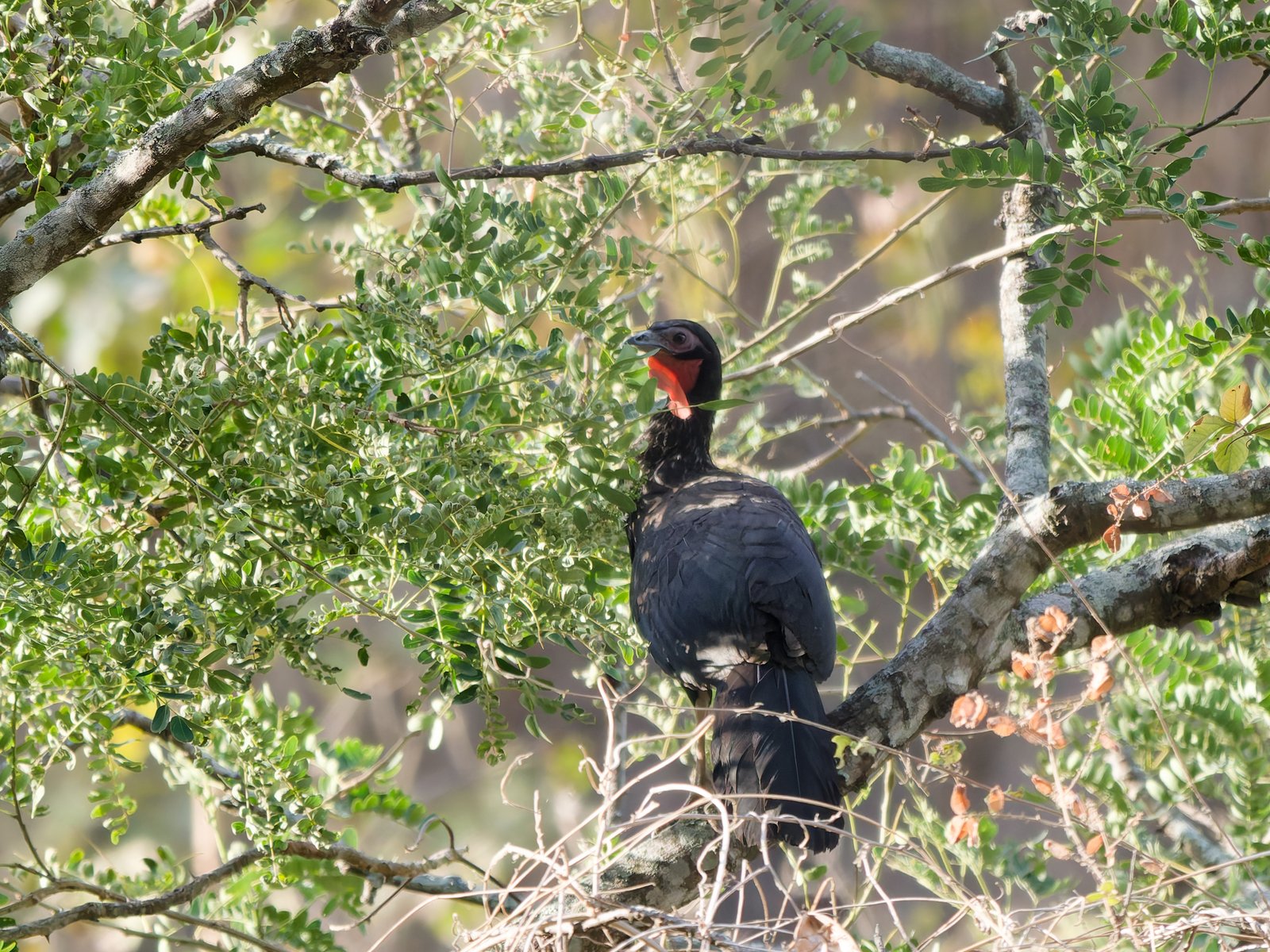
70–85 cm, a large, blackish-brown guan with a green gloss and a long tail. The outer primaries are white and form a large white patch in flight; on perched birds the white shows as a narrow band along the edge of the wing. The breast has narrow pale feather edges. The bare skin around the eye is greyish blue and the dewlap is small and red. The bill is blue-grey with a dark tip, and the legs are pink to red. The sexes are alike.
Confusion species
Rufous-headed Chachalaca Ortalis erythroptera is much smaller, with a rufous head and rufous primaries, and lives in the same dry forests. Other guans, such as Andean Guan Penelope montagnii in the montane forest above, lack white in the wing.
Habitat
Dry forest and thorn scrub in steep ravines (quebradas) on the western slope of the Andes, with dense vegetation along dry stream beds, roughly between 300 and 1500 m. It eats fruit, flowers, buds and leaves, mainly of native trees. It rests in dense vegetation by day and feeds at dawn and dusk. The nest is a platform of twigs in a tree or shrub.
Where the bird is most at home, classified by the vegetation units of the Andes and the west coast.


Range and movements
Only in Peru: on the western slope of the Andes in Piura, Lambayeque and Cajamarca. Released birds live in and around the Chaparrí reserve in Lambayeque. Absent from Colombia, Ecuador, Bolivia and the Galápagos.
- Resident
- dark = core range, pale = thinly spread
How and when to look
In the Chaparrí reserve and in inland quebradas of Lambayeque, birds can be seen early in the morning and in the evening in tree crowns along the ravines, often near water.
Conservation status
Endangered. The world population numbers at most a few hundred birds and is threatened by the clearing of dry forest, overgrazing and hunting. Captive breeding, releases and protected areas such as Chaparrí support the species.
Scientific name
Penelope albipennis | Taczanowski, 1878
Taczanowski described the species in 1878 and placed it straight away in the genus where it still stands. The genus Penelope was introduced in 1786 by Merrem. The genus name comes from Greek mythology: Penelope was the daughter of the Spartan king Icarius and the wife of Odysseus. The species name comes from Latin albus, 'white', and penna, 'feather', for the white primaries. The specimen the first description was based on came from Santa Lucía near Tumbes, Peru.