All species › Swifts › Swifts › Spot-fronted Swift
Spot-fronted Swift | Cypseloides cherriei
Diadeemgierzwaluw | Vencejo frentipunteado | Taperuçu-de-testa-pintada
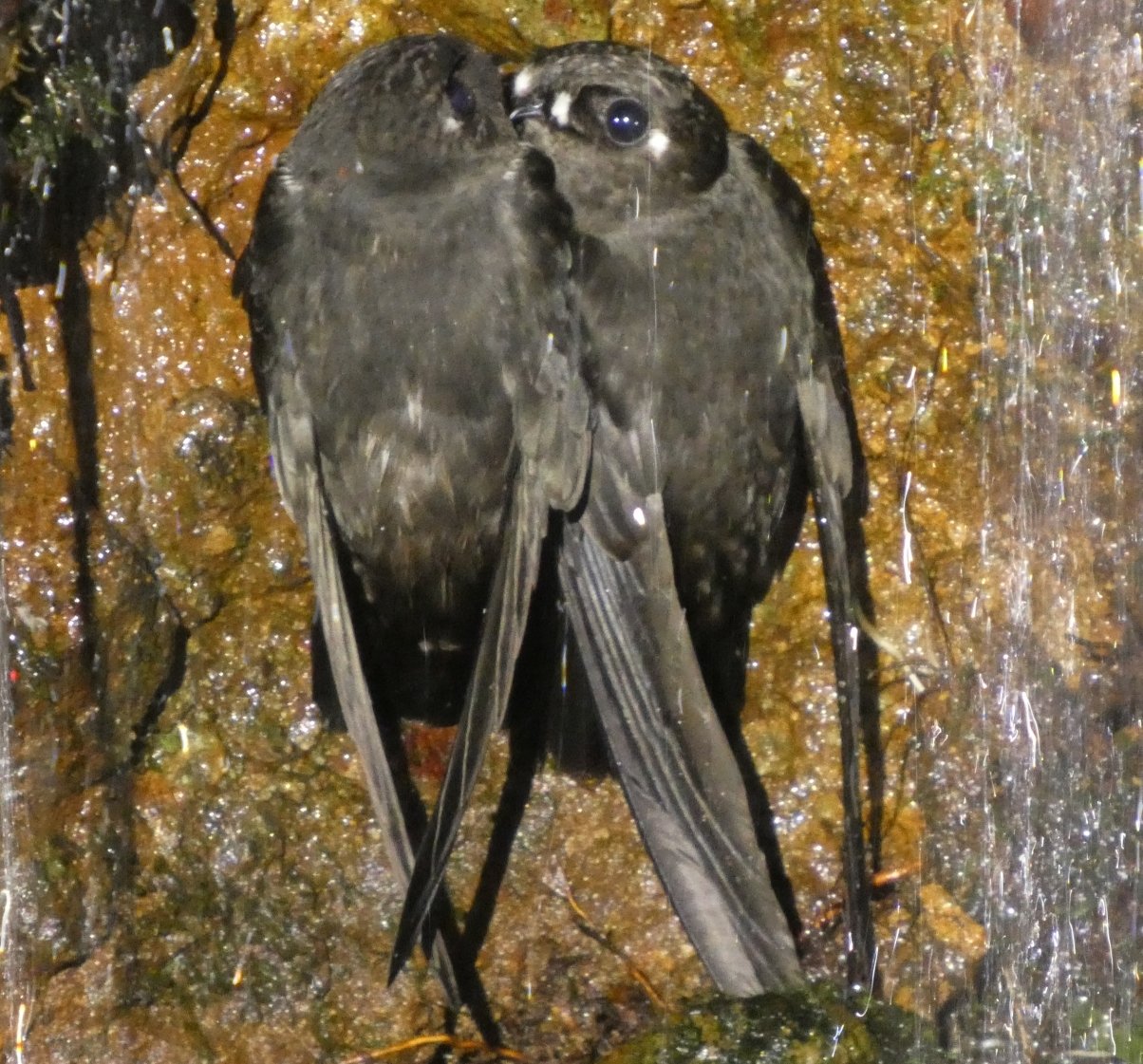
The Spot-fronted Swift is a small, blackish-brown swift with white spots on either side of the bill and behind the eye. It is known from a small number of widely separated sites from Costa Rica to northern Peru. Nests have been found on rock faces above running water, including in eastern Ecuador.
Voice
The flight call has been compared to the sound of a laser gun, rendered as chirr chi-t-t-ti chirr.
Recording: Mitch Lysinger — CC BY-NC-SA 4.0 · xeno-canto
Identification
13–14 cm, with a short, almost square tail. The plumage is almost entirely blackish brown, with greyish underwings and a white chin. Bright white spots lie on either side of the base of the bill and behind the eye, giving the head a marked look; they can be seen only at close range. Some birds have pale scaling on the lower belly. The sexes are alike.
Confusion species
White-chinned Swift Cypseloides cryptus is larger and bulkier, with a shorter tail, a white chin and only a short white streak above the eye. Chestnut-collared Swift Streptoprocne rutila is slightly slimmer; females without a collar lack the white head spots. At a distance these dark species often cannot be separated with certainty in flight.
Habitat
Airspace over montane forest, ravines and river valleys, mostly between 1100 and 2200 m, in Ecuador recorded down to 300 m. It hunts flying insects, often in flocks with other swifts. The nest is a cup of moss, ferns and mud on a vertical rock face, close to or directly above water; the clutch is a single egg.
Where the bird is most at home, classified by the vegetation units of the Andes and the west coast.


Range and movements
In Colombia at a few widely separated sites in the Andes. In Ecuador at scattered sites in the Andes, including the eastern slope. In Peru only a few records in the far north. Not known from Bolivia or the Galápagos. Outside the guide area in Costa Rica, locally in Panama and in western Venezuela.
- Resident
- dark = core range, pale = thinly spread
How and when to look
In flocks of swifts over forested ravines and mountain rivers, look for small, dark birds and try to photograph them when they fly low; the white head markings are best seen in photographs. Nest sites are at waterfalls and wet rock faces.
Conservation status
Least Concern. Distribution, numbers and trend are poorly known; the population is considered stable.
Scientific name
Cypseloides cherriei | Ridgway, 1893
Ridgway described the species in 1893 and placed it straight away in the genus where it still stands. The genus Cypseloides was introduced in 1848 by Streubel. The genus name combines the genus Cypselus (from Greek kupselos, 'swift') with Greek -oidēs, 'resembling'. The species name honours George Kruck Cherrie (1865–1948), an American naturalist and collector who worked for many years in Costa Rica. The specimen the first description was based on came from Volcán Irazú, Costa Rica.