All species › Swifts › Swifts › White-chinned Swift
White-chinned Swift | Cypseloides cryptus
Witkingierzwaluw | Vencejo barbiblanco | Taperuçu-de-queixo-branco
The White-chinned Swift is a dark, stocky swift with a large head and a short, square tail. The white chin patch that gives it its name is usually not visible in flight. The species occurs patchily from Central America to Peru, but is scarce everywhere and little studied; nests have been found only in Costa Rica and northern Brazil.
Voice
Sharp chips, more melodious chirping, explosive staccato clicking series and single dry ticks.
Recording: Otte Ottema — CC BY-NC-SA 3.0 · xeno-canto
Identification
14–15 cm, with broad wings, a very short, square tail and a large, broad head. The plumage is blackish brown; the crown and cheeks are dark brown, with a short white streak above the eye. The chin is white and the throat dark brown. The underparts are slightly paler than the back, and the underwing is paler than the upperwing. The sexes are alike.
Confusion species
Spot-fronted Swift Cypseloides cherriei is smaller, with white spots in front of and behind the eye and a slightly longer tail. Chestnut-collared Swift Streptoprocne rutila is smaller and slimmer, with a slightly notched tail; females without a collar resemble White-chinned Swift. White-chested Swift Cypseloides lemosi has a white breast patch and a slightly forked tail.
Habitat
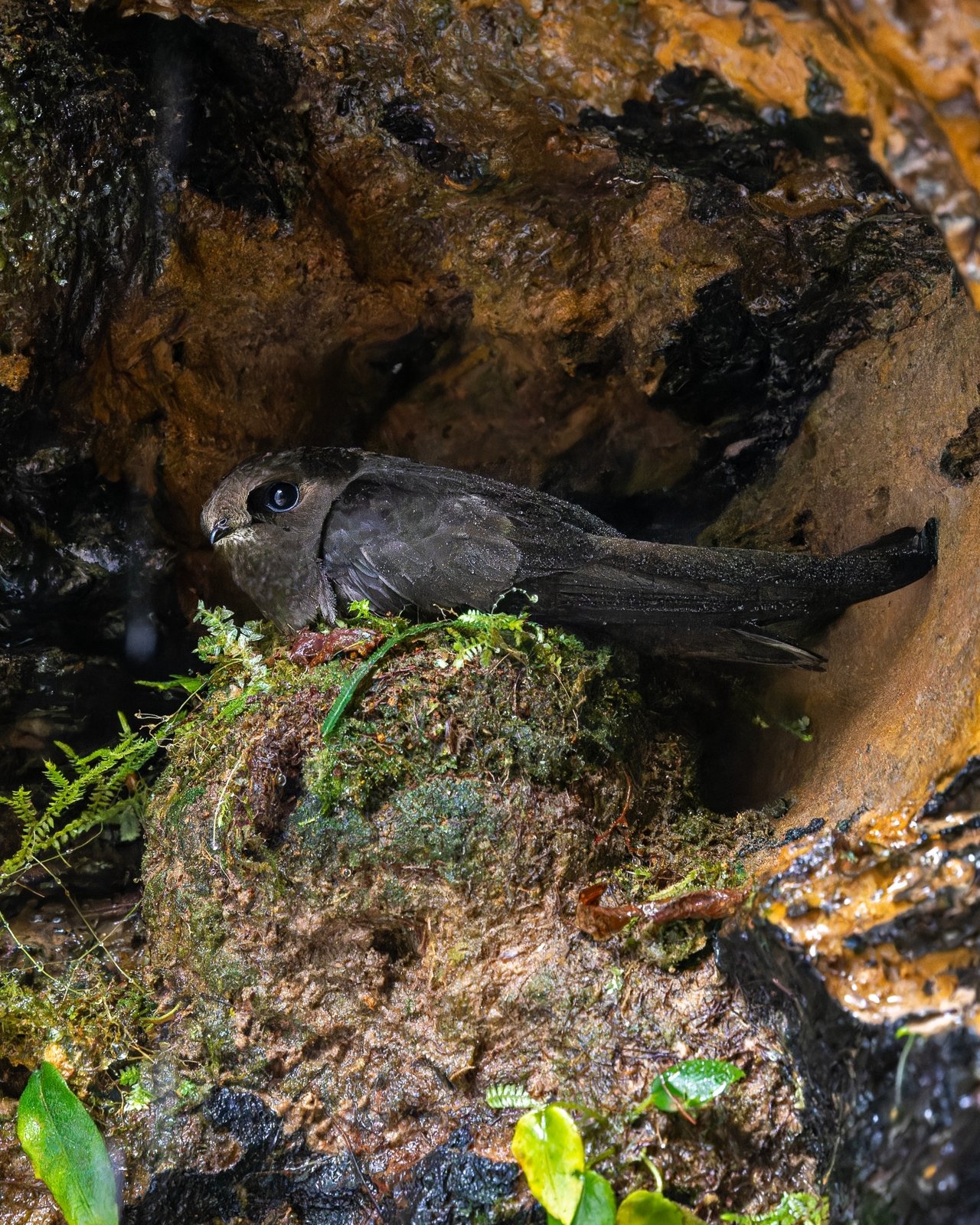
Airspace over evergreen montane forest and lowland rainforest, pastures and young secondary forest, from sea level to about 3000 m, most often in the foothills and on the lower mountain slopes. It hunts flying insects, often in mixed flocks with other swifts. The nest is a cup of moss, liverworts and mud on a rock face near or behind a waterfall, in a crevice or under an overhang; the clutch is a single egg.
Where the bird is most at home, classified by the vegetation units of the Andes and the west coast.


Range and movements
In Colombia scattered in the Andes and foothills. In Ecuador scattered on both slopes of the Andes. In Peru along the eastern slope of the Andes, south into the south-east. In Bolivia at least one sight record. Absent from the Galápagos. Outside the guide area from Belize through Central America and in Venezuela, Guyana, Suriname and northern Brazil.
- Resident
- dark = core range, pale = thinly spread
How and when to look
In flocks of swifts over the foothills, look for a bulky, dark bird with a short, square tail and a large head. At waterfalls in the foothills birds may come in at dusk.
Conservation status
Least Concern. The population is estimated at 20,000 to 50,000 mature individuals and is thought to be declining; no direct threats have been identified.
Scientific name
Cypseloides cryptus | Zimmer, 1945
Zimmer described the species in 1945 and placed it straight away in the genus where it still stands. The genus Cypseloides was introduced in 1848 by Streubel. The genus name combines the genus Cypselus (from Greek kupselos, 'swift') with Greek -oidēs, 'resembling'. The species name comes from Greek kruptos, 'hidden, obscure'. The specimen the first description was based on came from Río Távara, Puno, Peru.