All species › Passerines › Ovenbirds and woodcreepers › Streak-capped Treehunter
Streak-capped Treehunter | Thripadectes virgaticeps
Streepkopboomjager | Trepamusgos gorrilistado | Barranqueiro-de-coroa-listrada
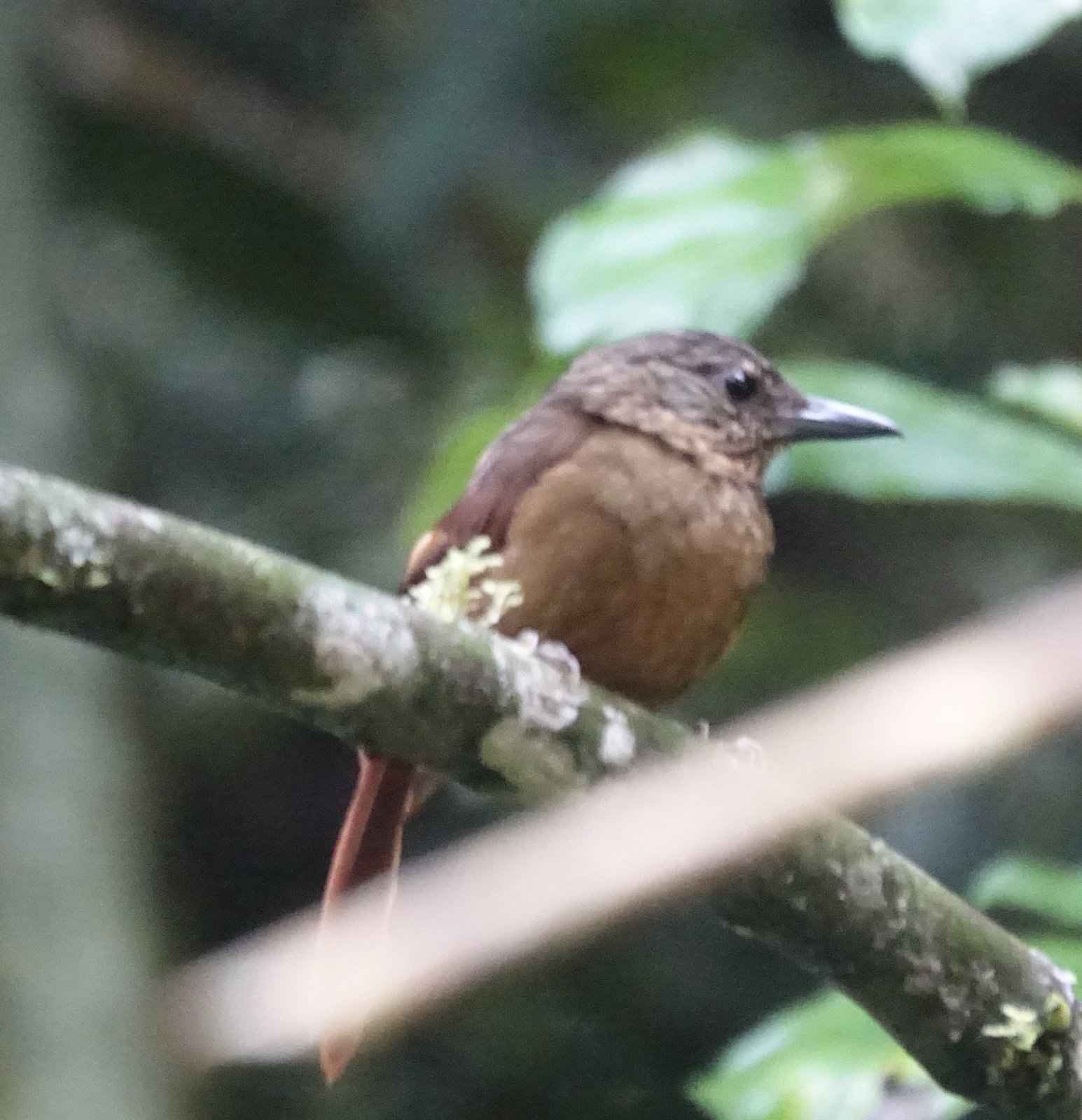
The Streak-capped Treehunter is a large, warm brown treehunter of montane forest in the northern Andes. Unlike most of its relatives only the head is streaked; the back and wings are almost plain. It keeps to dense undergrowth and forages in clusters of dead leaves.
Voice
The song is a short series of evenly pitched notes, roughly chup, cheyp-cheyp-cheyp-cheyp. The call is a fast, sharp ch-di-dit; when alarmed a nasal jwick.
Recording: Carlos Delgado JUMABITA — CC BY-NC-SA 4.0 · xeno-canto
Identification
21–23 cm, one of the larger treehunters, with a heavy, dark bill. The crown and cheeks are blackish with narrow buff streaks. The back is deep dark brown, the wings rufous-brown and the tail dark chestnut. The throat is warm buff with dark feather edges, giving a scaly look; the breast is buff with a few faint streaks, and the belly brown. The sexes are alike. Juveniles have an almost unstreaked throat.
Confusion species
Striped Treehunter Thripadectes holostictus is smaller, with a streaked back and a more heavily streaked breast. Flammulated Treehunter Thripadectes flammulatus is heavily streaked on the head, back and underparts and lives higher. Black-billed Treehunter Thripadectes melanorhynchus is smaller, with a black bill, and lives lower on the eastern slope. Uniform Treehunter Thripadectes ignobilis of the western slope is smaller and almost unstreaked. Ruddy Foliage-Gleaner Clibanornis rubiginosus is more uniformly rufous-brown, with no streaks on the head.
Habitat
The undergrowth of humid evergreen montane forest, locally also secondary forest, mostly between 1300 and 2100 m, in Colombia from 1200 to 2500 m. It searches dead leaves, moss and epiphytes for insects and other invertebrates. Like other treehunters it probably nests in a tunnel in an earth bank.
Where the bird is most at home, classified by the vegetation units of the Andes and the west coast.


Range and movements
In Colombia in all three Andean ranges, including the slopes of the Magdalena valley. In Ecuador on the western slope and in the north of the eastern slope, where the subspecies sumaco lives, which also occurs in adjacent southern Colombia. Absent from Peru, Bolivia and the Galápagos. Outside the guide area in the mountains of northern and western Venezuela.
- Resident
- dark = core range, pale = thinly spread
How and when to look
Search dense undergrowth along streams and forest trails in montane forest, for example on the western slope of the Andes in northern Ecuador. Birds sometimes join mixed understorey flocks and give themselves away by their sharp call.
Conservation status
Least Concern. Its numbers are believed stable, but the species depends on forest with dense undergrowth.
Scientific name
Thripadectes virgaticeps | Lawrence, 1874
Lawrence described the species in 1874 and placed it straight away in the genus where it still stands. The genus Thripadectes was introduced in 1862 by Sclater. The genus name comes from Greek thrips 'woodworm' and dēktēs 'biter' (from daknō 'to bite'). The species name comes from Latin virgatus 'striped' and -ceps 'headed', after the streaked crown. The specimen the first description was based on came from Quito, Ecuador.