All species › Passerines › Ovenbirds and woodcreepers › Black-billed Treehunter
Black-billed Treehunter | Thripadectes melanorhynchus
Zwartsnavelboomjager | Trepamusgos piquinegro | Barranqueiro-de-bico-preto
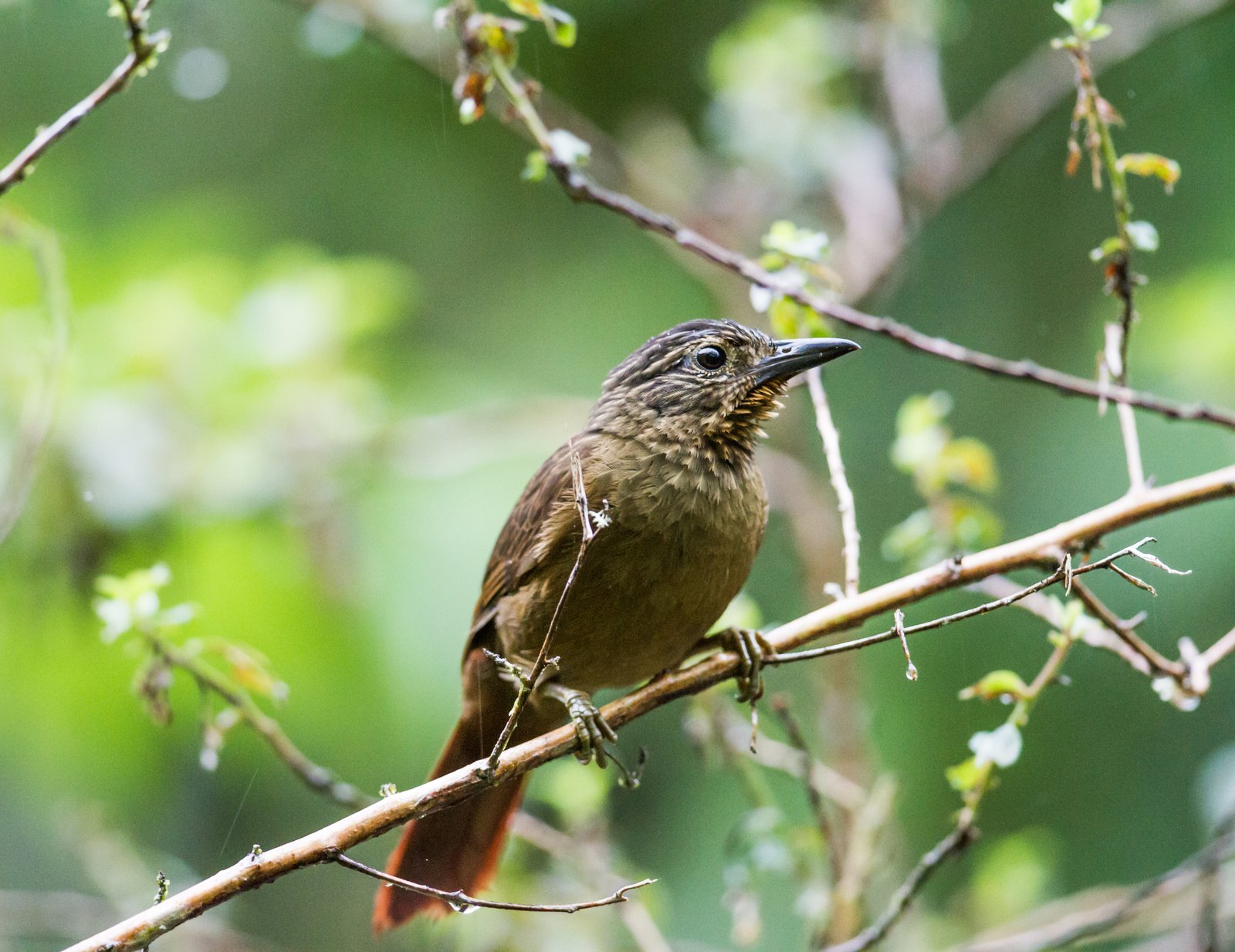
The Black-billed Treehunter is a stocky, dark treehunter of lower montane forest on the eastern slope of the Andes. The heavy, black bill and the scaly throat are its main features. It lives lower than most other treehunters, in the transition from foothills to cloud forest.
Voice
The song is a series of 10 to 13 sharp notes that first speeds up and then slows and drops slightly, with a laughing quality; the notes are sometimes paired.
Recording: Jorge L. Peña — CC BY-NC-SA 4.0 · xeno-canto
Identification
20–21 cm, stocky and thrush-like in shape, with a short, heavy, black bill. The upperparts are dark brown; the crown and nape have narrow buff streaks, and the back is almost plain. The tail is chestnut. The throat is buff with dark edges, giving a scaly look; the breast has narrow buff streaks. The sexes are alike. Juveniles are less clearly streaked. The subspecies striaticeps in Colombia has a paler crown and back.
Confusion species
Striped Treehunter Thripadectes holostictus has a clearly streaked back and a less heavy bill and usually lives higher. Streak-capped Treehunter Thripadectes virgaticeps is larger and warmer brown, with a buff breast. Peruvian Treehunter Thripadectes scrutator is larger, more heavily streaked and lives much higher. Ochre-throated Foliage-Gleaner Automolus ochrolaemus and other foliage-gleaners have a pale eyering or eyebrow and an unstreaked throat.
Habitat
Humid evergreen montane forest, also secondary forest and stunted ridge-top forest, on the eastern slope between about 1000 and 1800 m. It searches dense undergrowth for insects in dead leaves and moss. Little is known about the nest; relatives nest in a tunnel in an earth bank.
Where the bird is most at home, classified by the vegetation units of the Andes and the west coast.


Range and movements
In Colombia on the eastern slope of the Eastern Andes, from Boyacá and Casanare southward. In Ecuador on the eastern slope, from Sucumbíos southward. In Peru on the eastern slope of the Andes along its whole length, to Puno. Absent from Bolivia and the Galápagos. Does not occur outside the guide area.
- Resident
- dark = core range, pale = thinly spread
How and when to look
Search the undergrowth along trails and roads through lower montane forest on the eastern slope, for example around Sumaco in Ecuador or on the middle section of the Manu road in Peru. The laughing song is usually the first sign.
Conservation status
Least Concern. The species has a large range and its numbers are believed stable; deforestation on the lower eastern slope is a local threat.
Scientific name
Thripadectes melanorhynchus | (Tschudi, 1844)
Tschudi described the species in 1844 as Anabates melanorhynchus; because it was later moved to another genus, the author and year stand in brackets. The genus Thripadectes was introduced in 1862 by Sclater. The genus name comes from Greek thrips 'woodworm' and dēktēs 'biter' (from daknō 'to bite'). The species name comes from Greek melas 'black' and rhunkhos 'bill', after the black bill. The specimen the first description was based on came from Forest zone between 10° and 12° S, Peru.