All species › Passerines › Ovenbirds and woodcreepers › Striped Woodcreeper
Striped Woodcreeper | Xiphorhynchus obsoletus
Gestreepte muisspecht | Trepatroncos rayado | Arapaçu-riscado
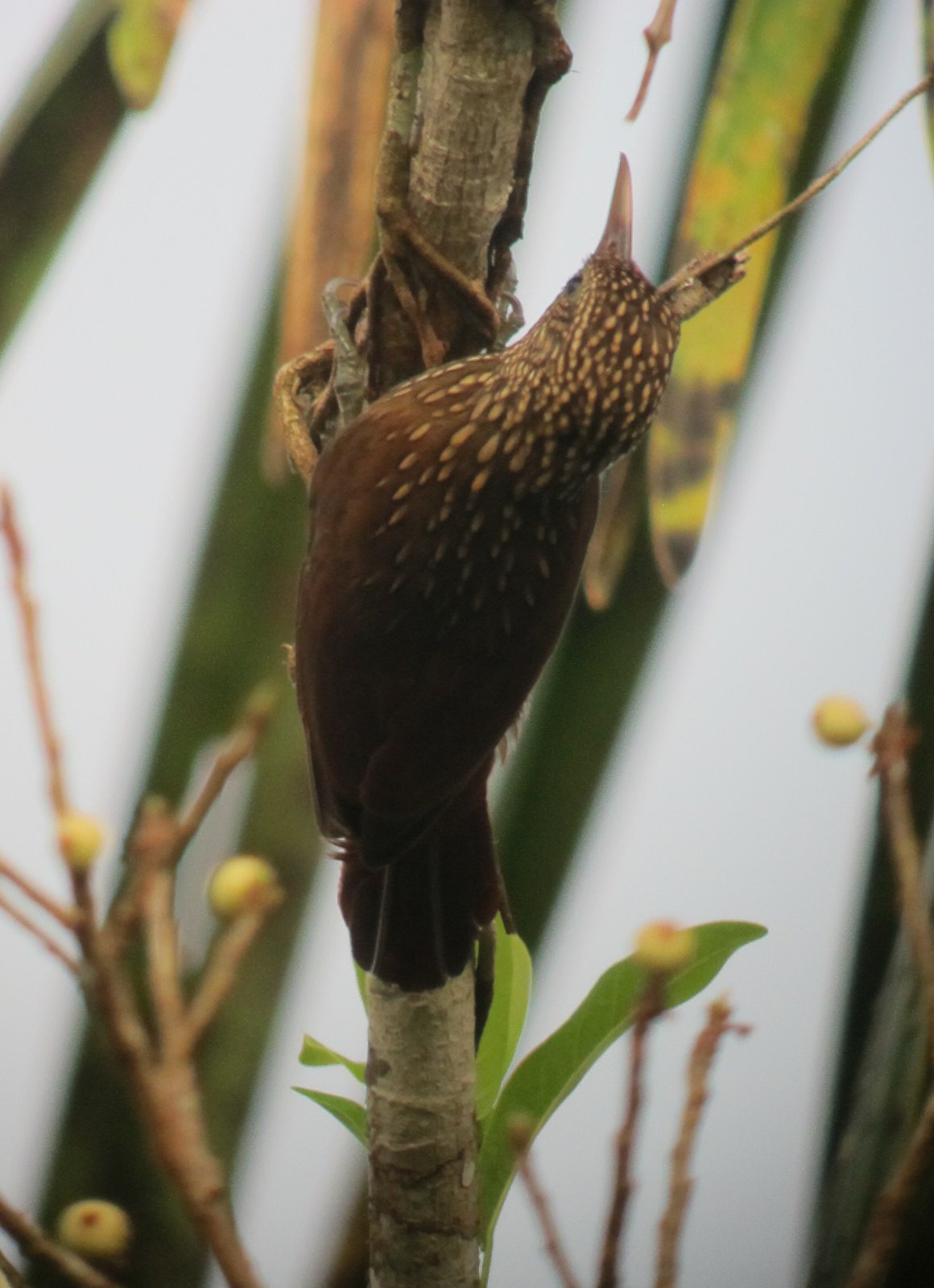
The Striped Woodcreeper is a small, heavily streaked woodcreeper of flooded forest along rivers and lakes in the Amazonian lowlands. It climbs trunks in várzea, igapó and palm swamps and is among the commonest woodcreepers there. Away from flooded forest it is scarce.
Voice
The song is a rapid, descending series of sharp notes that sounds like a chuckle, kee-kee-kee-ke-ke-ke. The call is a short, sharp cheek.
Recording: JAYRSON ARAUJO DE OLIVEIRA — CC BY-NC-SA 4.0 · xeno-canto
Identification
20 cm, with a fairly short, straight, pale bill. The upperparts are brown, with narrow buff streaks on the crown, nape and mantle. The rump, wings and tail are rufous. The throat is buff. The breast and belly are olive-brown with broad, pale, dark-edged streaks. The sexes are alike.
Confusion species
Straight-billed Woodcreeper Dendroplex picus has a straight, whitish, dagger-shaped bill, a paler, scaly face and an almost unstreaked back. Zimmer's Woodcreeper Dendroplex kienerii closely resembles Straight-billed and lives on river islands and in várzea. Elegant Woodcreeper Xiphorhynchus elegans and Ocellated Woodcreeper Xiphorhynchus ocellatus are slightly larger, with a darker bill and drops rather than streaks on the breast, and live mainly in terra firme forest. Streak-headed Woodcreeper Lepidocolaptes souleyetii is slimmer, with a thin, decurved bill.
Habitat
Seasonally flooded forest (várzea and igapó), palm swamps, riverine forest and forest on river islands, also forest edges along oxbow lakes, in the lowlands up to about 500 m. It climbs trunks and thick branches at low and middle levels and searches bark and crevices for insects and spiders. The nest is in a cavity or crevice in a trunk.
Where the bird is most at home, classified by the vegetation units of the Andes and the west coast.


Range and movements
Colombia: in the lowlands east of the Andes, in the Orinoco and Amazon basins. Ecuador: in the eastern lowlands. Peru: in the Amazonian lowlands. Bolivia: in the lowlands of the north and centre. Absent from the Galápagos. Outside the guide area in Venezuela, the Guianas and Amazonian Brazil.
- Resident
- dark = core range, pale = thinly spread
How and when to look
Travel by boat or walk along the banks of blackwater rivers and lakes in the Amazonian lowlands and watch the trunks in flooded forest. The chuckling song often gives it away before it is seen.
Conservation status
Least Concern. Flooded forest along the large rivers is still largely intact over most of its range.
Scientific name
Xiphorhynchus obsoletus | (Lichtenstein, 1820)
Lichtenstein described the species in 1820 as Dendrocolaptes obsoletus; because it was later moved to another genus, the author and year stand in brackets. The genus Xiphorhynchus was introduced in 1827 by Swainson. The genus name comes from Greek xiphos, 'sword', and rhunkhos, 'bill'. The species name comes from Latin obsoletus, 'indistinct, plain'. The specimen the first description was based on came from Pará, Brazil.