All species › Passerines › Wrens › Tooth-billed Wren
Tooth-billed Wren | Odontorchilus cinereus
Amazonewinterkoning | Cucarachero dentado | Cambaxirra-cinzenta
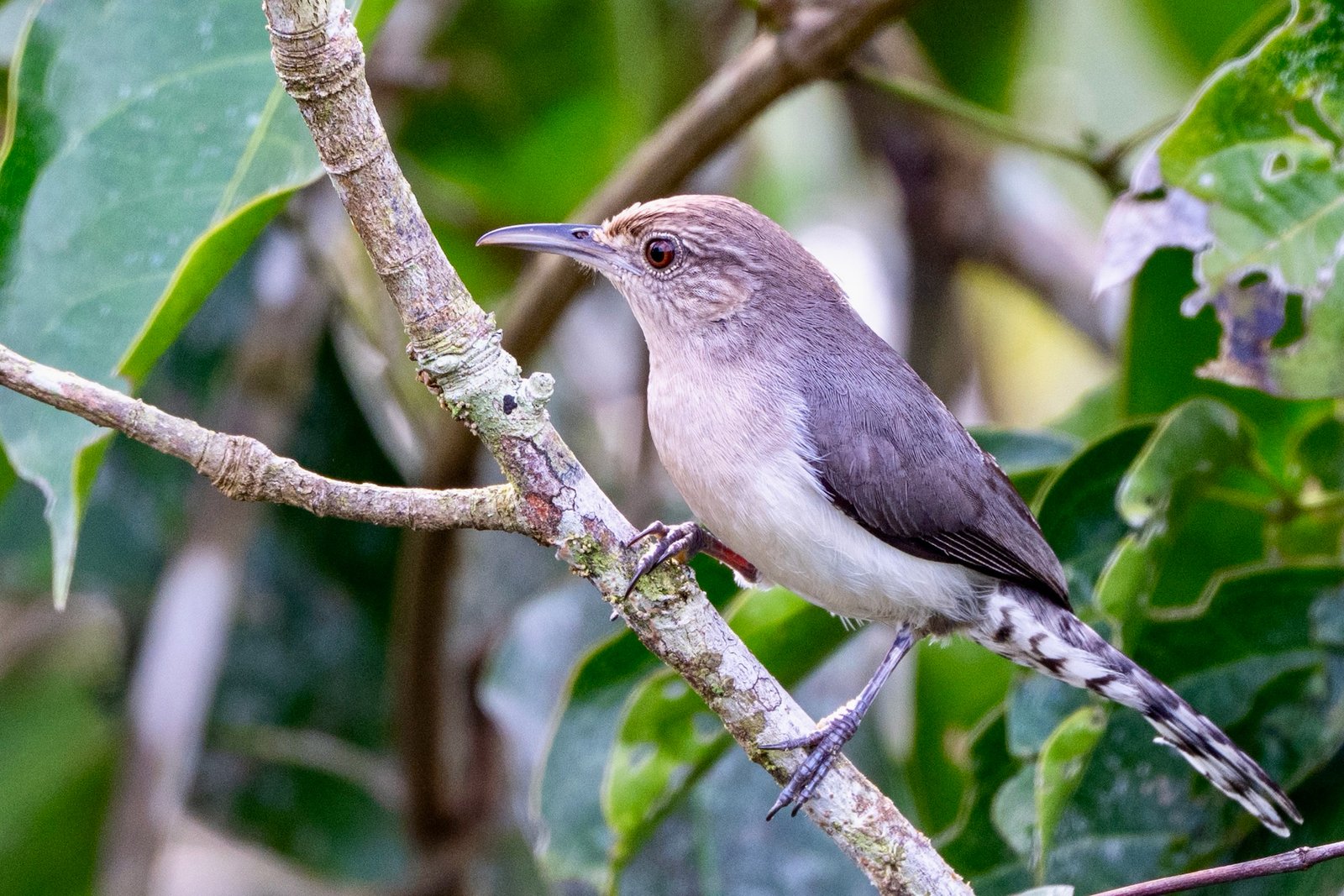
The Tooth-billed Wren is a grey-brown, long-tailed wren of the canopy of Amazonian forest south of the Amazon. It behaves more like a gnatcatcher than a wren and forages high in the trees, often in mixed flocks. Its name refers to the finely serrated edges of the bill.
Voice
The song is a short, simple trill, sung by both sexes; also high, dry calls.
Recording: JAYRSON ARAUJO DE OLIVEIRA — CC BY-NC-SA 4.0 · xeno-canto
Identification
12 cm, with a long, thin, straight bill and a fairly long tail, often cocked. The upperparts are grey-brown, the crown slightly browner. A narrow, whitish supercilium is inconspicuous; the side of the head is finely speckled. The underparts are whitish, with grey-brown flanks. The tail is grey with narrow black bars. The sexes are alike.
Confusion species
Grey-mantled Wren Odontorchilus branickii is very similar, but lives in the montane forest of the eastern slope of the Andes, not in the lowlands. Tropical Gnatcatcher Polioptila plumbea is blue-grey, with white outer tail feathers and no barring; the male has a black crown.
Habitat
The canopy and edges of tall, humid terra firme lowland forest, up to about 600 m. It seeks insects and spiders among leaves and on thin branches high in the trees, often in mixed flocks. Little is known about the nest.
Where the bird is most at home, classified by the vegetation units of the Andes and the west coast.


Range and movements
In Bolivia only in north-eastern Santa Cruz, on the Brazilian border. Absent from Colombia, Ecuador, Peru and the Galápagos. Outside the guide area in Brazilian Amazonia south of the Amazon, between the Madeira and the Xingu, south to Rondônia and Mato Grosso.
- Resident
- dark = core range, pale = thinly spread
How and when to look
In mixed canopy flocks in tall forest, watch for a small, grey bird with a cocked, barred tail; a tall canopy tower or a clearing with a view of the crowns helps.
Conservation status
Least Concern, but the population is suspected to be declining through deforestation in southern Amazonia.
Scientific name
Odontorchilus cinereus | (Pelzeln, 1868)
Pelzeln described the species in 1868 as Odontorhynchus cinereus; because it was later moved to another genus, the author and year stand in brackets. The genus Odontorchilus was introduced in 1915 by Richmond. The genus name comes from Greek odous, odontos, 'tooth', and orkhilos, 'wren', for the toothed edge of the bill. The species name comes from Latin cinereus, 'ash-grey'. The specimen the first description was based on came from Salto do Jirau, Rio Madeira, Brazil.